
Post
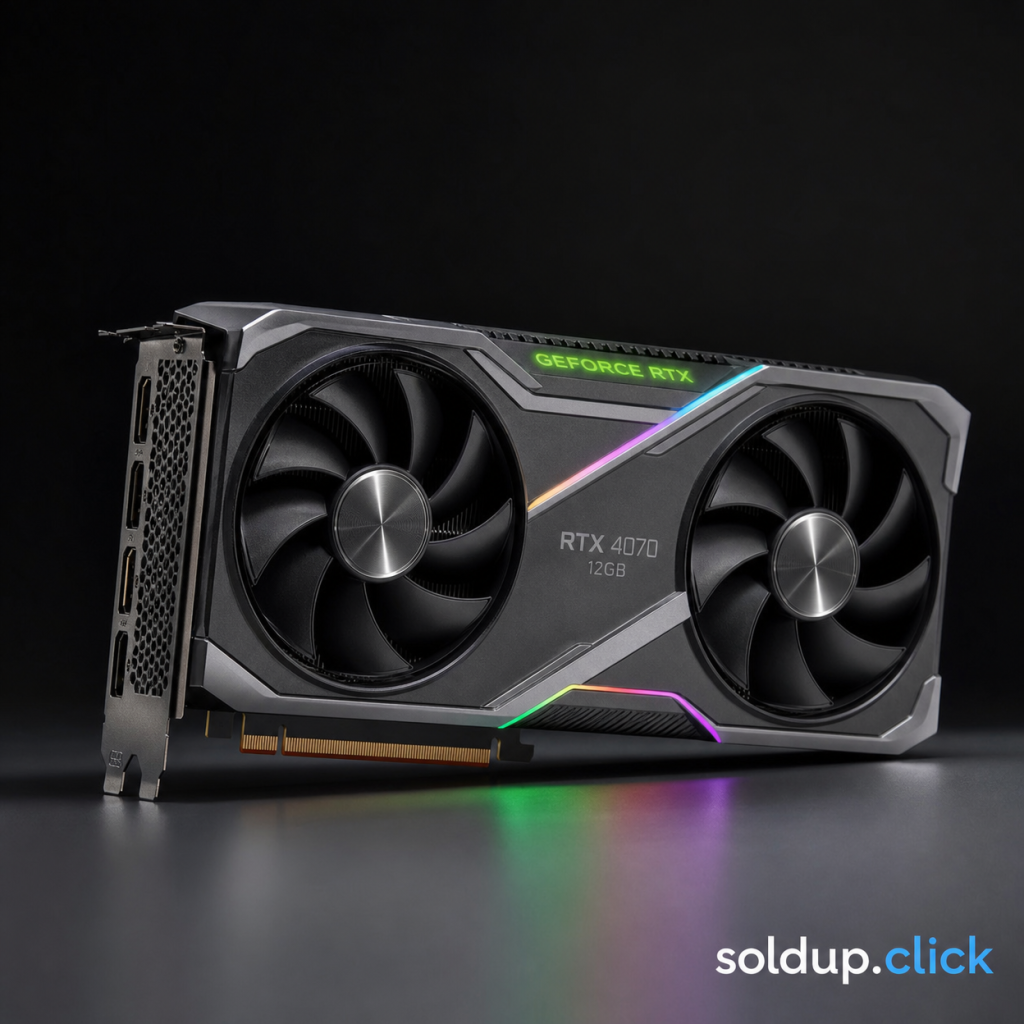
NVIDIA GeForce RTX 4070 12GB
May
Introduction
The NVIDIA GeForce RTX 4070 represents the mainstream enthusiast segment of the Ada Lovelace GPU lineup. Positioned below the RTX 4070 Ti and well below the RTX 4080, it is designed to deliver a strong balance between performance, efficiency, and affordability.
For most gamers, especially those playing at 1440p resolution, the RTX 4070 hits a practical “sweet spot.” It offers modern features such as DLSS 3, strong ray tracing capability, and excellent power efficiency without the high cost and power demands of the upper-tier GPUs.
While it is not intended to be a flagship performer, the RTX 4070 is arguably one of the most balanced GPUs in NVIDIA’s current generation, making it a popular choice for both new PC builds and mid-range upgrades.
Key Specifications and Technical Overview
The NVIDIA GeForce RTX 4070 is built on the AD104 GPU, a mid-to-high-end chip within the Ada Lovelace architecture. While it is a cut-down version of the AD104 used in the RTX 4070 Ti, it still retains strong performance characteristics for modern gaming workloads.
The GPU features 5,888 CUDA cores, which provide the core compute power required for rendering, shading, and general GPU acceleration. While this is significantly fewer than higher-tier cards, it is still more than sufficient for 1440p gaming and even entry-level 4K performance.
The RTX 4070 is equipped with 12GB of GDDR6X memory on a 192-bit memory bus. This configuration delivers approximately 504 GB/s of memory bandwidth, which supports high-resolution textures and modern game engines effectively, particularly at 1440p.
The boost clock reaches approximately 2.48 GHz, with real-world performance depending on cooling solution and power headroom. NVIDIA’s dynamic boost technology allows the GPU to adjust clock speeds automatically based on thermal conditions, helping maximize performance efficiency.
Key architectural features include:
- Third-generation RT cores for ray tracing
- Fourth-generation Tensor cores for AI acceleration
- DLSS 3 with Frame Generation, enabling significant performance boosts in supported titles
The GPU supports PCIe 4.0 x16, HDMI 2.1, and DisplayPort 1.4a, making it compatible with modern gaming monitors including high-refresh-rate 1440p and 4K displays.
One of its most important specifications is its 200W TDP, making it significantly more power-efficient than higher-tier GPUs. It requires a recommended 650W power supply, making it accessible for a wider range of systems.
Performance Analysis
The RTX 4070 delivers excellent real-world gaming performance, particularly at 1440p resolution, which is its primary target use case.
1440p Gaming Performance
At 1440p, the RTX 4070 performs exceptionally well across modern AAA titles. In many games, it is capable of exceeding 100 FPS at High or Ultra settings, depending on optimization and engine efficiency.
In well-optimized titles such as Forza Horizon 5, Call of Duty: Warzone, and Shadow of the Tomb Raider, the RTX 4070 delivers smooth, high-refresh-rate gameplay with minimal need for graphical compromises.
This makes it an excellent match for 1440p monitors with refresh rates of 144Hz or higher. In this segment, it competes strongly with AMD’s Radeon RX 7800 XT, often trading performance wins depending on the title and whether ray tracing is enabled.
1080p Gaming Performance
At 1080p, the RTX 4070 is extremely powerful. It often becomes CPU-limited rather than GPU-limited in many modern games, meaning performance differences between GPUs become less noticeable.
It easily supports ultra-high frame rates, often exceeding 144 FPS in competitive esports titles such as Valorant, CS2, Apex Legends, and Fortnite. For competitive gamers, this makes it a very strong choice for high-refresh-rate 1080p monitors.
However, at this resolution, the GPU is often underutilized, meaning its full potential is not fully necessary for pure 1080p gaming.
4K Gaming Performance
At 4K resolution, the RTX 4070 can still run many modern games, but it is not primarily designed for this workload.
In demanding AAA titles, native 4K performance typically falls into the 35–60 FPS range depending on settings. This makes DLSS almost essential for smooth gameplay at this resolution.
With DLSS 3 Frame Generation enabled, performance improves significantly, allowing playable and sometimes smooth high-refresh experiences in supported games. However, compared to the RTX 4070 Ti and RTX 4080, the limitations of the lower CUDA core count and memory bandwidth become more noticeable.
Overall, the RTX 4070 is best considered a “capable but not ideal” 4K GPU.
Content Creation and Productivity Performance
The RTX 4070 performs well in creative workloads, especially for users working in 1080p and 4K production environments.
In applications such as Adobe Premiere Pro, DaVinci Resolve, Blender, and Unreal Engine, the GPU accelerates rendering, playback, and export processes efficiently.
The 12GB VRAM buffer is sufficient for most mid-level workloads, including:
- 4K video editing
- Medium-complexity 3D rendering
- Game development workflows
- AI-assisted creative tools
However, in more demanding scenarios—such as 8K video editing, large-scale 3D scenes, or advanced AI model training—the VRAM limit can become a constraint.
Despite this, for the majority of creators and semi-professional users, the RTX 4070 provides more than enough performance.
Architecture and Ada Lovelace Features
The RTX 4070 benefits from NVIDIA’s Ada Lovelace architecture, which focuses heavily on efficiency improvements and AI-driven performance enhancements.
One of the most important features is DLSS 3 with Frame Generation. This technology uses AI to generate additional frames between traditionally rendered frames, effectively increasing perceived FPS without significantly increasing GPU load. In supported titles, this can result in dramatic performance improvements.
The third-generation RT cores improve ray tracing efficiency, allowing more realistic lighting and reflections with less performance penalty compared to previous generations.
The fourth-generation Tensor cores are responsible for AI acceleration and DLSS functionality, making the RTX 4070 significantly more capable in AI-enhanced workflows than previous-generation GPUs.
Thermals, Power Efficiency, and Design
One of the strongest advantages of the RTX 4070 is its excellent power efficiency. With a TDP of just 200W, it delivers strong performance while consuming significantly less power than higher-tier GPUs.
This efficiency translates into lower heat output, quieter cooling solutions, and easier power supply requirements. Many RTX 4070 models can run comfortably on mid-range 650W PSUs, making it ideal for system upgrades without major PSU replacements.
Physically, the RTX 4070 is also much more compact than higher-end Ada Lovelace GPUs. Many AIB models are dual-slot designs, with shorter PCB lengths that fit comfortably in mid-tower and even compact cases.
Cooling performance across most models is strong, with quiet operation under typical gaming loads.
Value for Money and Market Position
At its launch price of approximately $599, the RTX 4070 is positioned as a mainstream enthusiast GPU. While not inexpensive, it is significantly more affordable than the RTX 4070 Ti and RTX 4080.
Its closest competitor is AMD’s Radeon RX 7800 XT, and the two GPUs often trade performance depending on the game engine and whether ray tracing is enabled. NVIDIA generally has the advantage in ray tracing and AI features, while AMD often provides more raw rasterization performance in certain titles.
The RTX 4070’s strongest value proposition comes from its balance of performance, efficiency, and feature set rather than raw power alone.
Pros and Cons
The RTX 4070 offers excellent 1440p performance, strong 1080p high-refresh capability, DLSS 3 Frame Generation support, low power consumption, and compact design options.
However, it also has limitations. Its 12GB VRAM may become restrictive in future high-end 4K gaming scenarios, and its 4K performance without DLSS is limited compared to higher-tier GPUs.
Who Should Buy the RTX 4070?
The RTX 4070 is ideal for gamers targeting high-quality 1440p gaming at high refresh rates. It is also a strong option for 1080p competitive gamers who want future-proofing and modern features.
Content creators working with moderate 4K workloads will also find it highly capable, provided their projects do not exceed VRAM limitations.
It is less suitable for users focused on heavy 4K gaming or professional workloads requiring large memory buffers.
Conclusion
The NVIDIA GeForce RTX 4070 is one of the most well-balanced GPUs in the Ada Lovelace lineup. It delivers excellent 1440p gaming performance, strong efficiency, and access to NVIDIA’s latest technologies at a relatively accessible price point.
While it is not a flagship performer and has limitations in 4K and VRAM-heavy workloads, it succeeds in its intended role as a mainstream enthusiast GPU.
For most gamers, especially those building a modern 1440p system, the RTX 4070 stands as one of the best-value and most practical choices in NVIDIA’s current generation.
