Post
AMD Radeon RX 7700 XT 12GB
May
Introduction
The AMD Radeon RX 7700 XT is designed as a mainstream RDNA 3 graphics card targeting the highly competitive mid-range GPU segment. It is positioned between entry-level 1080p cards and higher-end 1440p-focused GPUs, aiming to strike a balance between price, performance, and modern feature support.
For most gamers, especially those still playing at 1080p or transitioning into 1440p gaming, the RX 7700 XT offers a solid combination of performance and VRAM capacity. It is not intended to compete with high-end 4K GPUs, but rather to provide a smooth and modern gaming experience at more accessible resolutions.
With 12GB of GDDR6 memory and AMD’s latest RDNA 3 architecture, the RX 7700 XT delivers strong rasterization performance, though it faces tough competition from NVIDIA’s RTX 4060 Ti and RTX 4070 depending on workload priorities.
Key Specifications and Technical Overview
The AMD Radeon RX 7700 XT is built on the Navi 32 GPU, part of AMD’s chiplet-based RDNA 3 architecture. Like other GPUs in this generation, it separates compute and memory functions into different dies, improving scalability and manufacturing efficiency.
The GPU includes:
- 3,456 Stream Processors
- 54 Compute Units (CUs)
- RDNA 3 architectural improvements
The RX 7700 XT is equipped with 12GB of GDDR6 memory on a 192-bit memory bus, providing approximately 432 GB/s of memory bandwidth. While not class-leading, this configuration is sufficient for modern 1080p and entry-level 1440p gaming workloads.
Boost clocks reach up to approximately 2.54 GHz, depending on cooling and power conditions. RDNA 3 allows the GPU to maintain relatively high sustained clock speeds under gaming loads.
Key platform features include:
- PCIe 4.0 x16 interface
- HDMI 2.1 support
- DisplayPort 2.1 support (future-ready for next-generation high-refresh displays)
The card has a total board power (TBP) of 245W, placing it in the upper-mid-range power bracket compared to competing NVIDIA offerings, which are often more power efficient.
Performance Analysis
The RX 7700 XT is primarily designed for 1080p gaming, with some capability at 1440p depending on game optimization and settings.
1080p Gaming Performance
At 1080p resolution, the RX 7700 XT performs extremely well. In most modern AAA titles, it delivers high or ultra settings with frame rates consistently above 100 FPS depending on the game.
In esports and competitive titles such as Valorant, Counter-Strike 2, Fortnite, and Apex Legends, the GPU easily exceeds very high frame rates, often well above 144 FPS. This makes it an excellent match for high-refresh-rate 1080p monitors.
At this resolution, the RX 7700 XT delivers a smooth, responsive experience that satisfies the majority of mainstream gamers.
1440p Gaming Performance
At 1440p, performance becomes more variable. In well-optimized games or less demanding titles, the RX 7700 XT can maintain 60–100 FPS at high settings.
However, in modern AAA games with demanding graphics engines, users may need to lower settings from Ultra to High or Medium to maintain smooth performance.
While the GPU can handle 1440p gaming, it is best suited for entry-level or optimized 1440p experiences rather than ultra settings in every title.
VRAM and Memory Considerations
One of the RX 7700 XT’s key advantages over some competing GPUs is its 12GB VRAM buffer.
In modern gaming, VRAM usage has steadily increased due to:
- Higher-resolution textures
- More detailed open-world environments
- Advanced lighting and shader systems
- Asset-heavy game engines
At 1080p, 12GB is more than sufficient for all current titles. At 1440p, it still provides comfortable headroom in most games, though future AAA titles may begin to push closer to this limit.
Compared to GPUs with 8GB VRAM, the RX 7700 XT offers better longevity and reduced risk of texture streaming issues or performance drops in VRAM-heavy games.
Ray Tracing and Upscaling Technologies
Like other AMD GPUs, the RX 7700 XT includes ray tracing hardware, but performance is not its strongest feature.
While RDNA 3 improves ray tracing performance compared to RDNA 2, NVIDIA’s RTX series still maintains a noticeable advantage in ray-traced workloads. In games like Cyberpunk 2077, Control, and Metro Exodus Enhanced Edition, enabling ray tracing can significantly reduce frame rates.
AMD provides alternatives:
- FSR 2 (FidelityFX Super Resolution)
- RSR (Radeon Super Resolution)
These technologies help improve performance by rendering games at lower resolutions and upscaling them. While useful, they generally do not match NVIDIA’s DLSS 3 Frame Generation in terms of performance gains or image stability.
As a result, the RX 7700 XT is best experienced with ray tracing disabled or used at low-to-medium settings.
Content Creation and Productivity Performance
The RX 7700 XT performs adequately in content creation workloads, particularly in applications that are not heavily CUDA-dependent.
In software such as:
- DaVinci Resolve
- Blender (OpenCL/hip support)
- Adobe Premiere Pro
the GPU handles editing, rendering, and playback efficiently for mainstream workloads.
The 12GB VRAM is beneficial for:
- 1080p and light 1440p video editing
- Small-to-medium 3D projects
- Texture work and game asset creation
However, for heavy professional workloads or AI-accelerated tasks, NVIDIA GPUs typically offer stronger performance due to CUDA and broader software optimization.
Architecture and RDNA 3 Improvements
The RX 7700 XT benefits from AMD’s RDNA 3 architecture, which introduces improvements over RDNA 2 in several areas.
Key improvements include:
- Increased instructions per clock (IPC)
- Improved energy efficiency per compute unit
- Better clock scaling behavior
- Enhanced memory subsystem design
The chiplet-based architecture also improves manufacturing efficiency and allows AMD to scale GPU performance more effectively across different product tiers.
These improvements help the RX 7700 XT deliver strong 1080p performance while maintaining a reasonable cost structure.
Thermals, Power Consumption, and Design
With a 245W power rating, the RX 7700 XT consumes more power than some competing NVIDIA GPUs in the same price segment, such as the RTX 4060 Ti.
However, this higher power draw also translates into stronger raw rasterization performance in many games.
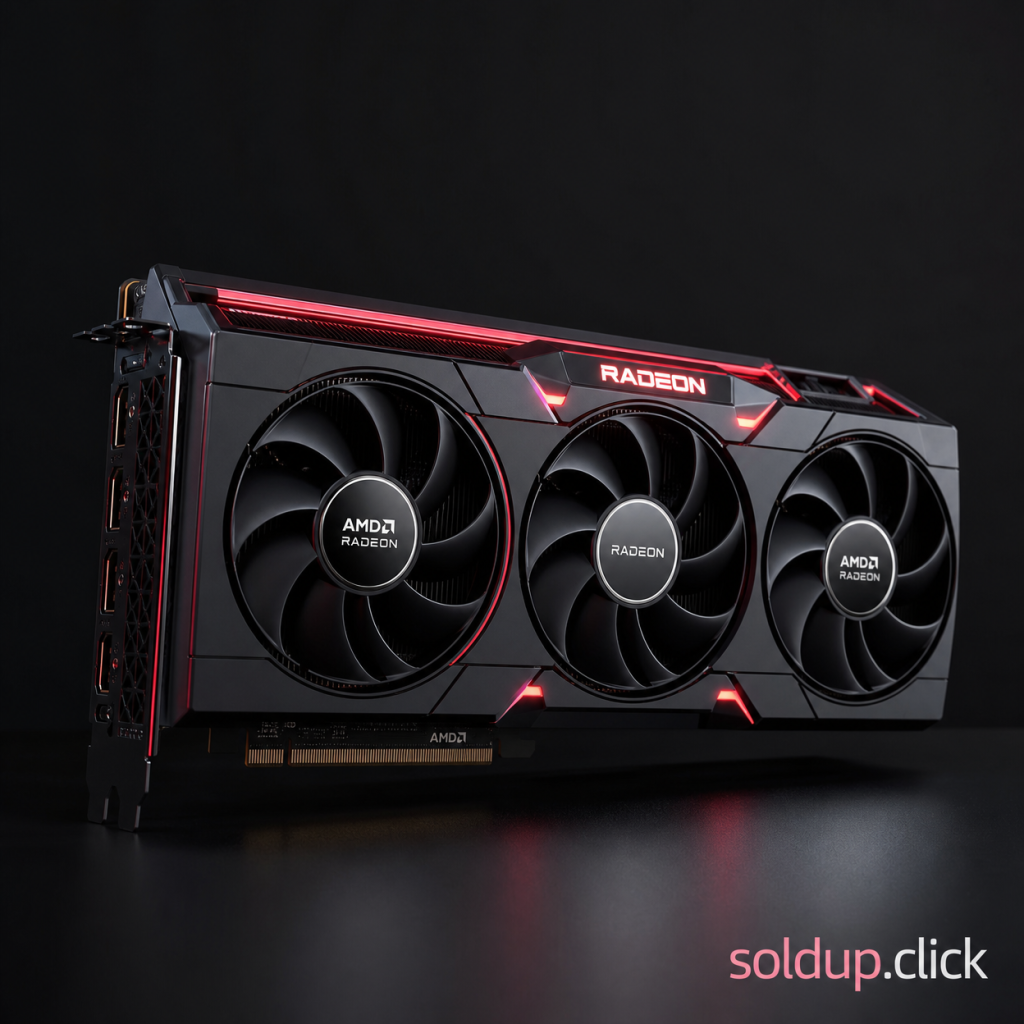
Most AIB models from manufacturers such as Sapphire, XFX, and PowerColor feature dual or triple-fan cooling solutions. These designs are generally effective at keeping temperatures and noise levels under control, even during extended gaming sessions.
Physically, the card is mid-to-large in size, typically requiring a standard mid-tower case for proper installation.
Value for Money and Market Position
At a launch price of around $449, the RX 7700 XT competes directly with NVIDIA’s RTX 4060 Ti and sometimes overlaps with lower-end RTX 4070 pricing depending on region.
Its value proposition is based on:
- Stronger rasterization performance than many competitors
- 12GB VRAM (advantage over 8GB cards)
- Competitive pricing in the mid-range segment
However, NVIDIA retains advantages in:
- DLSS 3 Frame Generation support
- Better ray tracing performance
- Lower power consumption in many cases
This creates a clear divide in priorities: AMD focuses on raw performance and VRAM, while NVIDIA emphasizes efficiency and advanced feature support.
Pros and Cons
The RX 7700 XT offers strong 1080p performance, solid entry-level 1440p capability, 12GB VRAM for improved longevity, and competitive pricing in the mid-range market.
On the downside, ray tracing performance is weaker than NVIDIA alternatives, and the higher power consumption may be a concern for efficiency-focused users.
Who Should Buy the RX 7700 XT?
The RX 7700 XT is best suited for:
- 1080p gamers seeking high FPS and modern graphics features
- Entry-level 1440p gamers on a budget
- Users who prioritize VRAM capacity over ray tracing performance
- AMD ecosystem users looking for a balanced mid-range GPU
It is less ideal for users who prioritize ray tracing, AI features, or ultra-efficient power consumption.
Conclusion
The AMD Radeon RX 7700 XT is a capable and well-balanced mid-range GPU that delivers excellent performance at 1080p and solid results at 1440p. With 12GB of VRAM and strong rasterization capabilities, it offers good long-term value for mainstream gamers.
While it does not lead in ray tracing or AI-enhanced features compared to NVIDIA competitors, it excels in raw gaming performance and memory capacity at its price point.
For gamers seeking a reliable and modern GPU for 1080p or entry-level 1440p gaming, the RX 7700 XT remains a practical and competitive choice in the RDNA 3 lineup.
