Post
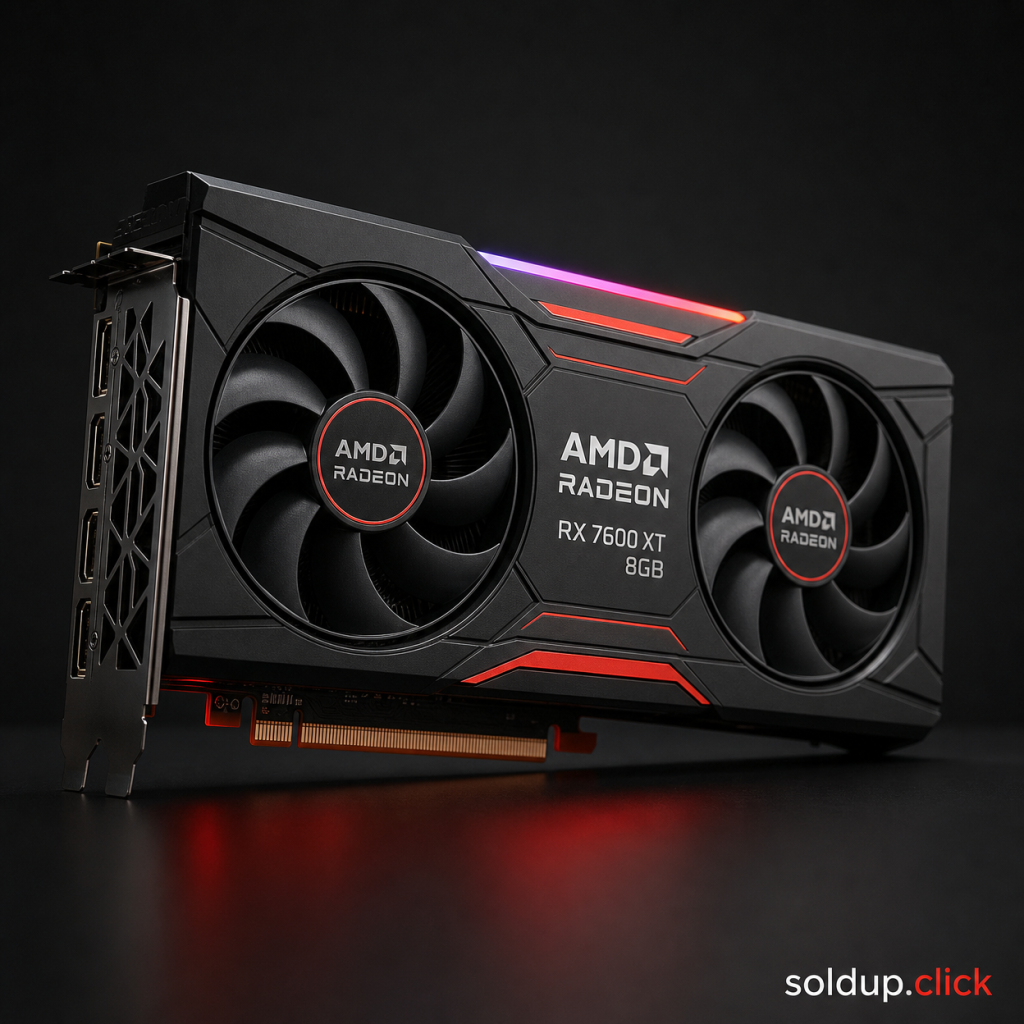
AMD Radeon RX 7600 XT 8GB
May
Introduction
The AMD Radeon RX 7600 XT is positioned as an entry-level GPU within AMD’s RDNA 3 lineup, targeting budget-conscious gamers who primarily play at 1080p resolution. It is designed for users upgrading from older GPUs such as GTX 16-series, RX 500-series, or early RTX 20-series cards, as well as first-time PC builders who want modern gaming features without a high price tag.
Unlike higher-end RDNA 3 cards that aim for 1440p or 4K gaming, the RX 7600 XT focuses strictly on delivering smooth and stable 1080p performance. It brings modern architectural improvements, including better efficiency and support for technologies like FSR 2, while keeping cost and power consumption relatively low.
However, while it succeeds as a budget gaming solution, it also comes with clear limitations in memory bandwidth and VRAM capacity that may affect long-term performance in future AAA titles.
Key Specifications and Technical Overview
The AMD Radeon RX 7600 XT is built on the Navi 33 GPU, which is part of AMD’s RDNA 3 architecture. Unlike higher-tier RDNA 3 GPUs that use chiplet designs, Navi 33 is a monolithic die, making it simpler and more cost-effective to produce.
The GPU features:
- 2,048 Stream Processors
- 32 Compute Units (CUs)
- RDNA 3 architectural improvements
The RX 7600 XT comes equipped with 8GB of GDDR6 memory connected via a 128-bit memory bus, delivering approximately 288 GB/s of bandwidth. While this configuration is sufficient for current 1080p gaming workloads, it is relatively modest compared to higher-tier GPUs and may become a limiting factor in future titles with heavier texture demands.
The boost clock reaches up to approximately 2.69 GHz, making it one of the higher clocked RDNA 3 GPUs. This helps compensate for its smaller core count and narrower memory interface.
Key specifications include:
- PCIe 4.0 x8 interface
- HDMI 2.1 support
- DisplayPort 1.4a support
The GPU has a total board power (TBP) of 165W, making it one of the more power-efficient dedicated gaming GPUs in the market.
Performance Analysis
The RX 7600 XT is designed primarily for 1080p gaming, where it performs best.
1080p Gaming Performance
At 1080p resolution, the RX 7600 XT delivers solid performance across most modern games. In many AAA titles, it is capable of running High settings at smooth frame rates, typically ranging from 60 to 100 FPS depending on optimization and game engine efficiency.
In esports titles such as Valorant, CS2, League of Legends, and Fortnite, the RX 7600 XT can easily exceed 144 FPS, making it suitable for high-refresh-rate monitors.
However, performance can vary significantly in more demanding AAA games, where Ultra settings may not be practical without frame drops or stuttering due to VRAM and bandwidth limitations.
1440p Gaming Performance
While technically capable of running games at 1440p, the RX 7600 XT is not optimized for this resolution.
In lighter or well-optimized games, it may still deliver playable performance at reduced settings. However, in modern AAA titles, users will likely need to lower settings to Medium or use upscaling technologies to maintain smooth gameplay.
As a result, 1440p gaming is considered outside its primary target use case.
VRAM and Memory Limitations
One of the most debated aspects of the RX 7600 XT is its 8GB VRAM configuration.
While 8GB is currently sufficient for most 1080p games, modern AAA titles are increasingly demanding more memory due to:
- High-resolution texture packs
- Complex open-world environments
- Advanced lighting and shader systems
- Higher asset streaming requirements
At present, 8GB is still workable, but it offers limited future-proofing compared to GPUs with 12GB or 16GB VRAM.
Additionally, the 128-bit memory bus restricts bandwidth, which can lead to performance bottlenecks in memory-intensive scenarios. This is particularly noticeable in newer games when running ultra texture settings.
Ray Tracing and Upscaling Technologies
Like other AMD GPUs, the RX 7600 XT supports ray tracing, but performance is not its strongest feature.
While RDNA 3 improves ray tracing performance compared to previous generations, NVIDIA still maintains a significant advantage in this area due to more mature RT core hardware and software optimization.
In ray-traced titles such as Cyberpunk 2077 or Control, enabling ray tracing can significantly reduce performance, often requiring lowered settings or resolution scaling.
AMD provides alternative technologies:
- FSR 2 (FidelityFX Super Resolution)
- RSR (Radeon Super Resolution)
These upscaling technologies improve performance by rendering games at lower resolutions and upscaling the image. While useful, they generally do not match the image quality or performance gains of NVIDIA’s DLSS 3 Frame Generation.
For best results, the RX 7600 XT is typically used with ray tracing disabled or set to low settings.
Content Creation and Productivity Performance
The RX 7600 XT offers basic support for content creation workloads, particularly for casual users.
In applications such as:
- Adobe Premiere Pro
- DaVinci Resolve
- Blender (light workloads)
the GPU performs adequately for entry-level editing and rendering tasks.
However, its 8GB VRAM and lower compute resources make it less suitable for professional workloads involving:
- High-resolution 4K/8K video editing
- Complex 3D rendering projects
- AI or machine learning workloads
For casual creators or students, it is sufficient, but professionals will benefit from higher-tier GPUs.
Architecture and RDNA 3 Features
The RX 7600 XT is based on AMD’s RDNA 3 architecture, which brings several improvements over RDNA 2, even at the entry level.
Key enhancements include:
- Improved instructions per clock (IPC)
- Better energy efficiency
- Higher boost clock capabilities
- Improved media encoding/decoding support
The use of a monolithic die (Navi 33) makes the RX 7600 XT more cost-efficient to produce, helping AMD target a lower price segment without sacrificing modern feature support.
While not as advanced as higher-end RDNA 3 chiplet-based GPUs, it still benefits from architectural refinements that improve overall gaming performance.
Thermals, Power Consumption, and Design
With a 165W TDP, the RX 7600 XT is a relatively efficient GPU. It requires significantly less power than mid-range or high-end GPUs, making it suitable for budget systems with smaller power supplies.
Most models feature compact dual-fan cooling solutions, which are ideal for:
- Small form factor builds
- Budget gaming PCs
- Systems with limited airflow
Cooling performance is generally sufficient for its power class, and noise levels remain relatively low under gaming loads.
A 550W power supply is typically more than enough for a system using the RX 7600 XT.
Value for Money and Market Position
At a launch price of around $329, the RX 7600 XT competes directly with NVIDIA’s RTX 4060.
The comparison highlights different strengths:
AMD Advantages:
- Lower or similar pricing in many regions
- Comparable or better rasterization performance
- Potentially better value in raw FPS per dollar
NVIDIA Advantages:
- DLSS 3 Frame Generation
- Better ray tracing performance
- Lower power consumption
- Stronger software ecosystem support
The RX 7600 XT is best suited for users who prioritize traditional gaming performance over advanced AI features.
Pros and Cons
The RX 7600 XT offers affordable pricing, efficient power consumption, compact design options, and solid 1080p gaming performance.
However, it is limited by its 8GB VRAM configuration, narrow 128-bit memory bus, and weaker ray tracing performance compared to NVIDIA alternatives. It also lacks an equivalent to DLSS 3 Frame Generation.
Who Should Buy the RX 7600 XT?
The RX 7600 XT is best suited for:
- Budget 1080p gamers
- First-time PC builders
- Users upgrading from older GTX or RX 500/5000 series GPUs
- Casual gamers who do not prioritize ray tracing
It is less suitable for:
- 1440p high-end gaming
- VRAM-heavy modern AAA gaming at ultra settings
- Professional content creation workloads
Conclusion
The AMD Radeon RX 7600 XT is a practical entry-level GPU that delivers solid 1080p gaming performance at an affordable price point. While it is not designed for high-resolution gaming or demanding future AAA workloads, it performs well within its intended scope.
Its combination of RDNA 3 features, efficient power consumption, and accessible pricing makes it a reasonable choice for budget gamers and first-time builders.
However, the limitations of its 8GB VRAM and 128-bit memory bus mean that users should be mindful of its long-term potential. Within its target segment, though, it remains a capable and functional option for mainstream 1080p gaming.
