
Post
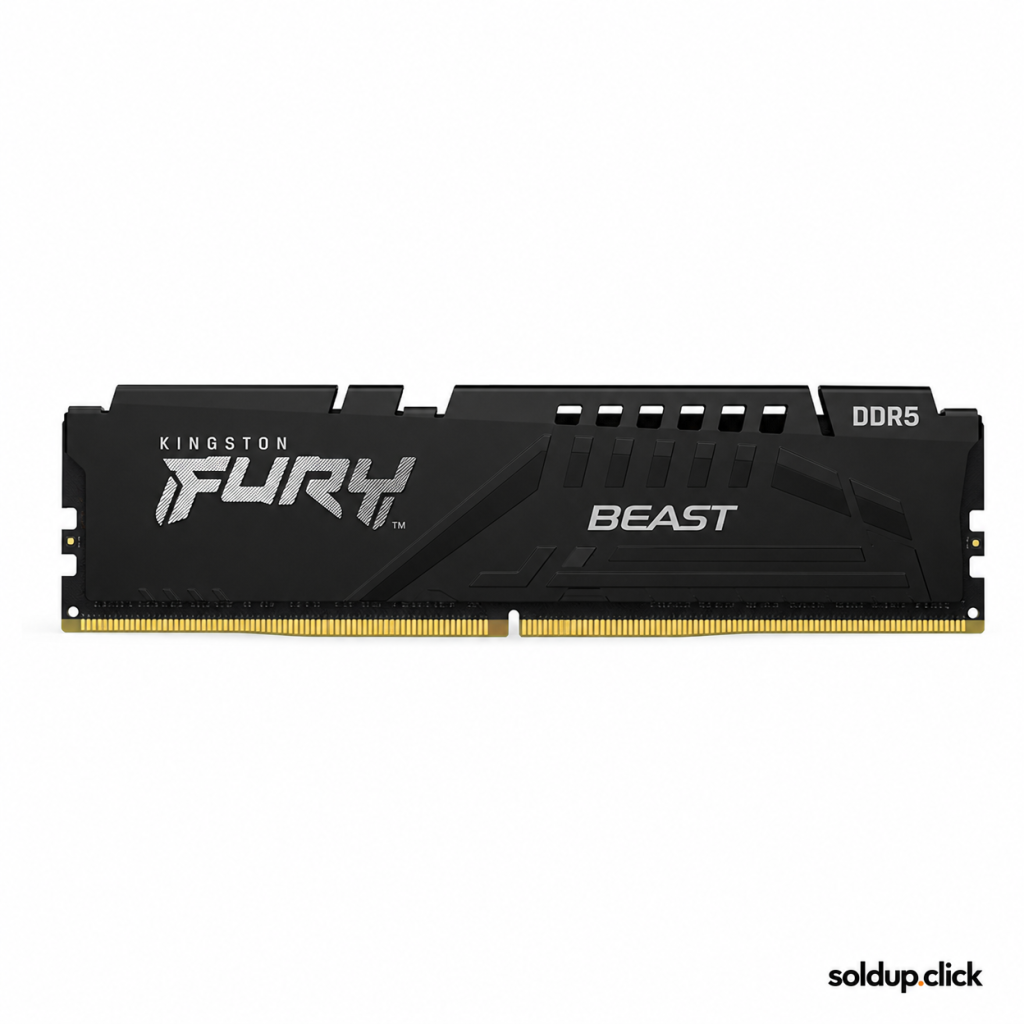
Kingston Fury Beast DDR5 16GB (1x16GB) 5200MHz
May
Introduction
The Kingston Fury Beast DDR5 16GB 5200MHz module represents one of the most accessible entry points into the DDR5 memory ecosystem. Designed for budget-conscious builders and upgraders, it provides a straightforward way to move from DDR4 to DDR5 without paying for high-frequency enthusiast-grade kits.
While it does not aim to compete with premium DDR5 kits in raw performance, it offers a stable and reliable foundation for modern PC builds. For users assembling systems based on platforms like the Intel Core i5-13600K or entry-level AMD Ryzen 7000 CPUs, this module delivers sufficient bandwidth for everyday gaming and productivity tasks.
Its biggest appeal lies in simplicity: plug-and-play DDR5 functionality at a relatively low cost.
Key Specifications and Technical Overview
The Kingston Fury Beast DDR5 16GB module is built as a single-stick configuration, making it suitable for entry-level systems or gradual upgrades.
Key specifications include:
- DDR5 SDRAM standard
- 16GB single module (1×16GB)
- 5200MT/s memory speed
- CL40-40-40 latency timings
- 1.25V operating voltage
- Intel XMP 3.0 support
- On-die ECC (error correction at chip level)
At 5200MHz, this module sits at the lower end of DDR5 performance tiers. However, compared to DDR4 (typically 3200–3600MHz), it still provides higher theoretical bandwidth and improved efficiency.
DDR5 introduces several architectural improvements over DDR4, including:
- Two independent 32-bit subchannels per module
- On-die error correction for improved stability
- Integrated power management (PMIC on DIMM)
- Higher burst lengths and bandwidth scaling
However, because this is a single-module configuration, it does not take full advantage of dual-channel memory architecture, which is a key factor in real-world performance.
Performance Analysis
Single-Channel Limitations
The most important factor affecting performance in this configuration is that it operates in single-channel mode.
Modern CPUs such as the AMD Ryzen 7 7800X3D or Intel 13th Gen processors benefit significantly from dual-channel memory setups. Single-channel memory reduces effective bandwidth by approximately 30–50%, depending on workload.
This means:
- Lower memory throughput
- Reduced CPU efficiency in memory-heavy tasks
- Slightly lower gaming performance in CPU-bound scenarios
- Increased stuttering potential in some open-world games
While the system remains fully functional, it is not optimized for performance until a second matching module is added.
Gaming Performance
In gaming scenarios, the Kingston Fury Beast 5200MHz performs adequately for entry-level DDR5 systems.
At 1080p resolution:
- Esports titles (Valorant, CS2, League of Legends) run smoothly
- AAA games are playable at medium-to-high settings depending on GPU
- Frame rates are generally stable but not fully optimized
However, compared to dual-channel DDR5 configurations, users may notice:
- Lower 1% lows in CPU-heavy games
- Slightly reduced frame consistency
- Longer asset streaming times in open-world games
For GPUs like the NVIDIA GeForce RTX 4060 Ti, the memory limitation is not catastrophic, but it can prevent the system from reaching its full potential in CPU-bound scenarios.
Productivity and Everyday Use
For general productivity tasks, the module performs reliably:
- Web browsing and office applications run smoothly
- Light photo editing is unaffected
- Basic programming and development workloads are well supported
- Streaming and multitasking are functional
However, heavier workloads such as:
- 4K video editing
- Large Photoshop projects
- Virtual machines
- 3D rendering
benefit significantly from dual-channel memory and higher total capacity (32GB or more).
In short, this module is sufficient for everyday computing but not ideal for demanding professional workloads.
Design and Build Quality
Kingston has focused on simplicity and reliability with the Fury Beast DDR5 series.
Design characteristics include:
- Low-profile black heat spreader
- No RGB lighting
- Clean, minimalist aesthetic
- Compact height for cooler compatibility
The low-profile design ensures compatibility with large air coolers, such as tower-style CPU coolers, without clearance issues. This makes it especially suitable for compact or budget builds.
Build quality is consistent with Kingston’s reputation for durability. The PCB design is stable, soldering quality is solid, and the heat spreader provides adequate thermal dissipation for standard operating conditions.
Unlike premium RGB-focused kits, this module prioritizes function over form.
Platform Compatibility and Overclocking
The Kingston Fury Beast DDR5 5200MHz module is designed for maximum compatibility across modern platforms.
Intel Compatibility (XMP 3.0)
On Intel platforms such as B660, Z690, and Z790 motherboards, enabling XMP 3.0 allows the module to automatically run at its rated 5200MHz speed.
This makes installation simple, even for first-time builders.
AMD Compatibility
On AMD AM5 platforms, compatibility is generally good, but performance is less optimal compared to higher-frequency kits (such as 6000MHz). AMD processors tend to perform best with faster memory due to their Infinity Fabric behavior.
Overclocking Potential
While some headroom exists, this module is not designed for aggressive overclocking. Most users will remain at or near the rated 5200MHz CL40 specification for stability.
Attempts to tighten timings or increase frequency may yield limited gains due to the entry-level nature of the memory ICs used.
Value for Money and Market Position
The Kingston Fury Beast DDR5 5200MHz sits in the budget DDR5 category, making it one of the most affordable ways to enter the DDR5 platform.
Its value proposition is based on:
- Low entry cost
- Trusted Kingston reliability
- Compatibility with modern Intel platforms
- Simple plug-and-play setup
However, its performance must be evaluated in context. Compared to dual-channel DDR5 kits like 32GB 6000MHz configurations, it delivers significantly lower bandwidth and overall system performance.
It is best viewed as a starting point, not a final performance solution.
Pros and Cons
Pros
- Affordable DDR5 entry point
- Reliable Kingston build quality
- Intel XMP 3.0 support
- Low-profile, clean design
- Good compatibility across platforms
- Suitable for gradual system upgrades
Cons
- Single-channel configuration limits performance
- CL40 latency is relatively high
- Lower frequency compared to mainstream DDR5 kits
- Not ideal for high-end gaming or productivity builds
- Requires upgrade for optimal system balance
Who Should Buy This?
This memory module is best suited for:
- First-time PC builders on a tight budget
- Users transitioning from DDR4 to DDR5 gradually
- Office or general-use systems
- Entry-level gaming PCs with planned upgrades
- Systems where cost is more important than peak performance
It is not ideal for:
- High-end gaming systems
- Content creators working with large files
- Enthusiast builds targeting maximum performance
- Users who need immediate dual-channel performance
Conclusion
The Kingston Fury Beast DDR5 16GB 5200MHz module is a practical and affordable entry into the DDR5 memory ecosystem. It delivers stable performance, modern platform compatibility, and the reliability expected from Kingston, making it a strong choice for budget-conscious builders.
However, its single-channel configuration and lower frequency mean it is not designed for high-performance systems. Instead, it serves as a stepping stone—ideal for users planning to upgrade to a dual-channel setup in the future.
