Post
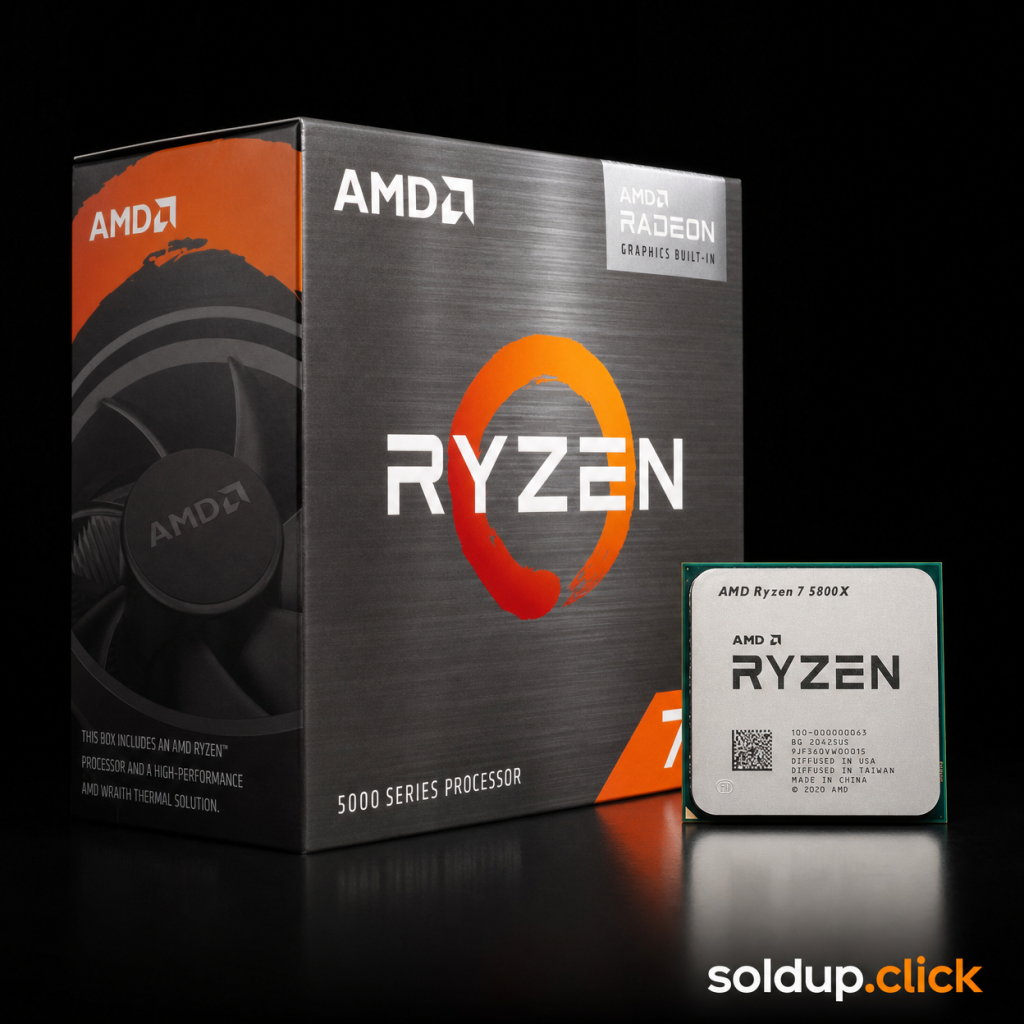
AMD Ryzen 7 5800X Processor
May
Introduction
The AMD Ryzen 7 5800X represents one of the most important mid-to-high-end processors in AMD’s Zen 3 lineup. It brought the architectural improvements of Zen 3 into the widely popular eight-core segment, delivering a CPU that balanced gaming performance, productivity capability, and efficiency in a way that appealed to a broad range of PC users.
As a direct successor to the Ryzen 7 3700X and 3800X, the 5800X marked a significant leap forward. It wasn’t just a small generational upgrade—it introduced meaningful architectural changes that improved both single-threaded and multi-threaded performance. At the time of its release, it positioned itself as one of the best gaming CPUs in its class while still maintaining strong productivity capabilities.
Even today, despite newer Ryzen generations being available, the 5800X remains a relevant and capable processor, especially for users on the AM4 platform or those looking for a cost-effective upgrade.
Key Specifications and Technical Overview
The AMD Ryzen 7 5800X features 8 cores and 16 threads, built on AMD’s Zen 3 architecture using TSMC’s 7nm manufacturing process. This combination allowed AMD to significantly improve performance per watt compared to previous Zen 2-based processors.
The CPU operates with a base clock of 3.8 GHz and can boost up to 4.7 GHz under optimal conditions. These clock speeds, combined with Zen 3’s improved IPC, give the processor strong responsiveness in both gaming and productivity workloads.
One of the key architectural advantages of Zen 3 is its unified Core Complex (CCX) design. Unlike Zen 2, which split cores into separate CCXs with added latency between them, Zen 3 places all 8 cores within a single CCX. This reduces inter-core communication latency and improves performance consistency, especially in gaming scenarios where fast data access is critical.
The processor includes 32MB of L3 cache, which plays an important role in reducing memory latency and improving performance in cache-sensitive applications such as games and simulation workloads.
The Ryzen 7 5800X uses the AM4 socket, which is one of the longest-supported CPU platforms in PC history. This makes it compatible with a wide range of motherboards, including budget B450 boards (with BIOS updates) and higher-end B550 and X570 boards.
It has a TDP of 105W, which is relatively moderate for an eight-core high-performance CPU. However, real-world power consumption can exceed this under sustained workloads, especially when Precision Boost aggressively increases clock speeds.
Performance Analysis
The Ryzen 7 5800X delivers strong and well-balanced performance across gaming and productivity workloads, making it one of the most versatile CPUs in the Zen 3 lineup.
Gaming Performance
In gaming, the 5800X performs exceptionally well. Zen 3’s improved IPC and reduced latency allow it to compete strongly with Intel’s 10th and 11th generation processors at the time of its release. Even today, it remains capable of delivering smooth frame rates in modern titles when paired with a capable GPU.
The processor pairs well with mid-to-high-end graphics cards, ranging from the RTX 3060 Ti and RTX 3070 up to more powerful GPUs like the RTX 4070 and even RTX 4080 in many gaming scenarios. While it may not always fully saturate the highest-end GPUs at 1080p in CPU-bound titles, it performs very well at 1440p and 4K resolutions where GPU limitations become more dominant.
In competitive esports titles such as CS2, Valorant, and Fortnite, the 5800X delivers high frame rates with excellent frame stability, making it suitable for high-refresh-rate gaming setups.
Productivity and Multi-threaded Workloads
With 8 cores and 16 threads, the Ryzen 7 5800X handles productivity tasks efficiently. It performs well in applications such as Adobe Premiere Pro, Photoshop, Blender, and DaVinci Resolve for moderate workloads.
While it is not designed for heavy workstation tasks, it is more than capable of handling video editing, rendering, and multitasking workflows for content creators who are not working at professional-scale production levels.
In multi-threaded benchmarks, the 5800X significantly outperforms older six-core CPUs and remains competitive with newer entry-level CPUs depending on workload optimization.
However, compared to higher-core CPUs like the Ryzen 9 5900X or modern 12–16 core processors, it does show limitations in heavily parallel tasks such as large-scale rendering or complex simulation workloads.
Architecture and Efficiency Improvements
Zen 3 introduced several important improvements over Zen 2, and the Ryzen 7 5800X benefits directly from these advancements.
The most significant improvement is the unified CCX design, which eliminates cross-CCX communication delays. This results in lower latency and improved performance consistency, particularly in gaming workloads.
Zen 3 also delivered approximately a 19% IPC improvement, meaning each clock cycle can execute more instructions compared to previous architectures. This contributes heavily to the 5800X’s strong performance despite having the same core count as its predecessor.
Combined with higher boost clocks and improved cache efficiency, Zen 3 helped AMD close the gaming performance gap with Intel at the time and, in many cases, surpass it.
Thermals, Cooling, and Power Behavior
One important consideration with the Ryzen 7 5800X is its thermal behavior. Despite its relatively modest 105W TDP, the CPU is known to run hotter than some of its Ryzen 5000 siblings.
This is partly due to its design, where all 8 cores are concentrated into a single CCX, resulting in higher heat density. As a result, effective cooling is important for maintaining optimal performance.
AMD does not include a stock cooler with the 5800X, so users must purchase an aftermarket solution. A high-quality air cooler or a 240mm All-in-One (AIO) liquid cooler is generally recommended.
Under gaming workloads, temperatures are typically manageable. However, under sustained multi-threaded loads, the chip can reach higher thermal levels if cooling is insufficient. Better cooling can also help maintain higher boost clocks for longer periods due to AMD’s Precision Boost algorithm.
Value for Money and Platform Considerations
One of the strongest advantages of the Ryzen 7 5800X today is its price-to-performance ratio. Since the release of Zen 4 and newer CPUs, the 5800X has seen significant price reductions, making it far more attractive than at launch.
The AM4 platform further enhances its value. With widespread motherboard availability and support for DDR4 memory, system costs are significantly lower compared to newer DDR5-based platforms. This makes it an excellent choice for budget-conscious builders or users upgrading existing systems.
Another advantage is the maturity of the AM4 ecosystem. BIOS stability, motherboard pricing, and component availability are all excellent, making system building straightforward and cost-efficient.
However, AM4 is a legacy platform at this point, meaning it will not support future CPU generations. While this limits upgrade paths, it also contributes to lower overall system costs.
Pros and Cons
The Ryzen 7 5800X offers strong gaming performance, solid eight-core productivity capability, excellent single-core performance for its generation, and access to the highly affordable and mature AM4 platform.
On the downside, it runs relatively warm compared to some alternatives, does not include a stock cooler, and has been surpassed by newer CPUs in both performance and efficiency. Additionally, it lacks modern platform features like DDR5 and PCIe 5.0.
Who Should Buy the Ryzen 7 5800X?
The Ryzen 7 5800X is ideal for gamers who want strong performance without moving to a newer and more expensive platform. It is also well-suited for moderate content creators who handle video editing, streaming, or productivity workloads on a regular basis.
It is particularly attractive for users already on the AM4 platform who want a meaningful performance upgrade without replacing their motherboard or memory.
However, users focused on heavy professional workloads or those building entirely new high-end systems may benefit more from newer Ryzen 7000 or Ryzen 9000 series CPUs.
Conclusion
The AMD Ryzen 7 5800X remains one of the most well-balanced processors in AMD’s recent history. Built on the successful Zen 3 architecture, it delivers strong gaming performance, capable productivity performance, and excellent efficiency within a widely supported platform.
While newer CPUs have surpassed it in raw performance and platform features, the 5800X continues to stand out as a highly capable and cost-effective option. For AM4 users in particular, it remains one of the best upgrade choices available, offering a meaningful boost in performance without requiring a full system overhaul.
Even years after its release, the Ryzen 7 5800X continues to prove that well-designed CPUs can remain relevant far beyond their initial launch window.
