
Post
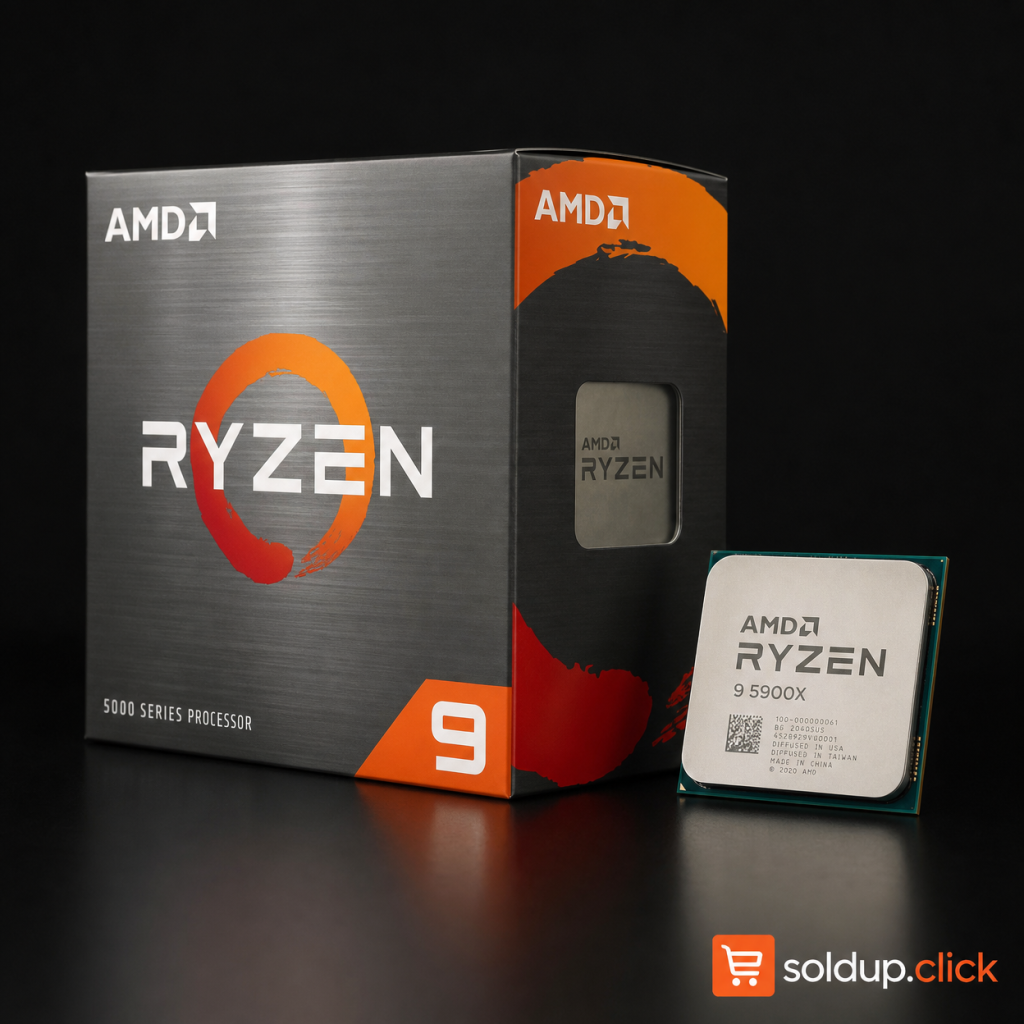
AMD Ryzen 9 5900X Processor
May
Introduction
When the AMD Ryzen 9 5900X launched in late 2020, it instantly became one of the most influential desktop processors of its generation. Built on AMD’s Zen 3 architecture and manufactured using TSMC’s 7nm process, it marked a major leap forward in both gaming and productivity performance. At the time, it successfully challenged Intel’s dominance in high-end desktop CPUs and, in many cases, surpassed it.
What made the 5900X particularly special was its ability to deliver exceptional multi-threaded performance without sacrificing gaming capability or efficiency. Unlike previous high-core-count CPUs that often struggled with latency or gaming performance, the Ryzen 9 5900X achieved a rare balance between workstation-level power and enthusiast gaming responsiveness.
Even several years after its release, the processor remains highly relevant. Thanks to significant price reductions and the maturity of the AM4 platform, it continues to offer outstanding value for gamers, creators, and professionals who want strong performance without transitioning to newer, more expensive platforms.
Key Specifications and Technical Overview
The AMD Ryzen 9 5900X features 12 cores and 24 threads, making it a strong high-end CPU even by modern standards. It operates with a base clock of 3.7 GHz and can boost up to 4.8 GHz, depending on workload, thermal conditions, and motherboard power delivery.
One of the key strengths of Zen 3 is its unified core complex (CCX) design. Unlike Zen 2, which split cores across multiple CCXs and introduced latency penalties when communicating between them, Zen 3 places all eight cores within a single CCX. This architectural change significantly reduces latency and improves performance consistency, especially in gaming workloads.
The processor includes a large 64MB L3 cache, which helps reduce memory access delays and improves performance in both gaming and productivity applications. Cache improvements were a major contributor to Zen 3’s strong gaming performance leap over its predecessor.
The Ryzen 9 5900X uses the AM4 socket, one of the most widely adopted CPU platforms in PC history. This ensures compatibility with a vast range of motherboards, from budget-friendly B450 and B550 boards to high-end X570 options. This wide ecosystem makes system building and upgrades significantly more affordable.
The chip has a TDP of 105W, which is relatively efficient for a 12-core processor. However, like most modern CPUs, real-world power consumption can exceed this under heavy multi-threaded workloads or when Precision Boost is fully engaged. It does not include a stock cooler, meaning users must purchase a separate cooling solution.
Performance Analysis
The Ryzen 9 5900X delivers excellent performance across both gaming and productivity workloads, making it one of the most balanced CPUs of its generation.
In productivity scenarios, it truly excels. Applications such as Blender, Adobe Premiere Pro, DaVinci Resolve, and HandBrake benefit significantly from its 12-core, 24-thread configuration. Video encoding and rendering tasks are completed quickly, while multitasking performance remains smooth even under heavy workloads.
In Cinebench R23 multi-core benchmarks, the 5900X typically scores between 21,000 and 23,000 points, placing it firmly in high-end territory even by today’s standards. While newer CPUs have surpassed it, the gap is not large enough to make it obsolete in real-world usage.
For software development, the 5900X remains a very capable processor. Large code compilations, virtual machine usage, and parallel workloads benefit from its strong multi-threaded performance, significantly reducing build times compared to lower-core CPUs.
In gaming, the Ryzen 9 5900X was a major turning point for AMD. At launch, it reclaimed gaming performance leadership in several titles, outperforming Intel’s competing CPUs at the time. Even today, it delivers excellent frame rates in modern games when paired with a capable GPU.
At 1080p and 1440p resolutions, where CPU performance matters most, the 5900X can still keep up with many modern processors. At higher resolutions such as 4K, performance differences between CPUs become even less noticeable, as GPU limitations dominate overall performance.
However, compared to newer gaming-focused CPUs like AMD’s X3D lineup, the 5900X is less specialized for gaming. Its strength lies more in balanced performance rather than gaming optimization.
Architecture and Efficiency Improvements
Zen 3 was a significant architectural upgrade over Zen 2, primarily due to its unified CCX design and improved instruction per cycle (IPC) performance. AMD achieved approximately a 19% IPC improvement, which had a major impact on both gaming and productivity workloads.
By reducing cross-core latency and improving cache access efficiency, Zen 3 made AMD CPUs much more competitive in gaming scenarios, an area where Intel previously held an advantage.
The architecture also improved branch prediction and execution efficiency, allowing the 5900X to deliver strong performance without excessive power consumption. This efficiency advantage made it particularly appealing for users who wanted high performance without extreme thermal output.
Thermals, Cooling, and Power Behavior
The Ryzen 9 5900X is known for its relatively efficient thermal profile compared to many high-core-count CPUs. With a 105W TDP, it can often be cooled effectively with mid-range cooling solutions.
However, since AMD does not include a stock cooler, users must choose an aftermarket solution. A high-quality air cooler or a 240mm All-in-One (AIO) liquid cooler is generally sufficient for most workloads.
Under gaming conditions, temperatures are typically well controlled. Under heavy multi-threaded workloads, the processor can consume more power as it boosts aggressively to maximize performance.
One of the strengths of Zen 3 is its ability to maintain high performance without requiring extreme cooling setups, making it more accessible than many competing high-end CPUs.
Value for Money and Platform Considerations
One of the biggest advantages of the Ryzen 9 5900X today is its price-to-performance ratio. Since the release of newer Zen 4 and Zen 5 processors, the 5900X has seen significant price reductions, making it far more accessible than at launch.
At its current market price, it offers performance that still competes with modern mid-to-high-end CPUs in many workloads. For users on a budget, this makes it an extremely attractive option.
The AM4 platform is another major advantage. With support for a wide range of motherboards and DDR4 memory, system costs can be significantly reduced compared to newer DDR5-based platforms. This makes it especially appealing for budget-conscious builders or those upgrading older systems.
However, AM4 is a mature platform, meaning it no longer receives new CPU generations. While this limits future upgrade paths, it also contributes to lower system costs and widespread availability of compatible components.
Pros and Cons
The Ryzen 9 5900X offers excellent multi-threaded performance, strong gaming capabilities, high efficiency for a 12-core CPU, and access to a mature and affordable AM4 ecosystem. It remains a highly balanced processor even years after release.
On the downside, it has been surpassed by newer Zen 4 and Zen 5 CPUs in both performance and efficiency. It lacks support for newer technologies such as DDR5 and PCIe 5.0, and it does not include a stock cooler.
Who Should Buy the Ryzen 9 5900X?
The Ryzen 9 5900X is ideal for users who want strong multi-threaded performance at a reduced cost. It is particularly well-suited for content creators, video editors, software developers, and multitasking users who benefit from 12 cores and 24 threads.
It is also a strong choice for gamers who already own an AM4 system and want a meaningful upgrade without replacing their motherboard or memory. Budget-conscious builders looking for high performance at lower system cost will also find it highly appealing.
However, users focused purely on gaming may benefit more from newer X3D processors, which are optimized specifically for gaming performance.
Conclusion
The AMD Ryzen 9 5900X remains one of the most successful and well-balanced processors AMD has ever produced. It played a key role in redefining AMD’s position in the high-performance desktop market and continues to deliver strong real-world performance years after its release.
While newer CPUs have surpassed it in raw performance and feature support, its combination of strong gaming capability, excellent multi-threaded performance, and affordable AM4 platform support ensures it remains highly relevant.
At today’s reduced pricing, the Ryzen 9 5900X is not just a capable CPU—it is one of the best value high-core-count processors available, making it a smart choice for budget-conscious enthusiasts and creators alike.
