Post
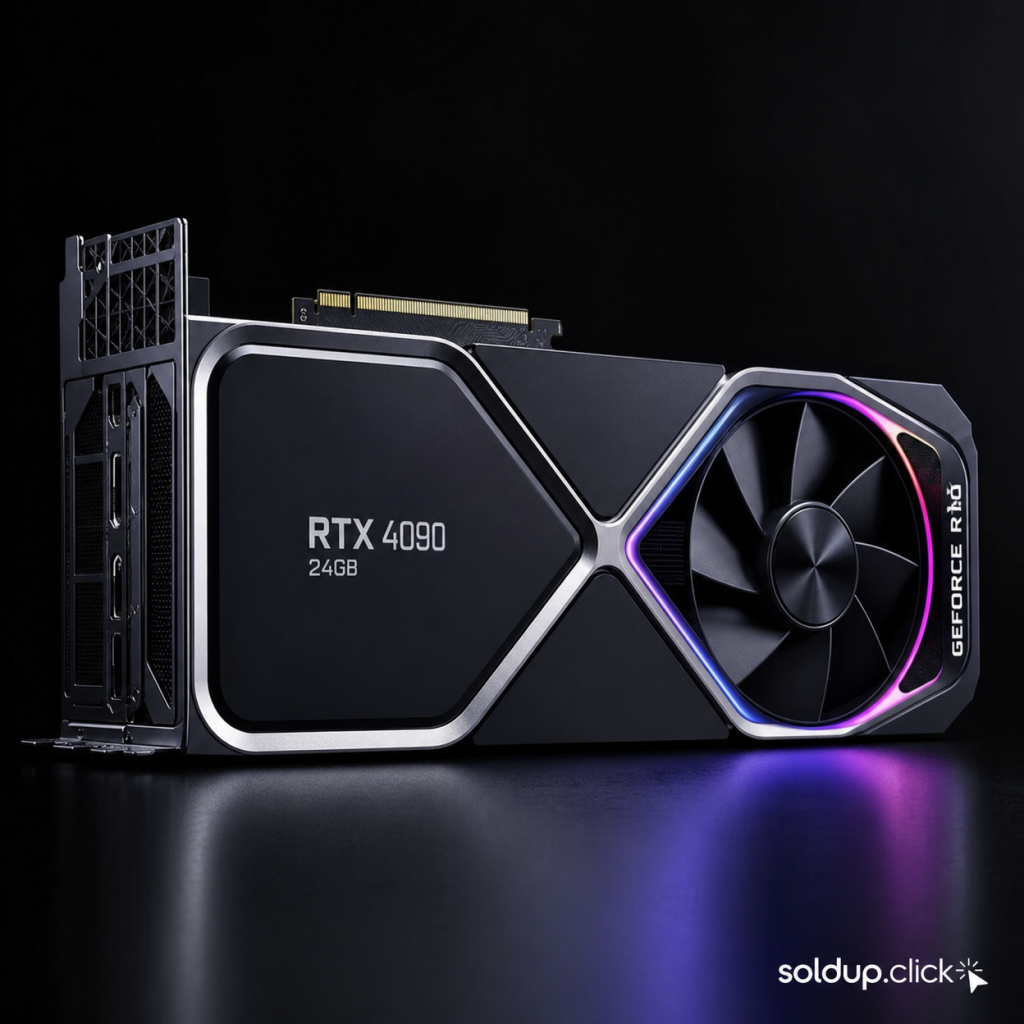
NVIDIA GeForce RTX 4090 24GB
May
Introduction
The NVIDIA GeForce RTX 4090 stands as the most powerful consumer graphics card ever released. Introduced in October 2022 as part of the Ada Lovelace generation, it represents a massive generational leap over its predecessor, the RTX 3090 Ti, and completely outpaces competing offerings from AMD’s Radeon lineup at the high end.
Rather than delivering incremental improvements, the RTX 4090 redefined expectations for what a consumer GPU can achieve. It excels in gaming, content creation, and AI-accelerated workloads, offering performance levels that were previously reserved for professional workstation hardware. This makes it a unique product in the consumer market—one that sits at the intersection of gaming enthusiast hardware and professional-grade compute power.
However, this level of performance comes at a significant cost, both financially and in terms of power consumption and physical size. The RTX 4090 is not a mainstream GPU—it is a specialized tool for users who demand absolute top-tier performance without compromise.
Key Specifications and Technical Overview
The NVIDIA GeForce RTX 4090 is powered by the AD102 GPU, built on TSMC’s advanced 4N process node, which is a customized version of 4nm technology optimized specifically for NVIDIA. This allows for significantly improved efficiency, transistor density, and performance compared to previous-generation GPUs.
At its core, the RTX 4090 features 16,384 CUDA cores, making it one of the most densely packed consumer GPUs ever created. It also includes 128 Streaming Multiprocessors (SMs), which contribute to its exceptional parallel processing capability.
The card is equipped with 24GB of GDDR6X memory running on a 384-bit memory interface. This configuration delivers an extremely high memory bandwidth of approximately 1,008 GB/s, ensuring smooth performance even in memory-intensive workloads such as 4K gaming, high-resolution texture rendering, and AI model inference.
The boost clock of the RTX 4090 is rated at around 2.52 GHz, though in real-world scenarios, the GPU often exceeds this due to NVIDIA’s aggressive boost algorithms and thermal headroom provided by high-end cooling solutions.
On the architectural side, Ada Lovelace introduces several major improvements:
- Third-generation RT cores for dramatically improved ray tracing performance
- Fourth-generation Tensor cores for AI acceleration
- DLSS 3 with Frame Generation, a breakthrough feature that uses AI to generate additional frames and significantly boost perceived performance
The card supports PCIe 4.0 x16, HDMI 2.1, and DisplayPort 1.4a, allowing compatibility with high-refresh-rate 4K displays and even 8K output configurations.
The RTX 4090 has a TDP of 450W, making it one of the most power-hungry consumer GPUs ever released. It uses the 16-pin 12VHPWR power connector and requires a high-quality power supply of at least 850W, with 1000W or more recommended for systems with high-end CPUs.
Performance Analysis
The RTX 4090 operates in a performance class of its own, significantly outperforming every other consumer GPU on the market.
Gaming Performance
In gaming workloads, the RTX 4090 delivers extraordinary performance at 4K resolution. Even in highly demanding titles such as Cyberpunk 2077, Microsoft Flight Simulator, and Hogwarts Legacy, the GPU maintains smooth frame rates at Ultra settings, often exceeding 60 FPS without difficulty.
When DLSS 3 Frame Generation is enabled, performance can increase dramatically, often doubling perceived frame rates in supported games. This allows the RTX 4090 to achieve 100+ FPS in extremely demanding scenarios that would otherwise be unplayable at native settings.
At 1440p resolution, the RTX 4090 becomes even more powerful, frequently exceeding 200 FPS in many modern titles. This makes it an ideal choice for high-refresh-rate gaming monitors, including 240Hz and even 360Hz displays.
However, at lower resolutions such as 1080p, the GPU often becomes CPU-limited, meaning its full potential is not fully utilized. This highlights the fact that the RTX 4090 is primarily designed for high-resolution gaming and extreme performance scenarios.
Content Creation and Professional Workloads
Beyond gaming, the RTX 4090 is an absolute powerhouse for content creation. Its 24GB VRAM buffer allows it to handle extremely large workloads that would exceed the memory capacity of most other consumer GPUs.
In 3D rendering applications such as Blender, OctaneRender, and V-Ray, the RTX 4090 dramatically reduces render times, often completing tasks in a fraction of the time required by previous-generation GPUs.
Video editing workflows in Adobe Premiere Pro and DaVinci Resolve also benefit significantly. The GPU can handle multiple streams of 4K and even 8K footage simultaneously, enabling smooth playback, faster rendering, and efficient encoding.
For AI workloads, the RTX 4090 is particularly impressive. Its Tensor cores and large VRAM capacity make it ideal for local AI model inference, machine learning training tasks, and generative AI applications. This has made it extremely popular not only among gamers but also among researchers and developers working with AI tools.
Architecture and Ada Lovelace Improvements
The Ada Lovelace architecture represents a significant leap in GPU design. One of its key innovations is the increased efficiency of its shader cores, allowing for higher performance without proportional increases in power consumption.
The third-generation RT cores significantly improve ray tracing performance, making real-time ray-traced lighting, shadows, and reflections much more practical in modern games. This allows developers to implement more realistic lighting systems without sacrificing performance to the same degree as previous generations.
The fourth-generation Tensor cores introduce DLSS 3 Frame Generation, which is one of the most important features of the RTX 4090. Unlike traditional upscaling techniques, Frame Generation uses AI to generate entirely new frames between rendered frames, significantly boosting performance in supported titles.
This combination of hardware and software innovation allows the RTX 4090 to deliver performance that far exceeds what raw rasterization power alone would suggest.
Thermals, Power Consumption, and Physical Design
The RTX 4090 is a physically massive GPU. The Founders Edition alone features a large triple-slot cooling system designed to handle its 450W power draw. Many third-party models from manufacturers such as ASUS, MSI, and Gigabyte are even larger, often occupying three to four expansion slots.
Due to its size, case compatibility is an important consideration. Many mid-tower cases may struggle to accommodate the length and thickness of high-end RTX 4090 models, which often exceed 336mm in length.
Power delivery is another critical factor. The 16-pin 12VHPWR connector must be properly seated to avoid overheating issues, which have been reported in some early adoption cases. Proper cable management and PSU compatibility are essential for safe operation.
Despite its extreme power consumption, the RTX 4090 is relatively efficient for the level of performance it delivers. Ada Lovelace’s architectural improvements allow it to achieve significantly higher performance per watt compared to previous-generation GPUs.
Value for Money and Market Position
At launch, the RTX 4090 carried a price tag of approximately $1,599, placing it firmly in the ultra-enthusiast category. This pricing makes it inaccessible for most mainstream gamers, but it is important to evaluate it in terms of performance rather than raw cost alone.
When compared to the RTX 4080, the 4090 offers roughly 30–40% higher performance in many workloads, while the price difference is significantly larger. This makes the RTX 4080 a better value choice for most gamers, but not a direct competitor in terms of absolute performance.
The RTX 4090’s value proposition becomes clearer when viewed through the lens of professional workloads. For users who rely on GPU compute performance for income or productivity, the time savings provided by the 4090 can justify its cost.
Pros and Cons
The RTX 4090 delivers unmatched gaming performance, massive 24GB VRAM capacity, industry-leading AI and ray tracing capabilities, and exceptional performance in professional content creation workloads.
However, it also has significant drawbacks. It is extremely expensive, consumes a large amount of power, requires a very large physical footprint, and is often underutilized at lower resolutions such as 1080p and 1440p in CPU-limited scenarios.
Who Should Buy the RTX 4090?
The RTX 4090 is designed for a very specific audience. It is ideal for 4K gamers who want the highest possible frame rates at ultra settings, content creators working with large 3D scenes or high-resolution video, AI researchers running local models, and enthusiasts who simply want the best possible GPU regardless of cost.
For mainstream gamers playing at 1080p or 1440p, the RTX 4090 is generally overkill. In those cases, more affordable GPUs provide better value while still delivering excellent performance.
Conclusion
The NVIDIA GeForce RTX 4090 is a landmark achievement in consumer graphics technology. It pushes the boundaries of gaming, content creation, and AI acceleration to levels previously thought impossible in a consumer product.
While its price, size, and power requirements make it impractical for many users, its raw performance is unmatched. For those who can fully utilize its capabilities, the RTX 4090 offers an experience that no other consumer GPU can replicate.
It is not just a graphics card—it is a statement of what is possible at the absolute peak of modern GPU engineering.
