Post
NVIDIA GeForce RTX 4080 16GB
May
Introduction
The NVIDIA GeForce RTX 4080 is the second-tier flagship GPU in NVIDIA’s Ada Lovelace generation, positioned just below the RTX 4090. While it does not reach the extreme performance levels of its larger sibling, it remains a high-end graphics card designed for enthusiast gamers and professionals who demand excellent 4K performance without stepping into the ultra-premium price bracket.
Built on the same architectural foundation as the RTX 4090, the RTX 4080 benefits from the same generational improvements in ray tracing, AI acceleration, and power efficiency. This makes it a highly capable GPU for both gaming and creative workloads, offering a more accessible entry point into NVIDIA’s top-tier performance ecosystem.
Although its launch price sparked debate within the PC hardware community, the RTX 4080 remains one of the most powerful consumer GPUs available and a strong option for users targeting smooth, high-quality 4K gaming.
Key Specifications and Technical Overview
The NVIDIA GeForce RTX 4080 is powered by the AD103 GPU, a slightly scaled-down version of the flagship AD102 chip used in the RTX 4090. Despite being a step below, it still delivers extremely high performance for gaming and content creation workloads.
The GPU features 9,728 CUDA cores, which provide the raw parallel processing power required for modern gaming, ray tracing, and compute workloads. It also includes a large number of Tensor and RT cores, which are critical for AI-based features and real-time ray tracing.
The card is equipped with 16GB of GDDR6X memory, running on a 256-bit memory interface. This configuration delivers approximately 736 GB/s of memory bandwidth, which is more than sufficient for 4K gaming and most professional workloads. While it is half the VRAM capacity of the RTX 4090, it remains a substantial amount for modern game engines and creative applications.
The RTX 4080 has a boost clock of approximately 2.51 GHz, although actual performance may vary depending on cooling and power limits. NVIDIA’s boost algorithms dynamically adjust clock speeds based on thermal and power headroom, meaning well-cooled models can often sustain higher real-world frequencies.
Like other Ada Lovelace GPUs, the RTX 4080 includes:
- Third-generation RT cores for improved ray tracing performance
- Fourth-generation Tensor cores for AI acceleration
- DLSS 3 with Frame Generation, which significantly increases performance in supported titles
The GPU supports PCIe 4.0 x16, HDMI 2.1, and DisplayPort 1.4a, enabling compatibility with modern high-refresh-rate displays, including 4K 120Hz and even 8K output scenarios.
The RTX 4080 has a TDP of 320W, making it significantly more power-efficient than the RTX 4090 while still delivering high-end performance. It requires a 16-pin 12VHPWR power connector and a recommended power supply of at least 750W.
Performance Analysis
The RTX 4080 delivers outstanding performance across both gaming and professional workloads, positioning it firmly in the high-end segment of the GPU market.
Gaming Performance
In gaming scenarios, the RTX 4080 is capable of delivering smooth 4K gameplay in most modern titles at high or ultra settings. In many demanding AAA games such as Cyberpunk 2077, Red Dead Redemption 2, and Hogwarts Legacy, the GPU typically achieves frame rates in the range of 60 to 90 FPS at native 4K resolution without upscaling.
When DLSS 3 Frame Generation is enabled, performance increases significantly in supported titles. This allows the RTX 4080 to achieve much higher frame rates, often exceeding 100 FPS in demanding games while maintaining visual quality that closely resembles native rendering.
At 1440p resolution, the RTX 4080 becomes even more powerful, frequently delivering extremely high frame rates that exceed 144 FPS in many titles. This makes it an excellent choice for high-refresh-rate gaming monitors, including 165Hz, 240Hz, and beyond.
At 1080p, the GPU is often underutilized and becomes heavily CPU-limited, meaning it is not the ideal resolution for this class of hardware.
Ray Tracing Performance
One of the RTX 4080’s standout strengths is its ray tracing performance. Thanks to NVIDIA’s third-generation RT cores, the GPU handles real-time global illumination, reflections, and shadows significantly more efficiently than previous generations.
While ray tracing still imposes a heavy performance cost, the RTX 4080 is capable of maintaining playable frame rates even in heavily ray-traced titles, especially when combined with DLSS.
Content Creation and Productivity
In creative workloads, the RTX 4080 performs very well. Applications such as Adobe Premiere Pro, DaVinci Resolve, Blender, and Unreal Engine benefit from its strong CUDA and Tensor performance.
The 16GB VRAM buffer is sufficient for most professional workloads, including 4K video editing, medium-to-large 3D scenes, and moderate AI model inference tasks. However, extremely large datasets or high-end 8K production workflows may push VRAM limits sooner than on the RTX 4090.
Overall, the RTX 4080 strikes a strong balance between gaming performance and productivity capability.
Architecture and Ada Lovelace Improvements
The Ada Lovelace architecture brings significant improvements in efficiency, ray tracing, and AI acceleration over the previous Ampere generation.
One of the most impactful improvements is the increase in shader efficiency and clock speeds, allowing the RTX 4080 to deliver higher performance without proportionally increasing power consumption.
The third-generation RT cores improve ray tracing performance significantly, reducing the performance penalty typically associated with ray-traced lighting effects.
The fourth-generation Tensor cores introduce DLSS 3 Frame Generation, which uses AI to generate additional frames between traditionally rendered frames. This feature can effectively double perceived frame rates in supported games, making high-refresh-rate 4K gaming much more accessible.
These architectural improvements allow the RTX 4080 to deliver performance that far exceeds what traditional rasterization metrics alone would suggest.
Thermals, Power Consumption, and Design
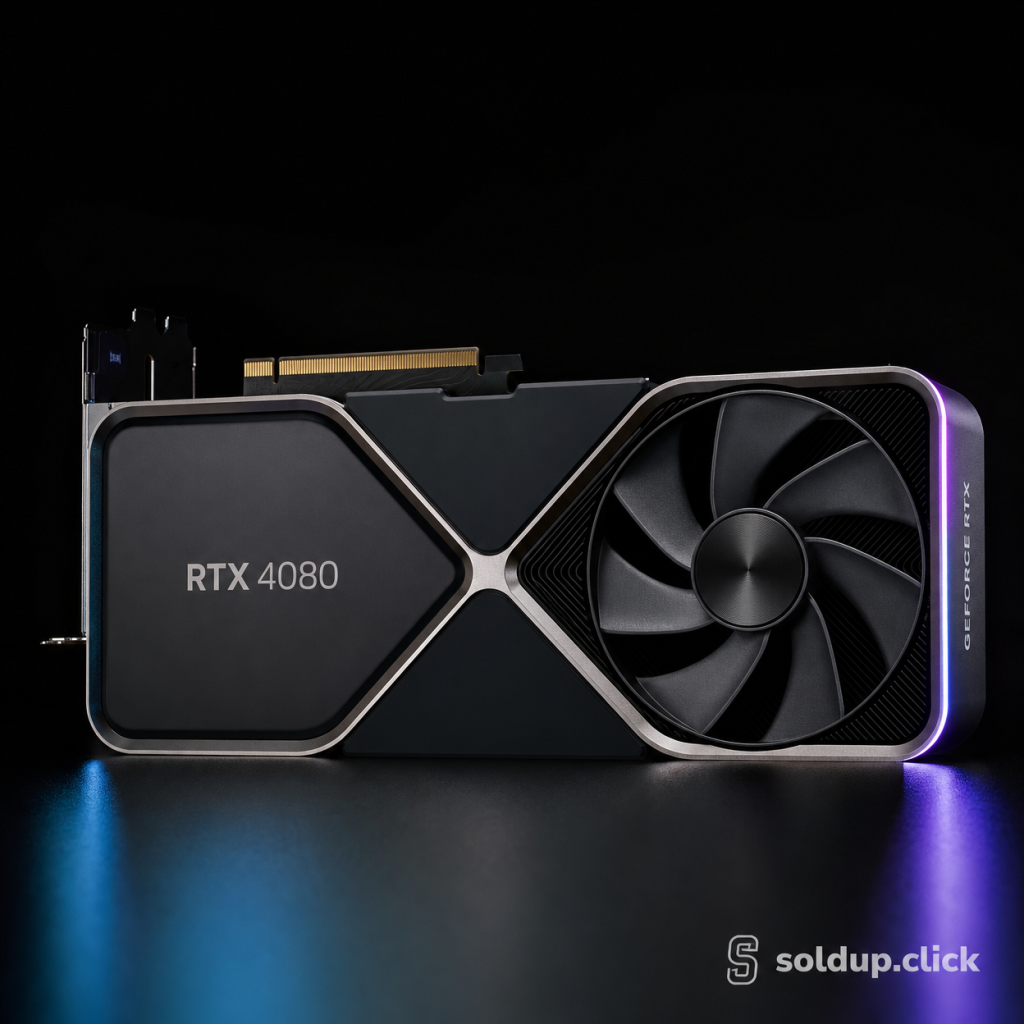
The RTX 4080 features a large and efficient cooling system, typically occupying a triple-slot design in both NVIDIA Founders Edition and AIB partner models. Despite its size, it is smaller and more manageable than the RTX 4090.
The 320W power draw places it in a more reasonable efficiency range for high-end GPUs. It delivers excellent performance per watt compared to previous-generation flagship cards, making it more suitable for a wider range of PC builds.
Case compatibility is still an important consideration, as most RTX 4080 models are long and thick. Users should ensure their case supports large GPUs before purchasing.
Cooling performance across partner models from ASUS, MSI, and Gigabyte is generally excellent, with most designs maintaining stable temperatures under heavy load while keeping noise levels relatively low.
Value for Money and Market Position
At a launch price of approximately $1,199, the RTX 4080 was widely debated within the PC community. Many users felt that its pricing was too close to flagship territory while offering significantly lower performance than the RTX 4090.
However, when evaluated independently, the RTX 4080 still delivers excellent value for users who want high-end 4K gaming performance without paying flagship prices.
Compared to the RTX 4090, the RTX 4080 delivers roughly 70–80% of the performance at a significantly lower cost. This makes it a more practical option for many enthusiasts, even if it is not the absolute fastest GPU available.
Pros and Cons
The RTX 4080 offers excellent 4K gaming performance, strong ray tracing capabilities, DLSS 3 support, efficient power consumption relative to performance, and 16GB of fast GDDR6X memory.
However, it also has drawbacks. Its high launch price makes it less accessible, the 16GB VRAM configuration may feel limiting in future ultra-demanding workloads, and it is significantly outperformed by the RTX 4090 in raw performance.
Who Should Buy the RTX 4080?
The RTX 4080 is ideal for gamers targeting high-quality 4K gaming at high or ultra settings without stepping up to the extreme cost of the RTX 4090. It is also well-suited for content creators who work with 4K video editing, 3D rendering, or moderate AI workloads.
It is less suitable for budget-conscious users or those gaming primarily at 1080p or 1440p, where lower-tier GPUs offer better value.
Conclusion
The NVIDIA GeForce RTX 4080 is a powerful and well-balanced high-end GPU that delivers exceptional performance across gaming and creative workloads. While its pricing places it in a premium category, its capabilities make it one of the strongest choices for 4K gaming outside of the flagship RTX 4090.
It represents a refined balance of performance, efficiency, and modern features, making it a compelling option for enthusiasts who want top-tier results without going all-in on NVIDIA’s most expensive hardware.
For users targeting high-end 4K gaming and professional-grade creative performance, the RTX 4080 remains one of the most capable and well-rounded GPUs available today.
