Post
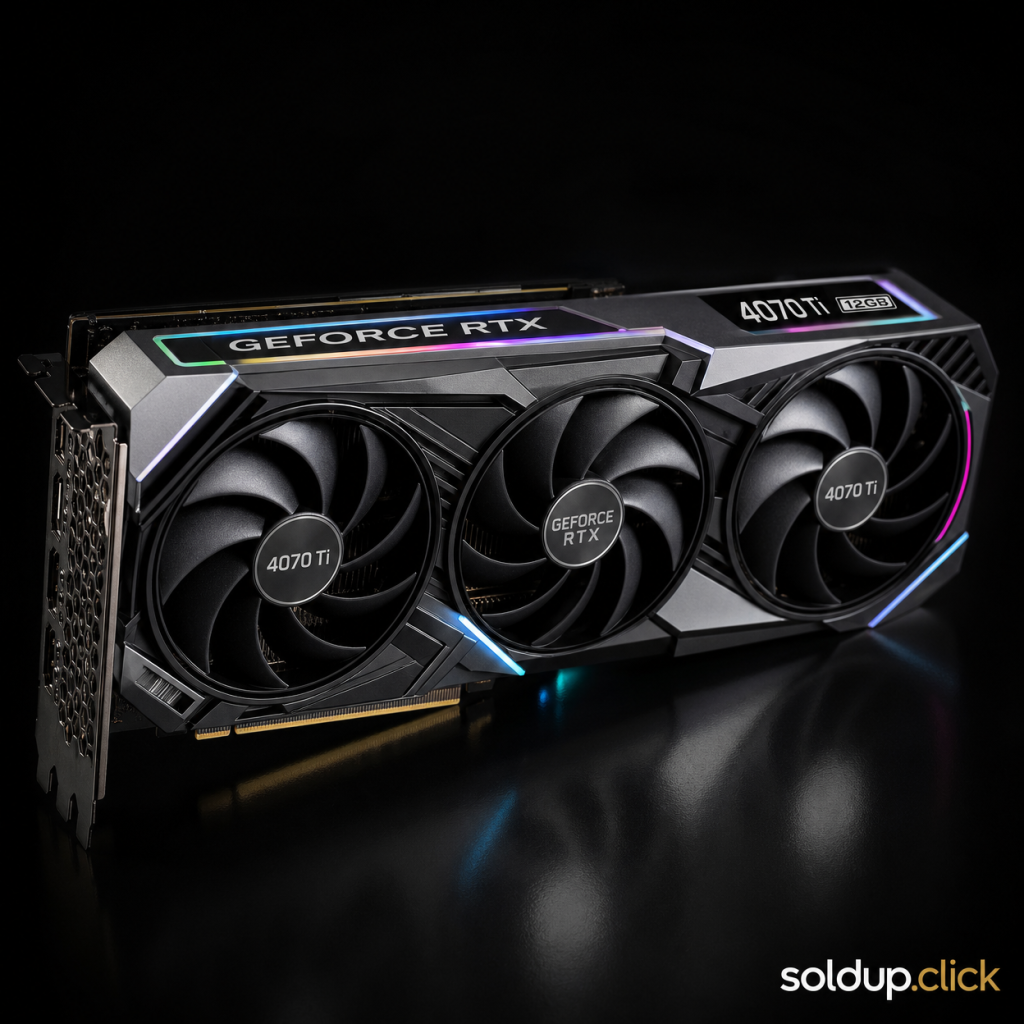
NVIDIA GeForce RTX 4070 Ti 12GB
May
Introduction
The NVIDIA GeForce RTX 4070 Ti occupies a unique and somewhat controversial position within the Ada Lovelace GPU lineup. Originally introduced as an “unlocked” version of the RTX 4080 12GB, it was later rebranded as the RTX 4070 Ti before launch. This repositioning significantly affected expectations, pricing perception, and how the card is viewed within the broader GPU hierarchy.
Despite the marketing confusion, the RTX 4070 Ti itself is a highly capable graphics card. It delivers strong 1440p performance and respectable 4K gaming capabilities while offering better efficiency and a lower price point than the RTX 4080. For many gamers, it represents a practical entry into high-end Ada Lovelace performance without paying flagship premiums.
It is not a top-tier GPU like the RTX 4090 or even the RTX 4080, but it plays an important role in the lineup by targeting enthusiast gamers who want strong performance per dollar in modern AAA titles.
Key Specifications and Technical Overview
The NVIDIA GeForce RTX 4070 Ti is powered by the AD104 GPU, a scaled-down version of the AD103 and AD102 chips used in higher-end models. While reduced in size, it still retains many of the architectural advantages of the Ada Lovelace generation.
The GPU features 7,680 CUDA cores, which provide the parallel processing power required for modern gaming workloads, ray tracing, and compute tasks. It also includes a full suite of RT and Tensor cores, enabling advanced lighting effects and AI-driven features.
The card is equipped with 12GB of GDDR6X memory on a 192-bit memory bus. This configuration provides approximately 504 GB/s of memory bandwidth, which is sufficient for high-performance 1440p gaming and moderate 4K workloads. However, the narrower bus and reduced VRAM compared to higher-tier cards can become a limiting factor in some extremely demanding scenarios.
The RTX 4070 Ti has a boost clock of approximately 2.61 GHz, although actual real-world performance may vary depending on cooling solution and power headroom. NVIDIA’s boost algorithms allow the GPU to dynamically adjust frequency to maximize performance within thermal limits.
Key architectural features include:
- Third-generation RT cores for improved ray tracing performance
- Fourth-generation Tensor cores for AI acceleration
- DLSS 3 with Frame Generation, significantly improving frame rates in supported titles
The GPU supports PCIe 4.0 x16, HDMI 2.1, and DisplayPort 1.4a, ensuring compatibility with modern gaming monitors, including high-refresh-rate 1440p and 4K displays.
The RTX 4070 Ti has a TDP of 285W, making it one of the more power-efficient high-performance GPUs in the Ada Lovelace lineup. It requires a 16-pin 12VHPWR power connector and a recommended PSU of around 700W–750W depending on system configuration.
Performance Analysis
The RTX 4070 Ti delivers strong performance across modern gaming and creative workloads, positioning itself as a high-end 1440p GPU with entry-level 4K capability.
1440p Gaming Performance
At 1440p resolution, the RTX 4070 Ti excels. It consistently delivers high frame rates in modern AAA titles, often exceeding 100 FPS at ultra settings depending on the game engine and optimization. This makes it an excellent choice for high-refresh-rate monitors, including 165Hz and 240Hz displays.
In competitive esports titles such as Valorant, CS2, and Fortnite, the GPU easily pushes extremely high frame rates, often limited more by the CPU than the GPU itself.
At this resolution, the RTX 4070 Ti provides one of the best price-to-performance ratios in the Ada Lovelace lineup.
4K Gaming Performance
At 4K resolution, the RTX 4070 Ti remains capable but begins to show its limitations compared to higher-tier GPUs. In demanding AAA titles, it typically delivers playable frame rates ranging from 45 to 70 FPS depending on graphical settings.
With DLSS 3 Frame Generation enabled, performance improves significantly, allowing many games to reach 80–100 FPS or more in supported titles. However, native 4K performance is noticeably behind the RTX 4080 and RTX 4090.
This makes the RTX 4070 Ti a “conditional 4K GPU”—capable of 4K gaming, but best optimized with DLSS or slightly reduced settings.
Content Creation and Productivity Performance
In creative workloads, the RTX 4070 Ti performs well but is limited by its 12GB VRAM capacity.
In applications such as Adobe Premiere Pro, DaVinci Resolve, Blender, and Unreal Engine, the GPU accelerates rendering and timeline playback effectively. For most 1080p and 4K workflows, it provides smooth and responsive performance.
However, the 12GB VRAM buffer can become a constraint in more demanding scenarios, such as:
- Large 3D scenes with high-resolution textures
- 8K video editing workflows
- Complex AI model inference or training tasks
- High-poly rendering projects
In these cases, higher-VRAM GPUs like the RTX 4080 or RTX 4090 provide significantly more headroom.
Despite this limitation, for semi-professional creators and hobbyist workloads, the RTX 4070 Ti remains a very capable GPU.
Architecture and Ada Lovelace Advantages
The RTX 4070 Ti benefits from NVIDIA’s Ada Lovelace architecture, which introduces major improvements in efficiency, ray tracing, and AI performance compared to the previous Ampere generation.
One of the most important innovations is DLSS 3 Frame Generation. This feature uses AI to generate additional frames between traditionally rendered frames, effectively increasing perceived frame rates without a proportional increase in GPU workload. In supported games, this can dramatically improve smoothness and responsiveness.
The third-generation RT cores enhance ray tracing performance, making real-time lighting effects more efficient and visually impressive. While ray tracing still carries a performance cost, Ada Lovelace GPUs handle it significantly better than previous generations.
The fourth-generation Tensor cores accelerate AI workloads and are essential for DLSS 3 functionality, contributing to the overall performance uplift in modern gaming.
Thermals, Power Efficiency, and Design
The RTX 4070 Ti is one of the more power-efficient high-performance GPUs in its class, with a 285W TDP. This allows it to deliver strong performance without the extreme power demands of higher-tier cards.
Most AIB models feature robust triple-fan cooling solutions, ensuring stable thermals even under sustained load. Brands such as ASUS, MSI, and Gigabyte offer well-designed cooling systems that keep temperatures and noise levels under control.
Physically, the GPU varies in size depending on the manufacturer, but most models fall between 300mm and 340mm in length. This means users should still verify case compatibility, as the card is relatively large despite being more compact than flagship GPUs.
Overall, thermal performance is strong, and power efficiency is one of the RTX 4070 Ti’s advantages.
Value for Money and Market Position
At its launch price of around $799, the RTX 4070 Ti sits in a competitive but controversial pricing segment. While significantly cheaper than the RTX 4080, it still represents a premium investment for a mid-to-high-end GPU.
In terms of raw performance, it delivers roughly 70–80% of the RTX 4080 depending on workload. This makes it a strong value option for users who want high-end gaming performance without paying flagship pricing.
However, the limited 12GB VRAM and narrower memory bus have been points of criticism, particularly regarding long-term future-proofing in 4K gaming scenarios.
Despite these concerns, the RTX 4070 Ti remains one of the strongest price-to-performance options in the upper mid-range GPU market.
Pros and Cons
The RTX 4070 Ti offers excellent 1440p performance, strong 4K capability with DLSS 3, good power efficiency, and access to NVIDIA’s latest AI and ray tracing technologies.
However, it also has limitations. The 12GB VRAM capacity may limit long-term 4K performance in future titles, native 4K performance is weaker than higher-tier GPUs, and its rebranding history created confusion around its positioning and value perception.
Who Should Buy the RTX 4070 Ti?
The RTX 4070 Ti is ideal for gamers targeting high-refresh-rate 1440p gaming or those who want entry-level 4K gaming with DLSS support. It is also suitable for content creators working in moderate-resolution workflows who do not require large VRAM buffers.
It is less suitable for users focused on heavy 4K gaming without upscaling or professionals working with large-scale rendering or AI workloads that require more than 12GB of VRAM.
Conclusion
The NVIDIA GeForce RTX 4070 Ti is a strong, efficient, and capable GPU that delivers excellent performance in modern gaming and creative workloads. While it sits in a somewhat awkward market position due to its pricing history and VRAM limitations, its real-world performance remains impressive.
For gamers who prioritize high-refresh-rate 1440p gaming or want solid 4K performance with DLSS 3 support, the RTX 4070 Ti remains one of the most compelling options in NVIDIA’s Ada Lovelace lineup.
