
Post
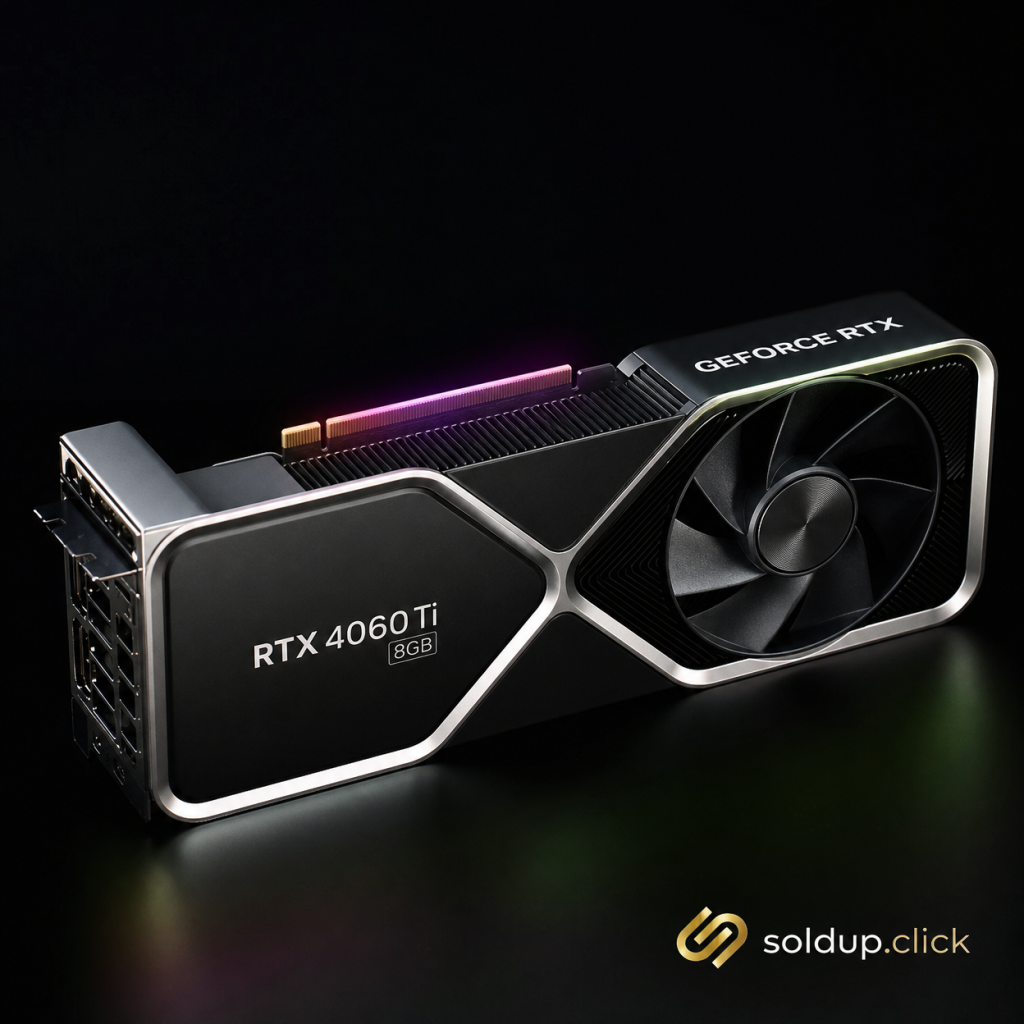
NVIDIA GeForce RTX 4060 Ti 8GB
May
Introduction
The NVIDIA GeForce RTX 4060 Ti represents the upper-mainstream segment of the Ada Lovelace lineup. It is designed primarily for the massive global audience of gamers who still play at 1080p, while also offering enough performance to handle 1440p gaming in many modern titles.
Unlike higher-end GPUs in the RTX 40 series, the RTX 4060 Ti focuses less on raw power and more on efficiency, affordability, and feature accessibility. It brings advanced technologies such as DLSS 3 and improved ray tracing support to a more budget-conscious audience, making it a popular choice for new PC builds and upgrades from older GTX or RTX 20-series cards.
However, despite its strengths, the RTX 4060 Ti has also been one of the more debated GPUs in NVIDIA’s lineup due to its narrow memory bus and limited VRAM configuration, which raises questions about long-term performance in demanding games.
Key Specifications and Technical Overview
The NVIDIA GeForce RTX 4060 Ti is based on the AD106 GPU, a mid-range chip within the Ada Lovelace architecture. While significantly smaller than the AD104 and AD102 chips used in higher-tier cards, it still incorporates all key architectural improvements of the generation.
The GPU features 4,352 CUDA cores, which provide the primary compute resources for rendering, shading, and general graphics workloads. While this is a noticeable step down from higher-tier models, it is still sufficient for smooth 1080p and entry-level 1440p gaming performance.
The RTX 4060 Ti is equipped with 8GB of GDDR6 memory connected via a 128-bit memory bus. This configuration results in a bandwidth of approximately 288 GB/s, which is relatively modest compared to other GPUs in its price range. While this is adequate for most current 1080p gaming scenarios, it can become a limiting factor in memory-heavy titles, particularly at higher resolutions or with ultra texture settings enabled.
The GPU operates with a boost clock of approximately 2.54 GHz, although actual real-world performance varies depending on cooling and power delivery.
Key architectural features include:
- Third-generation RT cores for ray tracing performance
- Fourth-generation Tensor cores for AI acceleration
- DLSS 3 with Frame Generation, significantly improving performance in supported games
The card supports PCIe 4.0 x8 (a reduction from x16 in higher-end GPUs), HDMI 2.1, and DisplayPort 1.4a, ensuring compatibility with modern displays.
One of its most notable characteristics is its extremely low power consumption. With a TDP of just 160W, the RTX 4060 Ti is one of the most power-efficient GPUs in its performance class.
Performance Analysis
The RTX 4060 Ti delivers strong performance for its intended target resolutions, especially 1080p gaming.
1080p Gaming Performance
At 1080p resolution, the RTX 4060 Ti performs exceptionally well. In most modern AAA titles, it is capable of exceeding 100 FPS at High or Ultra settings, depending on optimization.
In competitive esports titles such as Valorant, CS2, Apex Legends, and Fortnite, the GPU easily delivers extremely high frame rates, often well above 200 FPS. This makes it an excellent choice for high-refresh-rate monitors such as 144Hz, 165Hz, or even 240Hz displays.
At this resolution, the RTX 4060 Ti provides a smooth and responsive gaming experience that satisfies the majority of mainstream gamers.
1440p Gaming Performance
At 1440p, the RTX 4060 Ti remains capable but begins to show its mid-range limitations. In many modern AAA games, it can still achieve playable frame rates, but users may need to adjust settings from Ultra to High or Medium depending on the title.
In less demanding or well-optimized games, it can still exceed 60–90 FPS at 1440p, especially when DLSS is enabled.
However, the limited memory bandwidth and 8GB VRAM become more noticeable at this resolution, particularly in newer games that use high-resolution textures or large open-world environments.
Role of DLSS 3
One of the most important features of the RTX 4060 Ti is DLSS 3 with Frame Generation. This technology significantly boosts performance by generating AI-based frames between traditionally rendered frames.
In supported titles, DLSS 3 can effectively double or even triple perceived frame rates, making 1440p gaming much more comfortable and allowing the GPU to punch above its raw hardware limitations.
However, DLSS performance depends heavily on game support, meaning its benefits are not universal across all titles.
Memory System Limitations and Controversy
One of the most heavily discussed aspects of the RTX 4060 Ti is its memory configuration.
The combination of:
- 8GB VRAM
- 128-bit memory bus
- 288 GB/s bandwidth
has raised concerns among gamers and reviewers regarding long-term viability.
In modern gaming, VRAM usage has steadily increased, particularly in AAA titles with high-resolution textures and open-world environments. In some cases, 8GB can become a bottleneck, leading to texture pop-in, reduced performance, or the need to lower texture settings.
Additionally, the narrow memory bus limits bandwidth, which can affect performance in bandwidth-heavy workloads.
While the GPU performs well today in 1080p scenarios, its future-proofing compared to competing GPUs with larger memory configurations is a major point of criticism.
Architecture and Ada Lovelace Features
Despite its limitations, the RTX 4060 Ti benefits significantly from NVIDIA’s Ada Lovelace architecture.
The third-generation RT cores improve ray tracing performance compared to previous generations, allowing for more realistic lighting, shadows, and reflections with reduced performance penalties.
The fourth-generation Tensor cores enable DLSS 3 Frame Generation, which is one of the most impactful features in the RTX 40 series. By generating additional frames using AI, the GPU can deliver significantly higher perceived performance in supported titles.
These technologies allow the RTX 4060 Ti to feel more powerful than its raw specifications might suggest.
Thermals, Power Efficiency, and Design
One of the strongest advantages of the RTX 4060 Ti is its excellent power efficiency. With a TDP of just 160W, it consumes significantly less power than most modern GPUs, making it ideal for compact and energy-conscious builds.
This low power requirement also results in:
- Lower heat output
- Quieter cooling solutions
- Compatibility with smaller power supplies
Many RTX 4060 Ti models are compact dual-fan designs, making them suitable for small form factor (SFF) builds, micro-ATX systems, and compact mid-tower cases.
Cooling performance is generally excellent, with most models operating quietly even under full gaming load.
Value for Money and Market Position
At a launch price of around $399, the RTX 4060 Ti sits in a competitive and somewhat controversial pricing segment.
Its main competitors include AMD’s Radeon RX 7700 XT and previous-generation GPUs like the RTX 3070, both of which offer different strengths depending on workload.
While the RTX 4060 Ti excels in efficiency and DLSS 3 support, some competing GPUs offer:
- More VRAM
- Wider memory buses
- Stronger raw rasterization performance
This creates a mixed value proposition depending on user priorities.
For gamers who prioritize efficiency, NVIDIA features, and 1080p performance, the RTX 4060 Ti is attractive. For those focused on long-term 1440p or VRAM-heavy gaming, alternatives may offer better value.
Pros and Cons
The RTX 4060 Ti offers excellent 1080p performance, strong efficiency, DLSS 3 Frame Generation support, compact design options, and low power consumption.
However, it also has notable drawbacks. The 8GB VRAM limit and narrow 128-bit memory bus can restrict performance in modern AAA titles, particularly at 1440p. Additionally, its pricing has been criticized relative to competing GPUs offering stronger raw specifications.
Who Should Buy the RTX 4060 Ti?
The RTX 4060 Ti is best suited for:
- 1080p gamers seeking high frame rates and modern features
- Users building compact or low-power systems
- Gamers upgrading from GTX 10-series or RTX 20-series GPUs
- Players who want DLSS 3 support without moving to higher-tier cards
It is less suitable for users focused on long-term 1440p ultra gaming or VRAM-heavy workloads.
Conclusion
The NVIDIA GeForce RTX 4060 Ti is a highly efficient and capable GPU that excels in 1080p gaming and delivers solid 1440p performance in many scenarios. With support for DLSS 3 and modern Ada Lovelace features, it provides a smooth and responsive gaming experience for mainstream users.
However, its narrow memory bus and 8GB VRAM configuration raise valid concerns about long-term performance in increasingly demanding games.
Overall, the RTX 4060 Ti is a practical, efficient, and feature-rich GPU—but one that requires careful consideration depending on a buyer’s performance expectations and future-proofing needs.
