Post
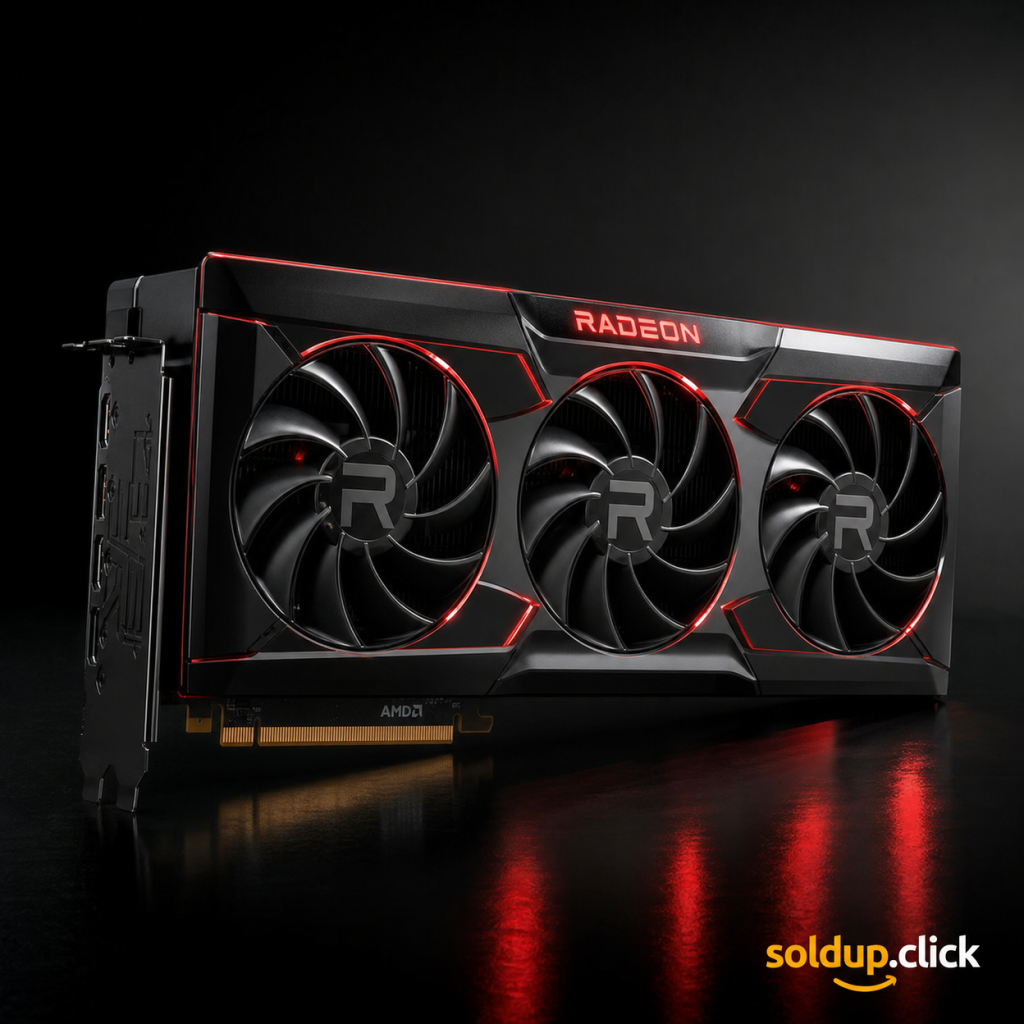
AMD Radeon RX 7900 XTX 24GB
May
Introduction
The AMD Radeon RX 7900 XTX represents the flagship of AMD’s RDNA 3 generation and is designed to compete directly with NVIDIA’s high-end GPUs, particularly the RTX 4080. It marks one of AMD’s most ambitious attempts in the enthusiast GPU market, combining a new chiplet-based architecture with a large 24GB memory buffer aimed at high-resolution gaming and professional workloads.
Unlike previous AMD flagship GPUs, the RX 7900 XTX focuses heavily on rasterization performance and memory capacity rather than pushing the absolute limits of ray tracing. This makes it particularly attractive for gamers who prioritize traditional rendering performance at 4K resolution and want a high amount of VRAM for future-proofing.
While it does not fully match NVIDIA’s ecosystem in ray tracing or AI upscaling features, the RX 7900 XTX offers a strong value proposition for users who prioritize raw performance per dollar and large memory capacity.
Key Specifications and Technical Overview
The AMD Radeon RX 7900 XTX is built on the Navi 31 GPU, which introduces AMD’s first major shift toward a chiplet-based design in the GPU space. Instead of a single monolithic die, Navi 31 uses a combination of a Graphics Compute Die (GCD) and multiple Memory Cache Dies (MCDs). This design allows AMD to improve scalability and manufacturing efficiency while maintaining high performance.
The GPU includes:
- 12,288 Stream Processors
- 96 Compute Units (CUs)
- Advanced RDNA 3 architecture improvements
The RX 7900 XTX is equipped with a massive 24GB of GDDR6 memory on a 384-bit memory interface. This results in a memory bandwidth of approximately 960 GB/s, which is significantly higher than many competing GPUs in its price class. This large VRAM buffer is especially beneficial for high-resolution textures, 4K gaming, and professional workloads such as 3D rendering and video production.
The boost clock reaches up to approximately 2.5 GHz, with real-world performance varying depending on cooling and power delivery. AMD’s architecture allows for strong sustained clock speeds under load, particularly in well-cooled AIB models.
Key platform features include:
- PCIe 4.0 x16 support
- HDMI 2.1 output
- DisplayPort 2.1 support (a major advantage for future high-resolution displays)
The card has a typical board power (TBP) of 355W, placing it in the high-power enthusiast category, though still below NVIDIA’s RTX 4090 in overall power consumption.
Performance Analysis
The RX 7900 XTX delivers strong performance across a wide range of gaming and professional workloads, with its strengths most visible in traditional rasterization performance.
4K Gaming Performance
At 4K resolution, the RX 7900 XTX performs extremely well in rasterized workloads. In many modern AAA titles, it is capable of delivering high or ultra settings with frame rates often in the 60–100 FPS range depending on optimization.
In games that rely heavily on traditional rendering techniques—such as Forza Horizon 5, Elden Ring, and Call of Duty titles—the RX 7900 XTX often matches or comes very close to the RTX 4080.
The large 24GB VRAM buffer provides a major advantage in 4K gaming scenarios, especially in games that use high-resolution textures or large open-world environments. This helps prevent VRAM-related performance drops or texture streaming issues that can appear on lower-memory GPUs.
1440p Gaming Performance
At 1440p, the RX 7900 XTX becomes extremely powerful, often exceeding 144 FPS in many AAA titles and far higher in esports games. However, at this resolution, the GPU is often underutilized unless paired with extremely high-refresh-rate monitors.
This makes it a “no-compromise” GPU for 1440p gaming, though arguably overkill for most users at that resolution.
Ray Tracing Performance and Upscaling Technologies
One of the main weaknesses of the RX 7900 XTX compared to NVIDIA’s offerings is ray tracing performance.
While RDNA 3 includes improved ray acceleration hardware, AMD still trails NVIDIA’s dedicated RT cores in complex ray-traced workloads. In games with heavy ray tracing effects, such as Cyberpunk 2077 or Metro Exodus Enhanced Edition, performance drops more significantly compared to equivalent NVIDIA GPUs like the RTX 4080.
However, AMD provides alternatives such as:
- FSR 2 (FidelityFX Super Resolution)
- RSR (Radeon Super Resolution)
These technologies improve performance by upscaling lower-resolution images, but they generally do not match the quality or performance gains of NVIDIA’s DLSS 3 Frame Generation, especially in supported titles.
As a result, the RX 7900 XTX is best experienced with ray tracing either disabled or used moderately, depending on the game.
Content Creation and Professional Workloads
The RX 7900 XTX performs well in content creation and productivity workloads, especially those that benefit from large VRAM capacity.
In applications such as Blender, DaVinci Resolve, and Adobe Premiere Pro, the GPU handles rendering, encoding, and playback efficiently. The 24GB VRAM is particularly valuable for:
- High-resolution video editing (4K and 8K workflows)
- Large 3D modeling projects
- Texture-heavy game development environments
- AI and machine learning workloads
While NVIDIA retains an advantage in CUDA-based workflows and certain professional software optimizations, AMD’s strong VRAM capacity makes the RX 7900 XTX highly competitive in memory-intensive tasks.
Architecture and RDNA 3 Improvements
The RDNA 3 architecture introduces several important improvements over RDNA 2.
The most significant change is the chiplet-based GPU design, which separates compute and memory functions into different dies. This allows for better manufacturing efficiency and scalability.
RDNA 3 also improves:
- Instructions per clock (IPC)
- Power efficiency per compute unit
- Clock speeds across the GPU
- Cache and memory subsystem design
These improvements help the RX 7900 XTX deliver significantly higher performance than its predecessor, the RX 6950 XT, especially in high-resolution gaming scenarios.
Thermals, Power Consumption, and Design
With a 355W power rating, the RX 7900 XTX sits firmly in the high-performance GPU category. While not as power-hungry as the RTX 4090, it still requires a robust cooling and power setup.
The reference design uses a triple-fan cooling solution with a vapor chamber and a hybrid airflow system that balances cooling performance and noise levels.
AIB models from manufacturers such as Sapphire, PowerColor, and XFX often improve upon the reference design with larger heatsinks, better thermal pads, and more aggressive fan curves.
Physically, the card is large and typically occupies three slots in most PC cases, requiring careful compatibility planning.
Value for Money and Market Position
At a launch price of around $999, the RX 7900 XTX positions itself as a direct competitor to the RTX 4080. In terms of rasterization performance, it often matches or slightly exceeds the RTX 4080 while costing less or offering more VRAM.
This creates a strong value proposition for gamers who prioritize traditional rendering performance over ray tracing or AI features.
However, NVIDIA still holds advantages in:
- Ray tracing performance
- DLSS 3 Frame Generation
- Software ecosystem (CUDA, AI tools, etc.)
This means the RX 7900 XTX is best suited for users who prioritize raw gaming performance and memory capacity over feature-rich AI acceleration.
Pros and Cons
The RX 7900 XTX offers excellent 4K rasterization performance, a massive 24GB VRAM buffer, strong price-to-performance ratio compared to NVIDIA’s RTX 4080, and future-proof display support with DisplayPort 2.1.
However, it also has drawbacks, including weaker ray tracing performance, higher power consumption than some competitors in similar workloads, and lack of a direct equivalent to DLSS 3 Frame Generation.
Who Should Buy the RX 7900 XTX?
The RX 7900 XTX is best suited for:
- 4K gamers who prioritize high frame rates in rasterized games
- Users who need large VRAM for content creation or professional workloads
- Gamers who prefer AMD’s ecosystem and pricing strategy
- Builders looking for strong performance without paying RTX 4090 prices
It is less suitable for users who rely heavily on ray tracing, DLSS 3, or CUDA-based professional applications.
Conclusion
The AMD Radeon RX 7900 XTX is one of the most powerful consumer GPUs AMD has ever produced. With its massive 24GB VRAM buffer, strong rasterization performance, and competitive pricing against NVIDIA’s RTX 4080, it stands out as an excellent choice for high-resolution gaming and content creation.
While it does not lead in ray tracing or AI-driven features, it excels where it matters most for many gamers: raw performance and value at 4K resolution.
For users who prioritize traditional gaming performance and future-proof memory capacity, the RX 7900 XTX remains one of the strongest flagship alternatives in the modern GPU market.
