Post
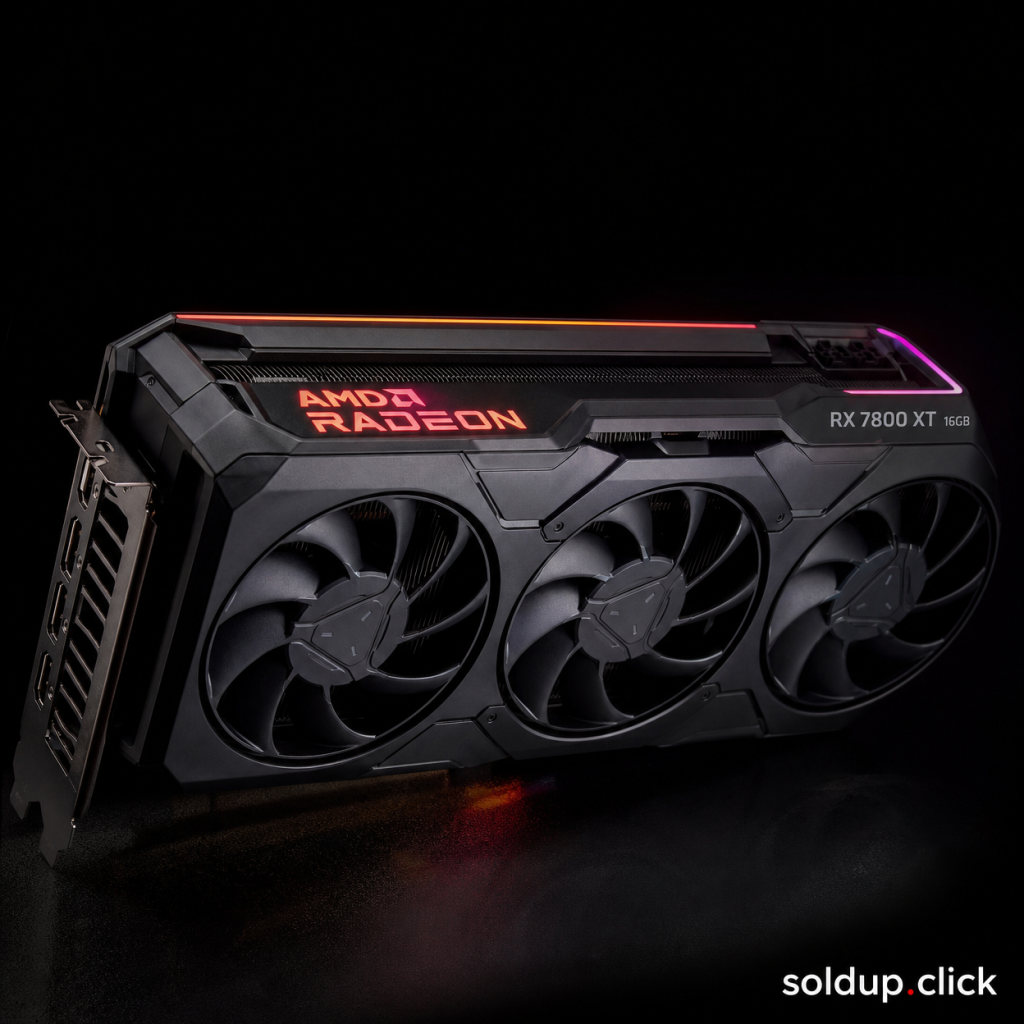
AMD Radeon RX 7800 XT 16GB
May
Introduction
The AMD Radeon RX 7800 XT is one of the most important GPUs in AMD’s RDNA 3 lineup, designed specifically for the mainstream enthusiast segment. It targets the highly competitive 1440p gaming market, where performance, efficiency, and price balance matter more than absolute flagship power.
Positioned directly against NVIDIA’s RTX 4070, the RX 7800 XT aims to offer stronger raw rasterization performance and significantly more VRAM at a similar price point. With 16GB of GDDR6 memory, it also attempts to address growing concerns about memory limitations in modern games.
For gamers who prioritize traditional rendering performance and long-term usability at 1440p, the RX 7800 XT is one of AMD’s most compelling modern GPUs.
Key Specifications and Technical Overview
The AMD Radeon RX 7800 XT is built on the Navi 32 GPU, part of AMD’s RDNA 3 architecture. Like other RDNA 3 GPUs, it uses a chiplet-based design, combining a Graphics Compute Die (GCD) with multiple Memory Cache Dies (MCDs). This approach improves manufacturing efficiency and allows AMD to scale performance across different product tiers.
The RX 7800 XT includes:
- 3,840 Stream Processors
- 60 Compute Units (CUs)
- RDNA 3 architectural improvements
The GPU is paired with 16GB of GDDR6 memory on a 256-bit memory bus, delivering approximately 624 GB/s of memory bandwidth. This is a significant advantage over competing GPUs in the same price range, particularly NVIDIA’s RTX 4070, which features only 12GB of VRAM and a narrower memory configuration.
Boost clocks reach up to approximately 2.43 GHz, depending on cooling and power conditions. In real-world usage, the GPU maintains stable performance under load, especially in well-designed AIB models with strong cooling solutions.
Key platform features include:
- PCIe 4.0 x16 interface
- HDMI 2.1 support
- DisplayPort 2.1 support (future-ready for high-resolution displays and high refresh rate monitors)
The card has a total board power (TBP) of 263W, placing it in a moderate-high power category for a mainstream enthusiast GPU.
Performance Analysis
The RX 7800 XT is designed primarily for 1440p gaming, where it delivers its best performance.
1440p Gaming Performance
At 1440p resolution, the RX 7800 XT performs extremely well in modern AAA titles. In many rasterized games, it delivers high or ultra settings at frame rates often exceeding 80–120 FPS depending on optimization.
In several titles, the RX 7800 XT matches or slightly exceeds the RTX 4070 in pure rasterization performance. This makes it particularly attractive for gamers who prioritize traditional rendering performance over ray tracing.
The 16GB VRAM buffer plays an important role here, allowing the GPU to handle high-resolution textures and large game worlds without running into memory bottlenecks. This is increasingly relevant in newer titles that can exceed 10–12GB VRAM usage at 1440p with high texture settings.
4K Gaming Performance
At 4K resolution, the RX 7800 XT remains playable in many games but is not primarily designed for this workload.
In less demanding or well-optimized titles, it can achieve 60 FPS or close to it with adjusted settings. However, in modern AAA games, users will often need to lower settings to medium or high and potentially rely on upscaling technologies for smooth performance.
While the GPU can handle 4K gaming, it is more comfortable and consistent at 1440p.
Ray Tracing Performance and Upscaling Technologies
One of the key differences between AMD and NVIDIA GPUs in this segment is ray tracing performance.
While RDNA 3 improves AMD’s ray tracing capabilities compared to RDNA 2, NVIDIA’s RTX 40 series still holds a clear advantage due to its more mature RT core implementation and DLSS ecosystem.
In ray-traced games such as Cyberpunk 2077, Control, or Metro Exodus Enhanced Edition, the RTX 4070 generally performs better or requires less aggressive settings to maintain similar frame rates.
AMD offers alternative technologies:
- FSR 2 (FidelityFX Super Resolution)
- RSR (Radeon Super Resolution)
These provide upscaling benefits but generally do not match the visual quality or performance uplift of NVIDIA’s DLSS 3 Frame Generation, especially in supported titles.
As a result, the RX 7800 XT is best experienced with ray tracing either disabled or used at moderate settings.
Content Creation and Productivity Performance
The RX 7800 XT performs well in content creation workloads, especially those that benefit from higher VRAM capacity.
In applications like:
- Blender
- DaVinci Resolve
- Adobe Premiere Pro
the GPU handles rendering, encoding, and playback efficiently for most mainstream workflows.
The 16GB VRAM is particularly useful for:
- 4K video editing
- High-resolution texture work
- Moderate 3D scene rendering
- Game development asset pipelines
However, NVIDIA still holds an advantage in CUDA-based workflows and certain AI-accelerated applications. For users relying heavily on those ecosystems, NVIDIA GPUs may still be preferred.
Architecture and RDNA 3 Improvements
The RX 7800 XT benefits from AMD’s RDNA 3 architecture, which introduces several meaningful improvements over RDNA 2.
The chiplet-based design improves manufacturing scalability and allows AMD to optimize performance across different GPU tiers more efficiently.
Key RDNA 3 improvements include:
- Increased instructions per clock (IPC)
- Better power efficiency per compute unit
- Improved clock scaling under load
- Enhanced memory subsystem design
These improvements contribute to the RX 7800 XT’s strong performance in 1440p gaming workloads and its ability to compete effectively with NVIDIA’s mid-to-high range offerings.
Thermals, Power Consumption, and Design
With a 263W power rating, the RX 7800 XT strikes a reasonable balance between performance and efficiency. It consumes more power than the RTX 4070 but delivers stronger rasterization performance in many scenarios.
Most AIB models from manufacturers like Sapphire, XFX, and PowerColor feature robust triple-fan cooling systems. These designs prioritize low noise levels and efficient heat dissipation, even under sustained gaming loads.
Physically, the card is large but typical for its class, often requiring a mid-to-large PC case for proper fitment.
Value for Money and Market Position
At a launch price of around $499, the RX 7800 XT is positioned as a direct competitor to the RTX 4070.
Its strongest advantages include:
- Higher VRAM (16GB vs 12GB)
- Stronger rasterization performance in many titles
- Competitive pricing in the 1440p segment
However, NVIDIA still leads in:
- Ray tracing performance
- DLSS 3 Frame Generation
- Software ecosystem support (CUDA, AI tools, etc.)
This creates a clear divide: AMD focuses on raw performance and VRAM, while NVIDIA emphasizes features and ray tracing efficiency.
Pros and Cons
The RX 7800 XT offers strong 1440p rasterization performance, a generous 16GB VRAM buffer, competitive pricing, and DisplayPort 2.1 support for future display technologies.
On the downside, ray tracing performance lags behind NVIDIA, and AMD’s upscaling technology is not yet as widely adopted or as advanced as DLSS 3 Frame Generation.
Who Should Buy the RX 7800 XT?
The RX 7800 XT is best suited for:
- 1440p gamers who prioritize high frame rates in rasterized games
- Users who want strong VRAM headroom for modern AAA titles
- Budget-conscious enthusiasts seeking strong performance per dollar
- Gamers who prefer AMD’s ecosystem and pricing strategy
It is less ideal for users heavily focused on ray tracing, AI workloads, or NVIDIA-exclusive technologies.
Conclusion
The AMD Radeon RX 7800 XT is one of the strongest 1440p GPUs in AMD’s lineup, delivering excellent rasterization performance, a generous 16GB VRAM buffer, and competitive pricing against NVIDIA’s RTX 4070.
While it does not lead in ray tracing or AI-driven features, it excels in the areas that matter most to many gamers: raw performance, memory capacity, and value.
For gamers targeting high-quality 1440p experiences with future-proof VRAM headroom, the RX 7800 XT stands as one of the most compelling choices in the mainstream enthusiast GPU market.
