
Post
NVIDIA RTX 5090 Review: The Ultimate 4K Gaming GPU in 2025
Jun
NVIDIA RTX 5090 Review: The Ultimate 4K Gaming GPU in 2025
The NVIDIA GeForce RTX 5090 is not merely an upgrade over the previous generation—it is a statement of intent. As the flagship graphics card built on NVIDIA’s latest Blackwell architecture, the RTX 5090 pushes gaming, content creation, AI acceleration, and workstation performance to levels that were previously unimaginable in the consumer market.
For years, flagship GPUs have delivered incremental improvements. The RTX 5090 changes that narrative by introducing significant architectural enhancements, faster memory technology, more AI acceleration hardware, improved ray tracing performance, and DLSS 4 Multi-Frame Generation. Combined, these innovations create a graphics card that establishes a new performance benchmark for enthusiasts.
Whether you’re targeting ultra-high-refresh-rate 4K gaming, experimenting with AI workloads, editing 8K video, or simply building the most powerful gaming PC possible, the RTX 5090 represents the pinnacle of consumer graphics technology in 2025.
First Impressions and Design
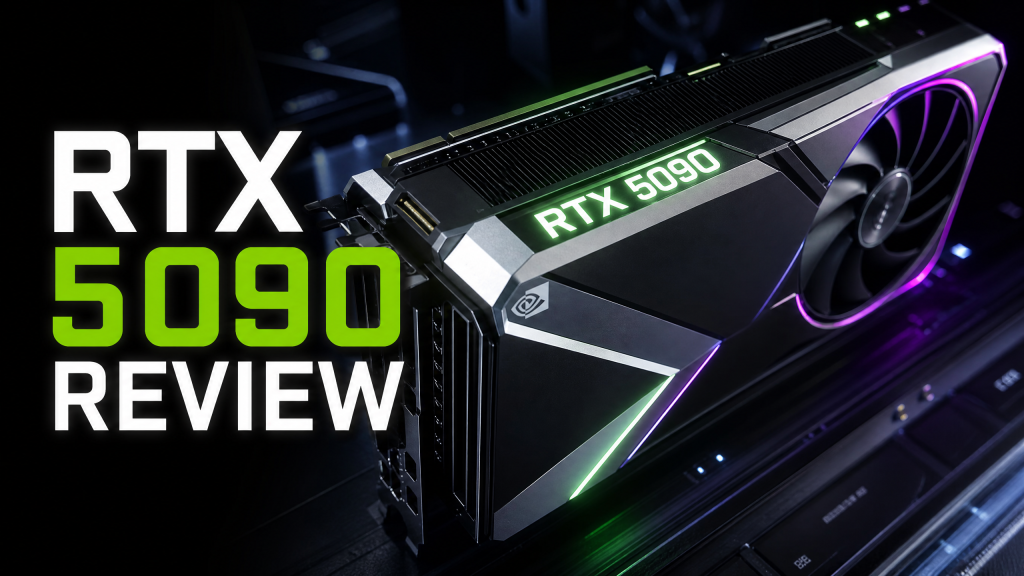
The RTX 5090 is physically imposing. NVIDIA’s Founders Edition design embraces a larger cooling solution to accommodate the card’s substantial power requirements. Measuring approximately 336mm long and occupying 3.5 PCIe slots, the card demands a spacious case and proper airflow planning.
The new triple-fan cooling system improves airflow significantly compared to previous Founders Edition models. NVIDIA has redesigned the internal airflow path to maximize heat dissipation while maintaining relatively quiet operation under load.
Premium materials dominate the design:
- Full metal shroud construction
- Reinforced frame for structural rigidity
- Vapor chamber cooling system
- Graphene-enhanced thermal interface material
- Customizable RGB lighting
- Improved airflow architecture
Despite consuming dramatically more power than mainstream GPUs, the RTX 5090 remains surprisingly refined in terms of acoustics and thermal behavior.
Blackwell Architecture Explained
At the heart of the RTX 5090 lies NVIDIA’s Blackwell architecture, representing the company’s largest architectural leap since Ada Lovelace.
The architecture focuses on four key areas:
- Traditional rasterization performance
- Ray tracing acceleration
- Artificial intelligence processing
- Memory bandwidth improvements
Manufactured using TSMC’s advanced 3nm process technology, the RTX 5090 packs approximately 92 billion transistors, making it one of the most complex consumer chips ever produced.
This process node allows NVIDIA to improve efficiency while simultaneously increasing performance and transistor density.
RTX 5090 Specifications
| Specification | RTX 5090 |
|---|---|
| Architecture | Blackwell |
| Manufacturing Process | TSMC 3nm |
| CUDA Cores | 24,576 |
| Tensor Cores | 512 |
| RT Cores | 192 |
| Memory | 32GB GDDR7 |
| Memory Bus | 512-bit |
| Memory Bandwidth | 1.7 TB/s+ |
| Base Clock | 2.0 GHz |
| Boost Clock | Up to 2.9 GHz |
| TDP | 600W |
| Display Outputs | DisplayPort 2.1, HDMI 2.1a |
The specification sheet alone highlights the enormous leap over previous generations.
Gaming Performance: A New Standard
The RTX 5090 was built with one primary goal: dominate gaming at every resolution.
At 1080p and 1440p, the card often becomes CPU-limited, meaning modern processors struggle to fully utilize its immense graphical power.
The real target audience for the RTX 5090 is gamers seeking:
- 4K gaming at maximum settings
- High-refresh-rate gameplay
- Advanced ray tracing
- Future-proof performance
4K Gaming Benchmarks
The RTX 5090 excels at 4K gaming. In many demanding AAA titles, the card consistently exceeds 150–200 FPS with maximum graphical settings enabled.
Games such as:
- Cyberpunk 2077
- Alan Wake 2
- Starfield
- Black Myth: Wukong
- Microsoft Flight Simulator
run smoothly even with advanced ray tracing effects enabled.
For gamers using 4K 144Hz and 4K 240Hz monitors, the RTX 5090 finally provides enough performance to fully exploit these premium displays.
Ray Tracing Performance
Ray tracing has evolved from a novelty to a standard feature in modern AAA games.
The RTX 5090 dramatically improves ray tracing performance thanks to:
- More RT cores
- Improved RT core efficiency
- Higher memory bandwidth
- Enhanced AI acceleration
Compared to previous generations, ray-traced lighting, shadows, reflections, and global illumination run substantially faster.
Many titles that previously required DLSS to maintain smooth frame rates can now run comfortably with ray tracing enabled even before upscaling technologies are activated.
DLSS 4 and Multi-Frame Generation
Arguably the most revolutionary feature of the RTX 5090 is DLSS 4.
NVIDIA’s AI-powered upscaling technology has matured significantly over the years, but DLSS 4 introduces a breakthrough feature called Multi-Frame Generation.
Instead of generating a single intermediate frame, DLSS 4 can generate multiple AI-created frames between traditionally rendered frames.
Benefits include:
- Massive FPS increases
- Improved smoothness
- Reduced rendering workload
- Enhanced visual quality
Games that previously achieved 60 FPS at native 4K can exceed 150 FPS with DLSS 4 enabled while maintaining image quality remarkably close to native rendering.
8K Gaming Finally Becomes Practical
For years, 8K gaming was more of a marketing term than a realistic use case.
The RTX 5090 changes that.
While not every title can run natively at 8K with maximum settings, many modern games become genuinely playable at 8K when DLSS 4 is enabled.
This achievement makes the RTX 5090 the first consumer GPU capable of delivering a practical 8K gaming experience across a meaningful number of titles.
Content Creation Performance
The RTX 5090 isn’t just for gamers.
Professional creators benefit enormously from its increased compute resources and expanded VRAM capacity.
Applications such as:
- Adobe Premiere Pro
- DaVinci Resolve
- Blender
- Autodesk Maya
- Cinema 4D
- Unreal Engine 5
show substantial performance improvements compared to previous flagship GPUs.
Tasks that benefit include:
- Video rendering
- Color grading
- 3D modeling
- GPU rendering
- Simulation workloads
- Virtual production
AI and Machine Learning Performance
AI has become one of the most important GPU workloads.
The RTX 5090’s 32GB of GDDR7 memory makes it especially attractive for:
- Local LLM inference
- Stable Diffusion image generation
- Machine learning research
- AI video generation
- Model fine-tuning
The upgraded Tensor Cores provide significantly higher AI throughput than previous generations.
Researchers and enthusiasts who previously required professional workstation GPUs may find the RTX 5090 an appealing alternative.
Power Consumption: The Biggest Drawback
The most controversial aspect of the RTX 5090 is its power requirement.
With a 600W TDP, this is one of the most power-hungry consumer graphics cards ever released.
NVIDIA recommends:
- 1000W minimum PSU
- 1200W recommended PSU
- High-quality ATX 3.1 power supplies
Users should carefully evaluate:
- Power supply capacity
- Case airflow
- Electricity costs
- Thermal management
While performance is unmatched, efficiency is not the RTX 5090’s strongest selling point.
Thermals and Noise
Despite its enormous power draw, NVIDIA’s cooling solution performs admirably.
Under gaming workloads, temperatures generally remain between:
- 70°C to 80°C
Fan noise remains surprisingly controlled thanks to the oversized cooling assembly.
Many users will find the RTX 5090 quieter than heavily overclocked RTX 4090 models despite consuming more power.
Who Should Buy the RTX 5090?
- 4K 240Hz gamers
- 8K gaming enthusiasts
- Professional content creators
- AI developers and researchers
- Simulation enthusiasts
- Users seeking the fastest GPU available
Who Should Skip It?
- 1080p gamers
- Budget-conscious buyers
- Small-form-factor PC builders
- Users with limited PSU capacity
- Gamers using 60Hz monitors
For many users, GPUs such as the RTX 5080 or RTX 5070 Ti may offer significantly better value.
Final Verdict
The NVIDIA GeForce RTX 5090 is a technological masterpiece. It delivers unprecedented gaming performance, industry-leading ray tracing, cutting-edge AI acceleration, and enough VRAM to handle virtually any modern workload. Whether you’re playing the latest AAA games at 4K Ultra settings, creating professional content, or experimenting with advanced AI applications, the RTX 5090 stands at the top of the consumer GPU hierarchy.
Its only meaningful weaknesses are its extraordinary power consumption and premium price. However, for enthusiasts who demand the absolute best regardless of cost, there is currently no alternative that comes close.
The RTX 5090 isn’t simply the fastest graphics card of 2025—it redefines what a consumer GPU can achieve.
Score: 9.5/10
Pros:
- Exceptional 4K and 8K gaming performance
- Industry-leading ray tracing capabilities
- DLSS 4 Multi-Frame Generation
- 32GB GDDR7 memory
- Outstanding AI and content creation performance
- Excellent thermal design
Cons:
- Extremely high power consumption
- Large physical size
- Requires premium cooling and power supply hardware
- Very expensive
