
Post
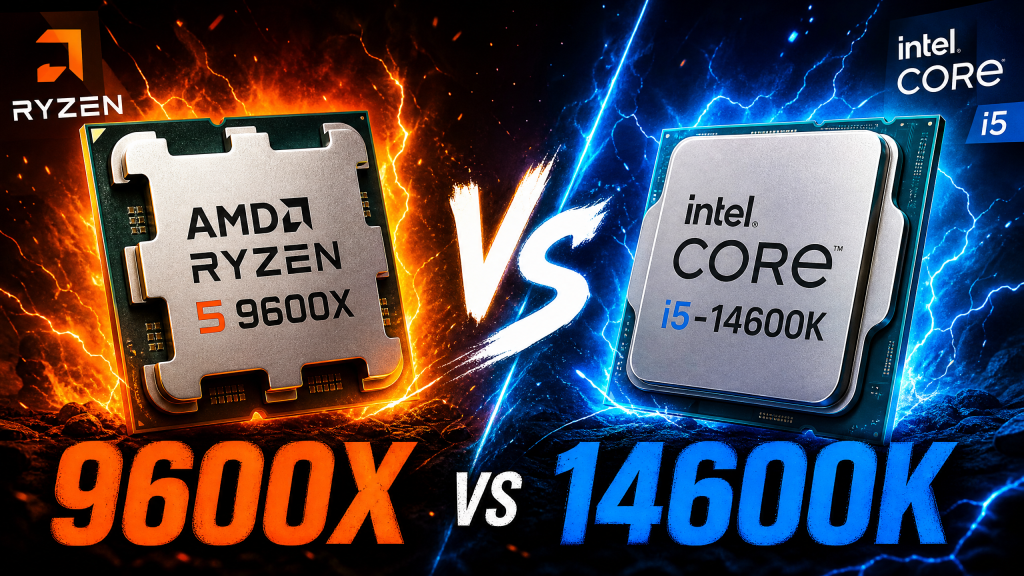
Ryzen 5 9600X vs Core i5-14600K: The Ultimate Budget Gaming CPU Showdown
Jun
Ryzen 5 9600X vs Core i5-14600K: The Ultimate Budget Gaming CPU Showdown
Choosing the right processor is one of the most important decisions when building a gaming PC. While graphics cards often receive the majority of attention, the CPU remains the foundation of system performance, influencing gaming frame rates, multitasking capabilities, content creation workloads, and overall system responsiveness.
In 2025, two of the most compelling processors in the sub-$300 market are AMD’s Ryzen 5 9600X and Intel’s Core i5-14600K. Both CPUs target gamers who want excellent performance without spending premium-tier money. However, despite competing in a similar price range, these processors take very different approaches to performance.
The Ryzen 5 9600X leverages AMD’s latest Zen 5 architecture, emphasizing high instructions-per-clock (IPC), power efficiency, and long-term platform support. Meanwhile, the Core i5-14600K relies on Intel’s hybrid Performance Core and Efficiency Core design to deliver exceptional multitasking and productivity performance.
So which processor offers the better value for gamers in 2025? In this detailed comparison, we’ll examine architecture, gaming performance, productivity benchmarks, power efficiency, platform longevity, and overall value to determine which CPU deserves a place in your next build.
Specifications Overview
AMD Ryzen 5 9600X
The Ryzen 5 9600X is built on AMD’s Zen 5 architecture and targets mainstream gamers looking for maximum gaming performance at a reasonable price.
- 6 Cores
- 12 Threads
- Base Clock: 3.9 GHz
- Boost Clock: Up to 5.4 GHz
- 38MB Cache
- 65W TDP
- AM5 Socket
- DDR5 Support
- PCIe 5.0 Support
Although it has only six cores, Zen 5 delivers significant IPC improvements compared to previous generations, allowing the 9600X to compete with processors that feature substantially higher core counts.
Intel Core i5-14600K
Intel’s Core i5-14600K belongs to the Raptor Lake Refresh family and uses a hybrid architecture that combines Performance Cores (P-Cores) with Efficiency Cores (E-Cores).
- 6 Performance Cores
- 8 Efficiency Cores
- 14 Total Cores
- 20 Threads
- Boost Clock: Up to 5.3 GHz
- 24MB L3 Cache
- 125W Base TDP
- LGA1700 Socket
- DDR4 and DDR5 Support
- PCIe 5.0 Support
The hybrid design gives the i5-14600K a major advantage in heavily threaded workloads, making it one of the most versatile processors in Intel’s lineup.
Gaming Performance
Gaming remains the primary focus for most buyers considering these CPUs.
To evaluate gaming performance accurately, benchmarks are typically performed at 1080p using a high-end graphics card such as an RTX 5080 or RTX 5090. This minimizes GPU bottlenecks and highlights differences between processors.
Ryzen 5 9600X Gaming Performance
AMD’s Zen 5 architecture delivers excellent gaming results thanks to its high IPC and efficient cache design.
In many modern games, the Ryzen 5 9600X leads the Core i5-14600K by approximately:
- 5% to 15% at 1080p
Games that particularly benefit from Zen 5 include:
- Cyberpunk 2077
- Spider-Man: Miles Morales
- Hogwarts Legacy
- Starfield
- Alan Wake 2
The 9600X also tends to produce stronger 1% low frame rates, contributing to smoother gameplay during demanding scenes.
Core i5-14600K Gaming Performance
The i5-14600K remains an excellent gaming processor despite being built on an older architecture.
Its hybrid core configuration helps maintain responsiveness in games that run extensive background calculations.
Titles that benefit from Intel’s thread count include:
- Cities: Skylines II
- Microsoft Flight Simulator
- Total War: Warhammer III
- Factorio
- Anno 1800
While the i5-14600K generally trails the Ryzen 5 9600X in average FPS, the difference becomes much smaller at higher resolutions.
1080p vs 1440p vs 4K Gaming
The impact of CPU choice depends heavily on gaming resolution.
1080p Gaming
At 1080p, the CPU has the greatest influence on frame rates.
This is where the Ryzen 5 9600X demonstrates its strongest advantage, frequently outperforming the i5-14600K in modern titles.
1440p Gaming
At 1440p, the graphics card becomes more important.
Differences between the two CPUs typically shrink to:
- 2% to 8%
In many games, the experience becomes virtually identical.
4K Gaming
At 4K resolution, the GPU is usually the primary bottleneck.
Whether you choose the Ryzen 5 9600X or Core i5-14600K, gaming performance is often nearly identical when paired with the same graphics card.
For 4K-focused builds, investing additional budget into the GPU usually delivers better returns than spending extra on the processor.
Productivity Performance
Not every user buys a CPU exclusively for gaming.
Many people also use their systems for:
- Video editing
- Streaming
- 3D rendering
- Software development
- Virtual machines
- Multitasking
Multi-Core Performance
This is where Intel’s Core i5-14600K shines.
With 14 total cores and 20 threads, the processor handles parallel workloads significantly better than the six-core Ryzen 5 9600X.
Benchmarks such as:
- Cinebench R24
- Blender
- HandBrake
- Adobe Premiere Pro
typically show the i5-14600K leading by a substantial margin.
For users who frequently render videos or perform intensive productivity tasks, Intel’s additional cores provide meaningful benefits.
Single-Core Performance
Single-threaded performance remains important for:
- Gaming
- General responsiveness
- Legacy applications
- Office workloads
Zen 5’s IPC improvements allow the Ryzen 5 9600X to lead in many single-core benchmarks.
This contributes directly to its gaming advantage.
Power Consumption and Efficiency
Power efficiency has become increasingly important due to rising electricity costs and growing concerns about heat generation.
Ryzen 5 9600X
- 65W TDP
- Lower operating temperatures
- Reduced power draw
- Less cooling required
The Ryzen 5 9600X can comfortably operate with affordable air coolers while maintaining excellent temperatures.
Core i5-14600K
- 125W Base TDP
- Higher peak power consumption
- More heat generation
- Requires stronger cooling
Under heavy workloads, the i5-14600K can consume significantly more power than the Ryzen 5 9600X.
This not only increases energy usage but also places greater demands on cooling solutions and power supplies.
Cooling Requirements
Because of its efficiency, the Ryzen 5 9600X works exceptionally well with:
- Budget tower coolers
- Compact PC builds
- Quiet systems
The i5-14600K, by comparison, benefits from:
- High-end air coolers
- 240mm AIO liquid coolers
- Strong case airflow
Cooling costs should be considered when evaluating total platform expenses.
Platform Comparison: AM5 vs LGA1700
One of the most important differences between these CPUs is the platform they belong to.
AMD AM5 Platform
The Ryzen 5 9600X uses AMD’s AM5 socket.
Benefits include:
- DDR5 support
- PCIe 5.0 support
- Future CPU upgrade compatibility
- Long-term platform support
AMD has publicly committed to supporting AM5 for multiple future CPU generations.
This means users can upgrade their processor later without replacing the motherboard.
Intel LGA1700 Platform
The Core i5-14600K uses the LGA1700 socket.
Advantages include:
- Mature motherboard ecosystem
- Affordable motherboard pricing
- DDR4 compatibility options
However, LGA1700 has effectively reached the end of its lifecycle.
Future Intel processors will require a new motherboard platform.
For long-term upgradability, AM5 holds a clear advantage.
Value for Money
Pricing fluctuates throughout the year, but both CPUs generally compete within a similar range.
The Ryzen 5 9600X offers:
- Superior gaming performance
- Excellent efficiency
- Lower cooling costs
- Longer upgrade path
The Core i5-14600K offers:
- Outstanding multi-threaded performance
- Excellent productivity value
- Potential motherboard savings
- Strong overall versatility
The best choice depends largely on how the system will be used.
Who Should Buy the Ryzen 5 9600X?
- Gamers focused primarily on gaming performance
- Users seeking maximum efficiency
- Builders planning future upgrades
- Small-form-factor PC enthusiasts
- Users wanting lower temperatures and quieter operation
Who Should Buy the Core i5-14600K?
- Gamers who also perform productivity work
- Content creators and streamers
- Users running heavily threaded applications
- Buyers finding significant discounts on LGA1700 hardware
- Users who do not plan future CPU upgrades
Final Verdict
The Ryzen 5 9600X and Core i5-14600K are both outstanding processors, but they excel in different areas. For pure gaming performance, the Ryzen 5 9600X is the stronger option. Its Zen 5 architecture delivers higher frame rates in modern titles, superior efficiency, lower temperatures, and access to AMD’s long-lasting AM5 platform.
The Core i5-14600K remains highly competitive thanks to its impressive 14-core design and exceptional multi-threaded capabilities. Users who regularly edit videos, stream, render 3D projects, or run demanding background workloads may find Intel’s additional cores more valuable than AMD’s gaming lead.
For most gamers building a new PC in 2025, the Ryzen 5 9600X earns the recommendation. Its combination of gaming performance, power efficiency, and future upgrade potential makes it one of the best-value gaming CPUs currently available. The i5-14600K remains an excellent alternative, especially when discounted, but AMD’s latest Zen 5 offering provides the more balanced and forward-looking platform for the majority of users.
