
Post
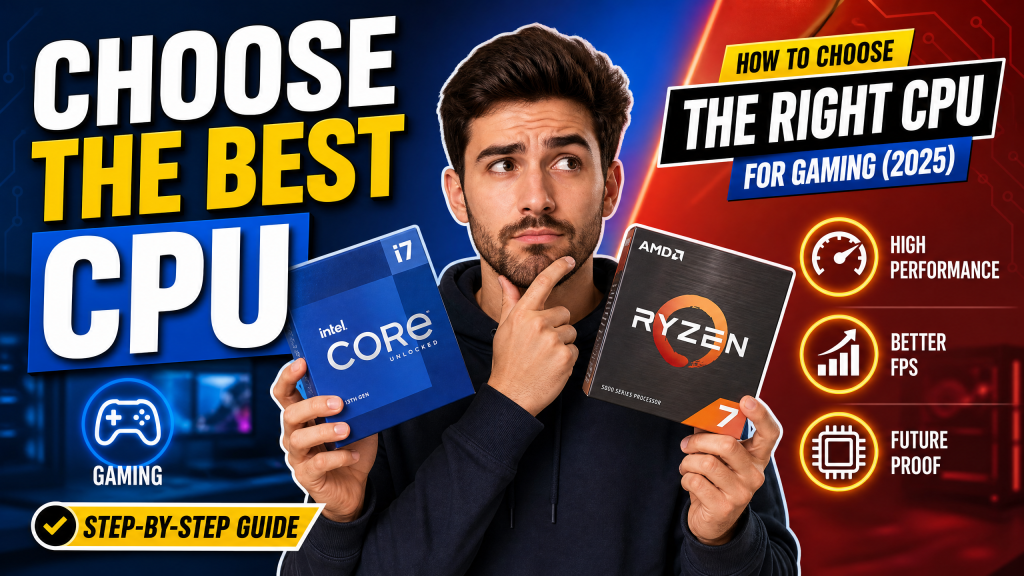
How to Choose the Right CPUs for Gaming: The Complete 2025 Guide
Jun
How to Choose the Right CPUs for Gaming: The Complete 2025 Guide
Building a gaming PC in 2025 is more exciting than ever. Modern processors from AMD and Intel offer incredible performance, advanced features, and excellent efficiency. However, with so many CPU models available across multiple generations and price ranges, choosing the right processor can quickly become confusing.
Many gamers focus heavily on graphics cards, and for good reason. The GPU is typically the most important component for gaming performance. However, selecting the wrong CPU can create bottlenecks that prevent your graphics card from reaching its full potential. A balanced gaming system requires both a capable processor and a powerful GPU working together.
This complete guide explains everything you need to know about choosing a gaming CPU in 2025, including core counts, clock speeds, cache sizes, platform considerations, budget recommendations, and how to avoid common mistakes.
Why the CPU Matters in Gaming
The Central Processing Unit (CPU) serves as the brain of your gaming PC. While the graphics card renders images and visual effects, the CPU manages many critical tasks behind the scenes.
In modern games, the CPU is responsible for:
- Game logic and mechanics
- Artificial intelligence behavior
- Physics calculations
- NPC interactions
- World simulation
- Network communication
- Background system tasks
- Sending instructions to the GPU
If your CPU cannot process data quickly enough, your graphics card will spend time waiting for instructions. This situation is known as a CPU bottleneck, and it can significantly reduce gaming performance regardless of how powerful your GPU may be.
Understanding CPU Bottlenecks
A bottleneck occurs when one component limits the performance of another. In gaming, the CPU and GPU work together continuously. If either component cannot keep up, overall performance suffers.
CPU bottlenecks are most common in:
- 1080p gaming
- High-refresh-rate gaming
- Competitive esports titles
- Simulation games
- Strategy games
- Open-world games with large NPC populations
For example, if you’re using an RTX 5080 with an older quad-core processor while gaming at 1080p 240Hz, the CPU may prevent the GPU from reaching maximum performance.
At 4K resolution, however, the GPU typically becomes the primary performance limitation. This means CPU choice becomes somewhat less critical for ultra-high-resolution gaming.
Core Count: How Many Cores Do You Really Need?
One of the most common questions gamers ask is how many CPU cores they need. Modern processors range from 4-core budget chips to 24-core enthusiast models, but more cores do not automatically mean better gaming performance.
4-Core CPUs
While some older games can still run adequately on four cores, modern AAA titles increasingly expect at least six cores. Four-core CPUs are generally no longer recommended for new gaming builds in 2025.
6-Core CPUs
Six-core processors remain an excellent choice for budget and mainstream gaming systems. CPUs such as the AMD Ryzen 5 7600 deliver outstanding gaming performance while maintaining affordable pricing.
For most gamers, six cores are sufficient for:
- 1080p gaming
- 1440p gaming
- Esports titles
- Most AAA games
8-Core CPUs
Eight-core processors represent the current sweet spot for gaming enthusiasts. They provide additional headroom for future games while improving multitasking performance.
Benefits include:
- Better streaming performance
- Improved multitasking
- Higher minimum frame rates
- More future-proofing
12+ Core CPUs
Processors with 12, 16, or more cores are typically aimed at content creators, developers, and professional users. While they offer exceptional productivity performance, gaming improvements over high-quality 8-core CPUs are often minimal.
For pure gaming, spending significantly more on additional cores usually delivers diminishing returns.
Clock Speed and Why It Still Matters
Clock speed measures how quickly a CPU executes instructions. In gaming workloads, clock speed remains one of the most important performance indicators.
Most modern gaming CPUs operate between:
- 4.5 GHz
- 5.0 GHz
- 5.5 GHz
- 5.7 GHz
Higher clock speeds generally improve:
- Frame rates
- Frame consistency
- Input responsiveness
- Game simulation performance
This is why CPUs such as the Intel Core Ultra 9 285K and AMD Ryzen 7 9800X3D perform exceptionally well in gaming despite having fewer total cores than some workstation-focused processors.
The Importance of Cache
Cache is ultra-fast memory located directly on the CPU. It stores frequently accessed data, allowing the processor to retrieve information much faster than accessing system RAM.
Gaming performance can benefit enormously from larger cache sizes.
AMD demonstrated this with its revolutionary 3D V-Cache technology. Processors such as the Ryzen 9 9800X3D feature massive L3 cache pools that dramatically improve gaming performance in many titles.
Games that benefit heavily from cache include:
- Microsoft Flight Simulator
- Factorio
- Cities: Skylines 2
- Escape from Tarkov
- Large open-world RPGs
For gamers, cache size often matters more than additional core count.
Best Gaming CPUs by Budget
Budget Tier ($100-$200)
AMD Ryzen 5 7600
- 6 cores / 12 threads
- Excellent gaming performance
- AM5 platform support
- Strong upgrade path
The Ryzen 5 7600 offers incredible value and remains one of the best budget gaming processors available.
Intel Core i5-14600K
- Strong gaming performance
- Excellent multitasking
- Competitive pricing
Intel’s offering remains highly competitive, though its platform longevity is less attractive than AMD’s AM5 ecosystem.
Mid-Range Tier ($200-$350)
AMD Ryzen 7 9700X
- 8 Zen 5 cores
- Excellent efficiency
- Outstanding gaming performance
- AM5 future-proofing
The Ryzen 7 9700X is arguably the best-balanced gaming CPU available today.
Intel Core i7-14700K
- Excellent gaming results
- Strong productivity performance
- High thread count
Gamers who also stream, edit videos, or multitask heavily may appreciate the additional threads.
High-End Tier ($350+)
AMD Ryzen 9 9800X3D
For pure gaming, this is arguably the best processor available. The massive 3D V-Cache provides exceptional frame rates and frame-time consistency.
AMD Ryzen 9 9950X
Ideal for users who need both gaming performance and professional workstation capabilities.
Intel Core Ultra 9 285K
Outstanding single-core performance and excellent gaming results make this Intel’s strongest gaming-focused processor.
AMD vs Intel in 2025
The AMD versus Intel debate remains highly competitive.
Choose AMD If:
- You value platform longevity
- You want AM5 upgrade support
- You prioritize gaming efficiency
- You are interested in 3D V-Cache CPUs
Choose Intel If:
- You prioritize high clock speeds
- You want strong mixed productivity performance
- You prefer Intel’s ecosystem
- You find better pricing locally
For most gamers today, AMD holds a slight advantage due to the longevity and flexibility of the AM5 platform.
Don’t Overspend on Your CPU
One of the biggest mistakes gamers make is allocating too much of their budget to the processor while neglecting the graphics card.
For example:
- Ryzen 5 7600 + RTX 5070 Ti often outperforms
- Ryzen 9 9950X + RTX 4060 in gaming scenarios
Gaming performance is typically more dependent on GPU power than CPU power. Once you’ve reached a capable six or eight-core processor, additional spending often produces minimal gaming gains.
Final Recommendation
For most gamers in 2025, the ideal CPU falls between six and eight cores with strong single-thread performance and a modern platform. The AMD Ryzen 5 7600 remains the best value choice, while the Ryzen 7 9700X represents the sweet spot for enthusiasts seeking maximum gaming performance without overspending.
If gaming is your primary goal, focus on achieving a balanced build. Pair a capable CPU with the strongest GPU your budget allows, invest in fast DDR5 memory, and choose a platform with future upgrade potential. By doing so, you’ll create a gaming system that delivers outstanding performance today while remaining relevant for years to come.
