
Post
Ray Tracing Explained: Everything You Need to Know About Real-Time RT Graphics GPU
Jun
Ray Tracing Explained: Everything You Need to Know About Real-Time RT Graphics
Over the last decade, gaming graphics have advanced at an incredible pace. Higher resolutions, faster refresh rates, realistic textures, and AI-powered upscaling technologies have transformed how games look and perform. Yet among all modern graphics innovations, few technologies have generated as much excitement as ray tracing.
Ray tracing has been marketed as the future of gaming graphics, promising movie-quality lighting, realistic reflections, and physically accurate shadows. NVIDIA introduced hardware-accelerated ray tracing with its RTX 20-series GPUs in 2018, AMD followed with RDNA 2, and Intel later joined the race with Arc graphics cards. Today, ray tracing support is available across all major GPU manufacturers and gaming platforms, including the PlayStation 5 and Xbox Series X.
But despite its popularity, many gamers still wonder: What exactly is ray tracing? How does it work? Why does it impact performance so heavily? And is it actually worth enabling in your favorite games?
This comprehensive guide explores everything you need to know about real-time ray tracing and how it is shaping the future of gaming graphics.
What Is Ray Tracing?
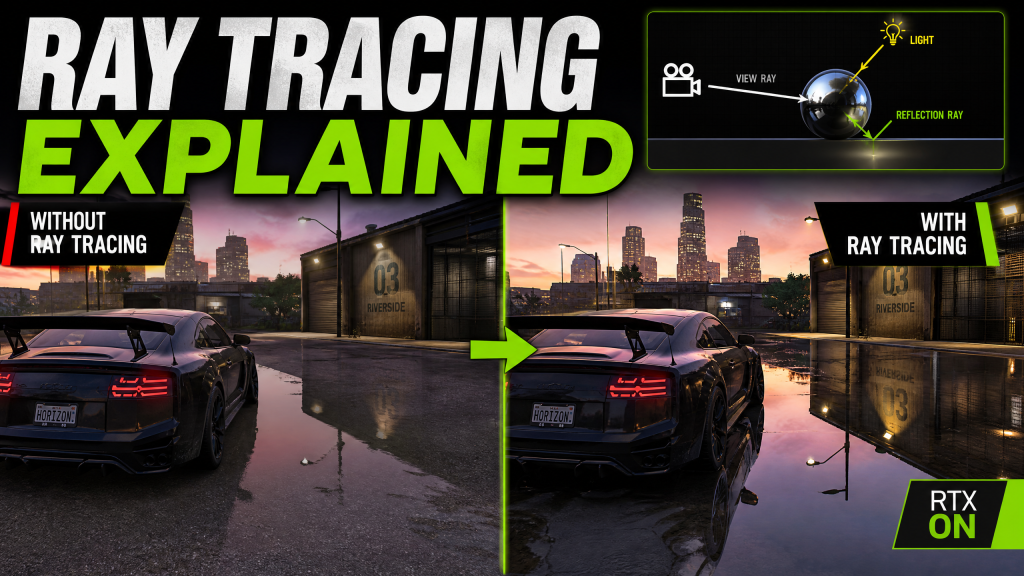
Ray tracing is a rendering technique that simulates how light behaves in the real world. Instead of relying on approximations and shortcuts, ray tracing calculates the paths that light rays travel as they interact with objects in a scene.
In reality, light bounces, reflects, refracts, and scatters countless times before reaching your eyes. Traditional rendering methods simplify these calculations to maintain performance. Ray tracing attempts to replicate these interactions much more accurately.
The result is significantly more realistic:
- Reflections accurately show objects outside the camera view.
- Shadows become softer and more natural.
- Lighting reacts dynamically to environmental changes.
- Global illumination creates realistic light bounce effects.
- Transparent materials behave more naturally.
The technology has existed for decades in film production, architecture visualization, and CGI animation. Movies from Pixar, Disney, and Marvel have relied on ray tracing for years. The challenge was always computational cost.
Until recently, rendering a single ray-traced frame could take minutes or even hours. Modern GPUs finally provide enough processing power to make ray tracing possible in real-time gaming.
Rasterization vs Ray Tracing
To understand ray tracing, it’s important to understand the technology it aims to improve: rasterization.
How Rasterization Works
Rasterization converts 3D models into 2D pixels displayed on your monitor. It is extremely fast and has been the foundation of gaming graphics for decades.
Modern rasterized games use numerous tricks to simulate realistic lighting:
- Screen Space Reflections (SSR)
- Shadow Maps
- Ambient Occlusion
- Light Probes
- Baked Lighting
- Cubemaps
These techniques work surprisingly well, but they have limitations.
For example, screen-space reflections can only reflect objects currently visible on the screen. If an object is behind the camera, it cannot appear in the reflection. This creates visual artifacts and unrealistic behavior.
Ray tracing eliminates many of these limitations by calculating actual light paths instead of relying on approximations.
How Ray Tracing Works
At its core, ray tracing follows the journey of light.
When rendering a scene:
- A ray is projected from the camera into the scene.
- The ray intersects with an object.
- The GPU calculates material properties.
- Additional rays determine reflections, shadows, or refractions.
- The final color is computed and displayed.
This process repeats millions or even billions of times every second.
Consider a shiny metal surface:
- A ray strikes the surface.
- The GPU calculates reflection direction.
- A secondary ray determines what object is reflected.
- The reflected color contributes to the final image.
This creates reflections that accurately represent the environment rather than approximations.
Why Ray Tracing Is So Demanding
The primary challenge of ray tracing is computational complexity.
A modern game rendered at 4K resolution contains:
- 8.3 million pixels per frame
- 60 to 144 frames per second
- Multiple rays per pixel
- Multiple bounces per ray
The math involved becomes enormous.
Without dedicated hardware acceleration, even the fastest GPUs would struggle to maintain playable frame rates.
This is why hardware ray tracing support became such a major milestone in GPU development.
Dedicated Ray Tracing Hardware
Modern GPUs include specialized hardware designed specifically for ray tracing calculations.
NVIDIA RT Cores
NVIDIA introduced RT Cores with the RTX 20-series.
RT Cores accelerate:
- Bounding Volume Hierarchy (BVH) traversal
- Ray-triangle intersection testing
- Ray tracing workload management
Each generation has significantly improved performance.
AMD Ray Accelerators
AMD introduced hardware ray tracing with RDNA 2.
Ray Accelerators perform similar functions but historically trail NVIDIA in ray tracing efficiency.
RDNA 4 significantly closes this gap.
Intel Ray Tracing Units
Intel Arc GPUs feature dedicated ray tracing units that provide surprisingly competitive ray tracing performance in modern games.
While Intel’s ecosystem is newer, ray tracing support continues to improve rapidly.
Types of Ray-Traced Effects
Most games do not fully replace rasterization with ray tracing. Instead, developers selectively apply ray tracing where it has the biggest visual impact.
Ray-Traced Reflections
One of the most noticeable improvements.
Unlike screen-space reflections, ray-traced reflections:
- Display off-screen objects
- Handle complex surfaces
- Produce accurate mirror reflections
- Improve immersion significantly
Games like Cyberpunk 2077 showcase this effect beautifully.
Ray-Traced Shadows
Traditional shadow maps often create:
- Aliasing artifacts
- Flickering shadows
- Hard shadow edges
Ray-traced shadows produce softer, more realistic results based on actual light source size and distance.
Ray-Traced Ambient Occlusion
Ambient occlusion simulates how light is blocked in corners and crevices.
Ray-traced ambient occlusion provides more realistic depth and contact shadows compared to traditional SSAO methods.
Global Illumination
Global illumination is arguably the most transformative ray tracing effect.
It calculates how light bounces around environments, creating:
- Color bleeding
- Natural indirect lighting
- Realistic interiors
- Dynamic lighting changes
Games such as Metro Exodus Enhanced Edition demonstrate the power of real-time global illumination.
Path Tracing
Path tracing represents the most advanced implementation of ray tracing.
Instead of ray tracing individual effects, path tracing simulates nearly all lighting interactions physically.
Examples include:
- Cyberpunk 2077 Overdrive Mode
- Alan Wake 2
- Minecraft RTX
- Portal RTX
Path tracing delivers visuals approaching CGI film quality but remains extremely demanding.
Performance Impact
Ray tracing can dramatically reduce frame rates depending on implementation.
| Effect | Performance Impact |
|---|---|
| Reflections | 10-25% |
| Shadows | 10-20% |
| Global Illumination | 20-40% |
| Path Tracing | 40-70%+ |
This is why upscaling technologies have become essential companions to ray tracing.
DLSS, FSR, and XeSS: The Perfect Partners
AI upscaling technologies help recover performance lost to ray tracing.
DLSS
NVIDIA’s Deep Learning Super Sampling uses AI to reconstruct higher-resolution images from lower-resolution renders.
FSR
AMD FidelityFX Super Resolution works across nearly all GPUs and significantly boosts frame rates.
XeSS
Intel’s Xe Super Sampling combines AI reconstruction with broad compatibility.
These technologies often provide:
- 30-100% performance gains
- Minimal image quality loss
- Improved ray tracing viability
Ray Tracing Evolution by GPU Generation
RTX 20 Series
- First-generation RT hardware
- Limited practical performance
- Best suited for selective RT effects
RTX 30 Series / RX 6000
- Much stronger ray tracing capability
- 1440p ray tracing becomes practical
- DLSS adoption expands rapidly
RTX 40 Series / RX 7000
- 4K ray tracing becomes realistic
- Frame Generation introduced
- Major RT efficiency improvements
RTX 50 Series / RX 9000
- Path tracing becomes playable
- Advanced AI reconstruction
- Best RT performance to date
Is Ray Tracing Worth It?
The answer depends on your hardware and priorities.
Ray tracing offers undeniable visual improvements:
- More realistic reflections
- Better shadows
- Enhanced immersion
- Superior lighting quality
However, it comes at a performance cost.
If you own a modern GPU such as:
- RTX 4070 or higher
- RTX 5070 or higher
- RX 7800 XT or higher
- RX 9900 XTX
- Intel Arc B580 and above
Ray tracing paired with DLSS, FSR, or XeSS generally provides an excellent balance of image quality and performance.
For older GPUs, selective ray tracing settings may be the smarter choice.
The Future of Gaming Graphics
Ray tracing is no longer an experimental feature. It is rapidly becoming a standard component of modern game development. As GPU performance improves and AI upscaling technologies mature, more developers are building games around ray-traced lighting from the start.
The long-term trajectory is clear: gaming graphics are moving toward fully path-traced environments that simulate light in ways previously reserved for Hollywood films and professional rendering software.
While rasterization will remain important for years to come, ray tracing represents the next major evolution in visual realism.
Final Thoughts
Ray tracing fundamentally changes how games are rendered by replacing visual shortcuts with physically accurate lighting calculations. The result is more immersive worlds, realistic reflections, natural shadows, and cinematic lighting effects that dramatically enhance visual quality.
Although ray tracing remains demanding, modern GPUs combined with AI-powered upscaling technologies have made it practical for everyday gaming. Whether you’re exploring Night City in Cyberpunk 2077, surviving the darkness in Alan Wake 2, or racing through beautifully lit environments in modern racing games, ray tracing is helping define the future of interactive graphics.
As hardware continues to evolve, ray tracing will become less of a premium feature and more of a standard expectation—much like programmable shaders, anti-aliasing, and high-definition textures before it.
