Post
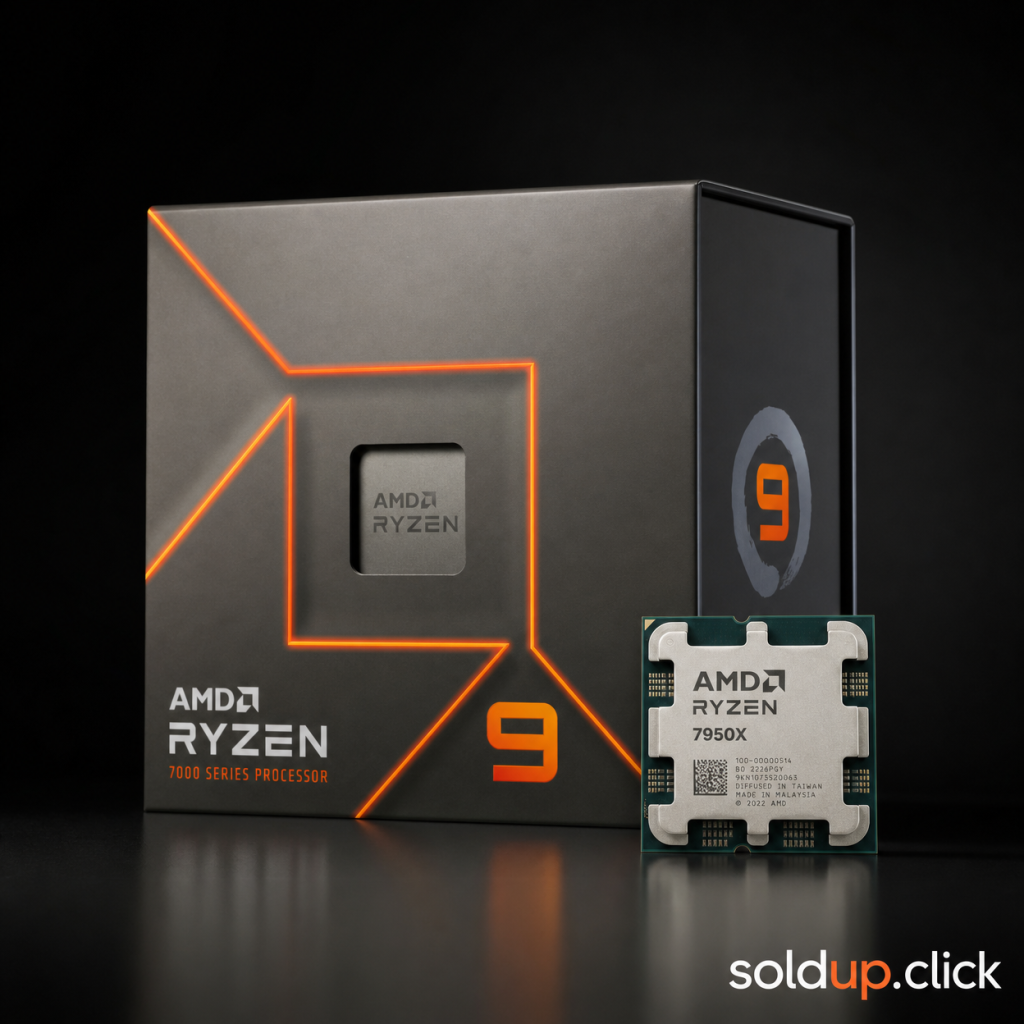
AMD Ryzen 9 7950X Processor
May
Introduction
The AMD Ryzen 9 7950X represents the absolute peak of AMD’s consumer desktop processor lineup, showcasing the full capabilities of the Zen 4 architecture. Designed for professionals, enthusiasts, and power users, this processor is built for workloads that demand sustained, high-level multi-threaded performance. It is not just a gaming CPU or a general-purpose chip—it is a workstation-class processor adapted for the consumer desktop market.
From 3D rendering and high-resolution video production to scientific simulations and large-scale software compilation, the Ryzen 9 7950X is engineered to handle workloads that push conventional processors to their limits. It delivers workstation-level performance while still fitting into a mainstream desktop platform, making it one of the most powerful CPUs ever released for consumer use.
While gaming performance is strong, the true identity of the 7950X lies in its ability to fully utilize all 16 cores and 32 threads simultaneously. This makes it particularly attractive to creators and professionals who rely on CPU-heavy applications where time savings directly translate into productivity gains.
Key Specifications and Technical Overview
The AMD Ryzen 9 7950X features 16 cores and 32 threads, built using AMD’s advanced Zen 4 architecture. It is manufactured on TSMC’s 5nm process node, marking a significant efficiency and performance improvement over the previous Zen 3 generation, which used a combination of 7nm and 6nm processes.
The processor operates with a base clock of 4.5 GHz and can boost up to an impressive 5.7 GHz on select cores. This combination of high core count and high frequency makes it one of the most versatile CPUs in AMD’s lineup, capable of handling both lightly threaded and heavily parallel workloads efficiently.
The chip includes 64MB of L3 cache and 16MB of L2 cache, which significantly improves data access speeds and reduces latency in demanding workloads such as rendering, simulation, and content creation. Large cache sizes are especially beneficial in professional applications where frequent data retrieval is required.
One of the defining features of the Ryzen 7000 series is its exclusive use of the AM5 socket. Unlike previous AMD platforms, AM5 supports only DDR5 memory and introduces PCIe 5.0 connectivity. This positions the 7950X as a forward-looking platform designed for long-term upgradeability and next-generation hardware compatibility.
The processor has a rated TDP of 170W, but real-world power consumption can exceed 230W under sustained heavy workloads, especially when Precision Boost Overdrive (PBO) is enabled. This places it firmly in the high-performance desktop category, requiring robust cooling and power delivery systems.
Performance Analysis
The Ryzen 9 7950X delivers exceptional multi-threaded performance, placing it among the fastest consumer CPUs available today. In benchmarks such as Cinebench R23, it consistently achieves multi-core scores exceeding 38,000 points, which places it in direct competition with Intel’s highest-end desktop processors.
In heavily threaded workloads, the 7950X excels. Applications such as Blender, V-Ray, and Cinema 4D benefit significantly from its 16-core architecture, allowing complex scenes and renders to complete in substantially shorter timeframes compared to previous-generation CPUs.
Video production workflows also benefit greatly from the processor’s raw compute power. In applications like Adobe Premiere Pro, DaVinci Resolve, and After Effects, users experience faster rendering times, smoother playback of high-resolution timelines, and improved multitasking when handling multiple effects or layers.
In software development environments, the Ryzen 9 7950X significantly reduces compile times for large projects. Game engines such as Unreal Engine and Unity, as well as large-scale C++ or Java codebases, compile much faster due to the processor’s ability to distribute workloads efficiently across all 32 threads.
In single-threaded performance, Zen 4 delivers a notable IPC (instructions per cycle) improvement of roughly 13–15% over Zen 3. This allows the 7950X to perform strongly in lightly threaded applications and gaming scenarios. However, in gaming specifically, Intel’s i9-13900K often holds a slight edge in certain CPU-bound titles due to higher boost behavior and scheduling advantages.
That said, in real-world gaming at higher resolutions such as 1440p and 4K, the difference becomes minimal, as GPU limitations tend to dominate performance.
Architecture and Platform Evolution
Zen 4 represents a major architectural leap for AMD. The transition to a 5nm process allows for higher clock speeds, improved efficiency, and better overall performance density. Combined with architectural improvements in branch prediction, cache access, and execution efficiency, Zen 4 delivers strong gains across both single-threaded and multi-threaded workloads.
The move to the AM5 platform also marks a significant shift. Unlike previous AMD platforms that supported DDR4, AM5 exclusively supports DDR5 memory. While this increases platform cost, it also ensures higher memory bandwidth and better future-proofing.
PCIe 5.0 support further enhances the platform’s longevity, enabling compatibility with next-generation GPUs and ultra-fast NVMe storage devices. AMD has also committed to long-term AM5 socket support, making it a more upgrade-friendly ecosystem compared to some competing platforms.
Thermals, Power Consumption, and Cooling Requirements
The Ryzen 9 7950X is a high-performance processor with correspondingly high thermal output. Under sustained full-load conditions, it can draw over 200–230W of power depending on workload intensity and motherboard configuration.
Unlike previous AMD generations, the 7950X does not include a stock cooler. This reflects its positioning as a premium enthusiast and professional CPU that requires a custom cooling solution.
For optimal performance, a high-end cooling solution is essential. A 280mm or 360mm All-in-One (AIO) liquid cooler is strongly recommended, especially for sustained workloads such as rendering or encoding. High-performance air coolers can handle lighter workloads, but thermal headroom may be limited under full multi-core utilization.
AMD’s Precision Boost 2 and Precision Boost Overdrive technologies dynamically adjust clock speeds based on temperature, power, and workload conditions. This allows the processor to maximize performance while staying within safe operating limits, but it also means that cooling quality directly affects real-world performance.
Value for Money and Platform Cost
At launch, the Ryzen 9 7950X was priced around $699, placing it firmly in the high-end enthusiast and workstation segment. While expensive, its value becomes clearer when compared to professional workstation CPUs, which often cost significantly more while offering similar or lower performance.
In direct comparison with Intel’s i9-13900K, the Ryzen 9 7950X generally excels in heavily multi-threaded workloads but trails slightly in gaming performance. However, the difference in gaming is often small enough that it does not significantly impact real-world user experience for most users.
One of the biggest considerations when evaluating value is platform cost. The AM5 platform requires DDR5 memory and a compatible motherboard, which increases the initial investment. However, AMD’s commitment to long-term socket support helps offset this cost over time by enabling future CPU upgrades without changing the motherboard.
For professionals, the productivity gains often outweigh the initial platform cost, especially in time-sensitive workflows where rendering or encoding speed directly impacts output efficiency.
Pros and Cons
The AMD Ryzen 9 7950X offers outstanding multi-threaded performance, excellent IPC improvements, strong single-core performance, and a forward-looking AM5 platform with DDR5 and PCIe 5.0 support. It is one of the most capable consumer CPUs available for professional workloads.
However, it also has drawbacks. The CPU is expensive, requires a high-end cooling solution, and consumes significant power under load. Platform costs are higher due to mandatory DDR5 and AM5 motherboard requirements. In gaming, it is slightly outperformed by some Intel competitors in specific CPU-bound scenarios.
Who Should Buy the Ryzen 9 7950X?
The Ryzen 9 7950X is ideal for professionals who rely on heavy multi-threaded workloads such as 3D artists, video editors, animators, engineers, and scientific researchers. It is also an excellent choice for software developers working with large codebases or complex compilation environments.
It is less suited for pure gaming builds unless the user also performs demanding productivity tasks. For gaming-only systems, more cost-effective CPUs often provide better value.
Conclusion
The AMD Ryzen 9 7950X stands as one of the most powerful consumer desktop processors ever created, showcasing the full strength of AMD’s Zen 4 architecture. It delivers exceptional multi-threaded performance, strong single-core speed, and a modern, forward-looking platform built around DDR5 and PCIe 5.0.
While it comes with high cost, power consumption, and cooling requirements, its productivity performance is unmatched in its class. For users whose workloads demand maximum CPU throughput, the Ryzen 9 7950X is not just a strong option—it is one of the best investments in high-performance computing available today.
