
Post
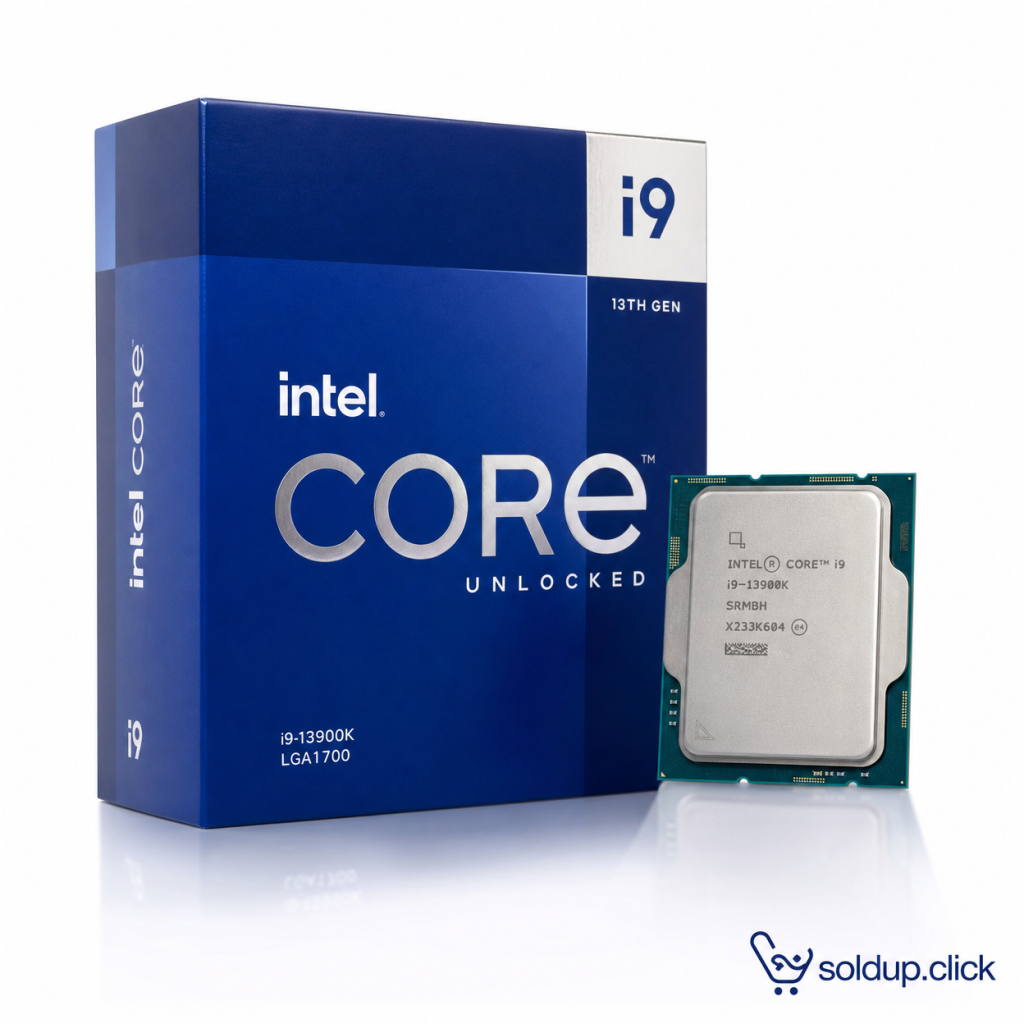
Intel Core i9-13900K Desktop Processor
May
Introduction
The Intel Core i9-13900K is Intel’s flagship desktop processor from the 13th Generation Raptor Lake lineup, and it immediately stands out as one of the most powerful consumer CPUs ever released. Introduced in late 2022, this processor represents the peak of Intel’s mainstream desktop engineering at the time, combining raw clock speed, a hybrid core architecture, and aggressive power scaling to deliver exceptional performance across gaming and productivity workloads.
Built as an evolution of the hybrid architecture first introduced with Alder Lake, the i9-13900K refines the balance between Performance cores (P-cores) and Efficiency cores (E-cores). This design allows it to intelligently distribute workloads depending on complexity, making it highly versatile in modern computing environments. For gamers, content creators, software developers, and power users who demand top-tier performance without compromise, the i9-13900K sits firmly at the top of Intel’s consumer product stack.
However, with extreme performance often comes extreme requirements—high power consumption, advanced cooling needs, and a premium platform cost. This raises an important question: does the performance justify the investment? To answer that, we need to examine its specifications, real-world performance, design considerations, and overall value proposition in detail.
Key Specifications and Technical Overview
The Core i9-13900K is built around a hybrid core configuration consisting of 24 total cores: 8 Performance cores and 16 Efficiency cores, delivering a total of 32 threads. This architecture is one of the defining features of Intel’s 13th generation processors and plays a crucial role in optimizing workload distribution.
The P-cores are responsible for handling demanding tasks such as gaming, rendering, and single-threaded applications. They operate at a base frequency of 3.0 GHz and can boost up to an impressive 5.8 GHz, making the i9-13900K one of the highest-clocked consumer CPUs available. Meanwhile, the E-cores focus on background tasks and multi-threaded workloads, running at lower power but still achieving boost speeds of up to 4.3 GHz. This dual-core strategy allows the CPU to maintain responsiveness while maximizing efficiency.
Cache design is another strength of this processor. The i9-13900K includes 36MB of L3 cache and 32MB of L2 cache, significantly reducing latency and improving performance in cache-sensitive applications such as gaming engines and real-time simulations.
Manufactured using Intel 7 process technology (an optimized 10nm-class node), the processor operates with a base power rating of 125W. However, under turbo or unlocked conditions, power consumption can easily exceed 250W, especially when power limits are removed on enthusiast motherboards. This makes thermal management a critical consideration for system builders.
The CPU uses the LGA1700 socket, ensuring compatibility with Intel 600- and 700-series motherboards, including Z690 and Z790 chipsets. This backward compatibility provides some upgrade flexibility for users already invested in the platform.
Performance Analysis
When it comes to raw performance, the Intel Core i9-13900K is nothing short of exceptional. In synthetic benchmarks such as Cinebench R23, it consistently scores above 40,000 points in multi-core tests, placing it among the fastest consumer CPUs ever tested. This level of performance allows it to compete directly with AMD’s Ryzen 9 7950X in heavily threaded workloads, often trading blows depending on the application.
In real-world productivity tasks, the processor excels in video editing, 3D rendering, and software compilation. Applications like Adobe Premiere Pro, After Effects, and DaVinci Resolve benefit significantly from its high core count and fast single-core boost speeds. Exporting 4K or even 8K video timelines is noticeably faster compared to previous-generation CPUs, reducing workflow bottlenecks for content creators.
For developers, the i9-13900K significantly reduces compile times for large codebases, particularly in environments like Unreal Engine or complex C++ projects. This makes it an attractive choice for professionals who value time efficiency.
Gaming performance is arguably where the i9-13900K shines the most. When paired with a high-end GPU such as the RTX 4090, it consistently delivers industry-leading frame rates. In CPU-bound scenarios, including competitive esports titles and high-refresh-rate gaming at 1080p or 1440p, the processor often leads the charts. Games like Cyberpunk 2077, Elden Ring, and Call of Duty benefit from its high boost clocks and strong single-thread performance, resulting in smoother frame pacing and higher minimum FPS values.
Thermals, Power Consumption, and Design Considerations
While performance is outstanding, it comes at a cost: heat and power consumption. The i9-13900K is known for running hot under full load, especially when power limits are removed for maximum performance. Under heavy workloads, it can easily reach temperatures that require advanced cooling solutions.
For this reason, enthusiast-grade cooling is strongly recommended. A 360mm AIO liquid cooler is often considered the minimum requirement for sustained high performance. High-end air coolers like the Noctua NH-D15 can also manage the chip, but thermal headroom may be limited under extreme workloads.
Intel has improved thermal efficiency by using a soldered integrated heat spreader (IHS), which enhances heat transfer between the silicon die and the cooler. This helps mitigate some of the thermal challenges, but it does not eliminate them entirely due to the chip’s high power density.
The physical design remains compatible with the LGA1700 socket, which is beneficial for users upgrading from 12th-generation systems. However, motherboard quality plays a significant role in performance stability, as high-end Z-series boards are better equipped to handle the CPU’s power demands.
Value for Money and Platform Cost
At launch, the Intel Core i9-13900K was priced at approximately $589, positioning it directly against AMD’s Ryzen 9 7900X and Ryzen 9 7950X. On paper, the pricing appears competitive, but the total system cost is significantly higher than the CPU alone suggests.
To fully unlock its potential, users typically need a Z690 or Z790 motherboard, high-quality DDR5 memory (or fast DDR4 in some configurations), and a robust cooling solution. These additional requirements increase the overall platform cost considerably.
In gaming scenarios, the i9-13900K often leads or ties with AMD’s offerings, making it an excellent choice for enthusiasts prioritizing frame rates. However, in heavily multi-threaded professional workloads, the Ryzen 9 7950X may offer slightly better efficiency and performance-per-watt, depending on the application.
Ultimately, the i9-13900K delivers strong value for users who prioritize top-tier performance over efficiency or budget constraints.
Pros and Cons
The Intel Core i9-13900K offers several key advantages. It delivers outstanding gaming performance, exceptional single-core speeds, and strong multi-threaded capabilities. Its compatibility with existing LGA1700 motherboards also makes it an attractive upgrade option for Intel users. Additionally, its hybrid architecture ensures efficient workload distribution across different types of tasks.
However, there are drawbacks. The processor consumes a significant amount of power under load, requiring advanced cooling solutions. It can also be expensive to build a complete system around it due to platform requirements. In addition, thermal output can be challenging for smaller or poorly ventilated cases.
Who Should Buy the i9-13900K?
The Intel Core i9-13900K is best suited for enthusiasts who want the absolute best gaming performance available on the desktop market. It is also ideal for streamers who need to game and encode simultaneously without performance drops. Content creators working with video editing, motion graphics, or rendering will benefit from its strong hybrid architecture.
It is particularly appealing for users already on the LGA1700 platform who want a powerful upgrade without changing motherboards. However, for professionals whose workloads are heavily multi-threaded—such as 3D rendering farms, scientific simulations, or large-scale production pipelines—alternative CPUs like AMD’s Ryzen 9 7950X may provide better efficiency and value.
Conclusion
The Intel Core i9-13900K stands as one of the most powerful desktop processors Intel has ever produced. It combines extreme gaming performance, excellent single-core speed, and strong multi-threaded capabilities into a single package. While it demands serious cooling and consumes significant power, its raw performance makes it a top choice for enthusiasts who refuse to compromise.
In the end, the i9-13900K is not just a processor—it is a statement of performance dominance. For users who are willing to invest in the necessary supporting hardware, it delivers one of the fastest and most capable computing experiences available on the desktop market today.
