Post
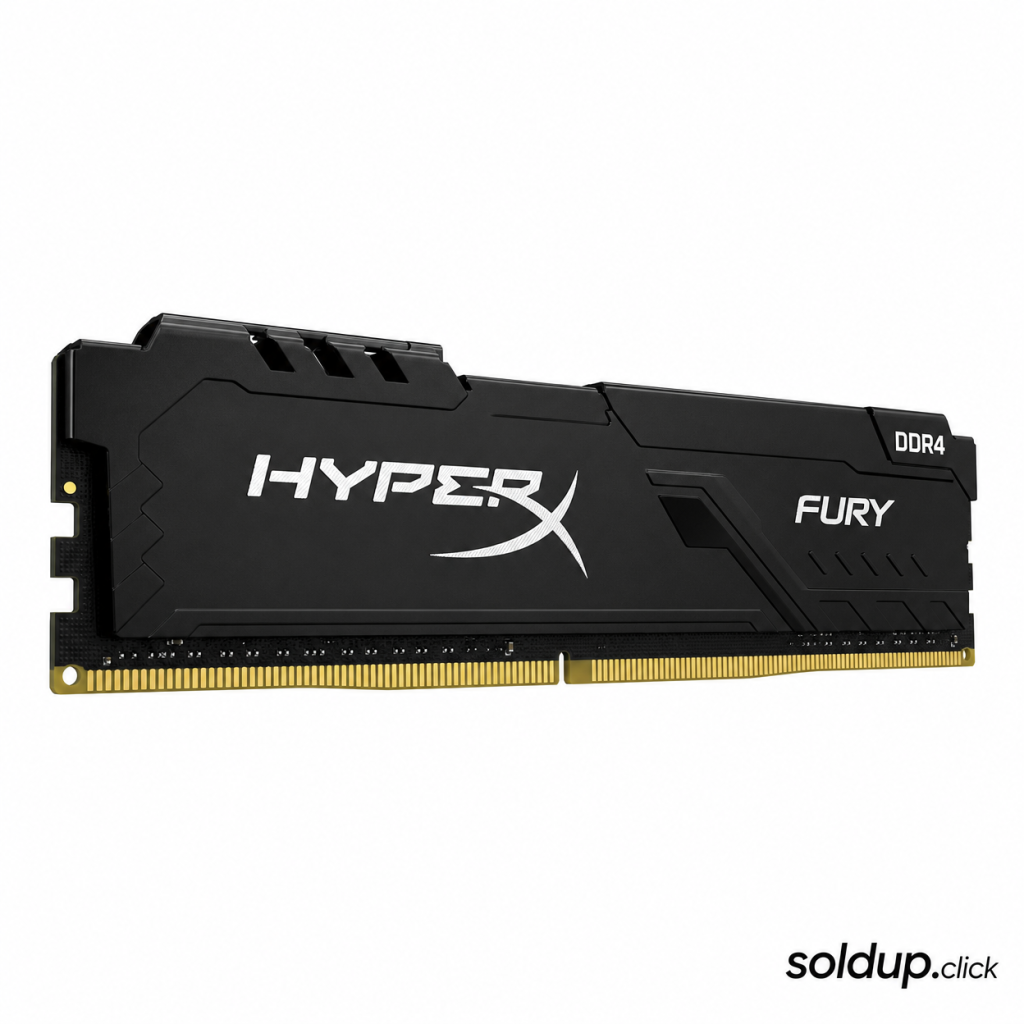
Kingston HyperX Fury DDR4 8GB (1x8GB) 3200MHz
May
Introduction
The Kingston HyperX Fury DDR4—now marketed under the Kingston Fury brand—is a widely used 8GB 3200MHz memory module designed for entry-level and budget-conscious PC builds. It is most commonly found in office systems, low-cost gaming PCs, and incremental upgrade scenarios where users add memory one stick at a time instead of purchasing a full dual-channel kit upfront. While it is not designed for enthusiasts or high-end workloads, it has remained extremely popular due to its strong balance of affordability, reliability, and compatibility across a wide range of platforms.
In today’s PC market, where DDR5 is gradually becoming the standard, DDR4 memory like the Kingston Fury 8GB 3200MHz still plays an important role. Millions of systems worldwide continue to rely on DDR4 platforms, especially Intel 8th to 13th Gen DDR4 configurations and AMD Ryzen AM4 systems. This makes budget-friendly modules like this one highly relevant, particularly in regions or builds where cost efficiency is more important than cutting-edge performance.
Key Specifications and Technical Overview
The Kingston Fury DDR4 8GB module operates at 3200MHz with CL16 latency timings (typically 16-18-18-38) at 1.35V. These specifications place it firmly in the mainstream DDR4 performance category, where 3200MHz is considered a baseline standard for modern gaming systems.
The module supports Intel XMP 2.0, allowing users to activate its rated speed with a single BIOS setting. It also works at standard JEDEC frequencies such as 2133MHz or 2666MHz by default, ensuring compatibility with older or budget-oriented motherboards that may not support memory overclocking.
Physically, the module uses Kingston’s signature low-profile heat spreader design. It is available in multiple color options, including black, red, and white, which helps it blend into different build aesthetics without requiring RGB lighting. This simple design choice is intentional, prioritizing function, compatibility, and cost reduction over visual customization.
Because it is a single 8GB DIMM, it operates in single-channel mode unless paired with another identical module. This is an important distinction, as memory configuration has a significant impact on real-world performance.
Performance Analysis
At its rated speed of DDR4-3200 CL16, the Kingston Fury module delivers solid baseline performance for everyday computing tasks. These include web browsing, office productivity, streaming, and light multitasking. In such workloads, memory bandwidth is rarely a bottleneck, so performance feels smooth and responsive.
In gaming scenarios, however, configuration matters significantly. When used as a single stick (single-channel mode), memory bandwidth is effectively halved compared to a dual-channel setup. This can lead to reduced performance in CPU-limited games, particularly open-world titles, strategy games, and simulation-heavy workloads. In some cases, frame rate drops and inconsistent frame pacing can be noticeable, especially when paired with integrated graphics or lower-end GPUs.
However, when a second identical 8GB module is added to form a 16GB dual-channel configuration, performance improves substantially. Dual-channel mode doubles memory bandwidth, which directly benefits gaming performance, multitasking, and system responsiveness. In this configuration, DDR4-3200 CL16 is still considered a well-balanced sweet spot for both Intel and AMD platforms.
For AMD Ryzen systems, DDR4-3200 is slightly below the ideal 3600MHz “sweet spot,” but the difference in real-world gaming is typically small. On Intel systems, especially 10th to 13th Gen DDR4 platforms, 3200MHz CL16 remains a widely accepted standard that offers excellent stability and performance without requiring expensive tuning.
Design and Build Quality
The Kingston Fury DDR4 module emphasizes simplicity and reliability over aesthetics. Its heat spreader is made of aluminum and serves a functional purpose: improving thermal dissipation and protecting the memory chips. Unlike RGB-focused modules, it avoids additional power draw and complexity.
One of its strongest design advantages is its low-profile height. This makes it compatible with large air coolers such as dual-tower heatsinks, where taller RGB RAM modules may cause clearance issues. This is especially important in compact or tightly packed builds where space is limited.
Kingston is known for strict manufacturing standards, and this module benefits from that reputation. It uses high-quality DRAM ICs and undergoes thorough testing before leaving the factory. As a result, failure rates are extremely low, and long-term stability is one of its key strengths.
The module is also backed by a lifetime warranty, which reinforces its position as a dependable long-term component rather than a disposable budget part.
Value for Money and Market Position
The Kingston Fury DDR4 8GB 3200MHz is positioned as an entry-level memory solution, and its value proposition reflects that. It is typically one of the cheapest ways to add DDR4 memory to a system while still maintaining acceptable performance standards.
However, its true value depends heavily on how it is used. As a single module, it is inexpensive but limited in performance due to single-channel operation. As part of a dual-channel configuration, its value improves significantly, making it a cost-effective way to reach 16GB of system memory.
Compared to competing brands like Corsair Vengeance LPX or Crucial Basic DDR4 modules, Kingston’s offering is generally similar in performance and price. The main differences come down to availability, branding preference, and aesthetic design rather than raw speed.
In the broader market context, DDR4 pricing has dropped significantly as DDR5 adoption increases. This makes DDR4 3200MHz kits and modules extremely attractive for budget builds, especially in developing markets or refurbished system upgrades.
Pros and Cons
Pros:
- Very affordable entry point into DDR4 memory
- Reliable Kingston build quality and strict testing standards
- Wide compatibility across Intel and AMD platforms
- Low-profile design suitable for large CPU coolers
- XMP support for easy performance activation
- Lifetime warranty and strong brand support
Cons:
- Single 8GB module limits performance in single-channel mode
- Only 8GB capacity is insufficient for modern AAA gaming alone
- Requires second module for optimal dual-channel performance
- Not future-proof compared to DDR5 systems
- Limited aesthetic features (no RGB or premium design elements)
Who Should Buy This?
The Kingston Fury DDR4 8GB 3200MHz module is best suited for specific user groups rather than general high-performance builds:
- Budget PC builders assembling entry-level systems
- Users upgrading older desktops one stick at a time
- Office PCs and productivity systems with light workloads
- Gamers planning a gradual upgrade to 16GB dual-channel RAM
- System integrators building cost-efficient prebuilt machines
It is not recommended as a standalone solution for modern gaming systems unless paired with another identical module in the near future.
Real-World Usage Scenarios
In real-world usage, this module performs differently depending on system configuration:
- Single-module setup: Adequate for basic computing, but limited in gaming performance and multitasking
- Dual-module setup (recommended): Smooth gaming performance, stable multitasking, and improved minimum frame rates
- Mixed workloads: Handles productivity tasks well, but may struggle with heavy multitasking or large applications when only 8GB is installed
For modern AAA gaming, 16GB dual-channel is widely considered the minimum standard, making this module more of a stepping stone than a final solution.
Conclusion
The Kingston HyperX Fury DDR4 8GB 3200MHz remains one of the most practical and widely used entry-level memory modules in the DDR4 ecosystem. While it is limited by its single-channel configuration and relatively small capacity, it compensates with strong reliability, broad compatibility, and excellent affordability.
For users building on a tight budget or upgrading gradually, it serves as a dependable foundation. When paired correctly into a dual-channel configuration, it transforms into a capable mainstream memory solution suitable for gaming, productivity, and everyday computing. In a market increasingly shifting toward DDR5, this module continues to represent the value-focused side of PC building where cost efficiency still matters as much as raw performance.
