Post
Patriot Viper Steel DDR4 16GB (2x8GB) 4400MHz
May
Introduction
The Patriot Viper Steel DDR4 4400MHz kit is a high-performance memory solution designed specifically for enthusiasts who want to push the limits of DDR4 technology. While DDR5 has already become the mainstream standard for new platforms, high-frequency DDR4 kits like this one continue to serve a niche but important segment of the PC hardware market—users who prioritize tuning potential, bandwidth experimentation, and competitive benchmarking.
Unlike mainstream DDR4 kits that focus on balanced performance and cost efficiency, the Viper Steel 4400MHz kit is built with one goal in mind: maximum memory frequency within the DDR4 standard. This makes it particularly appealing to overclockers, hardware enthusiasts, and performance-focused builders who enjoy extracting every bit of performance from their systems.
Its design philosophy is also notably different from many modern RGB-heavy memory kits. Instead of focusing on aesthetics, Patriot emphasizes functional simplicity, thermal stability, and frequency capability. As a result, the Viper Steel series has become a popular choice among users who value raw performance over visual flair.
Even in today’s DDR5-dominated market, DDR4-4400 remains relevant in specific use cases, especially where mature platform stability and fine-tuned latency optimization matter more than new-generation bandwidth advantages.
Key Specifications and Technical Overview
The Patriot Viper Steel DDR4 kit consists of two 8GB modules, totaling 16GB of dual-channel memory. It operates at an aggressive 4400MHz frequency with CL19 timings (19-19-19-39) at a relatively high voltage of 1.45V.
One of the defining characteristics of high-frequency DDR4 kits is the trade-off between speed and latency. While 4400MHz provides significantly higher theoretical bandwidth than standard DDR4 kits, the looser timings—especially CL19—mean that actual latency improvements are more limited than raw frequency numbers might suggest.
The kit supports Intel XMP 2.0 profiles, allowing users to enable its rated speed easily through BIOS without manual tuning. However, achieving stable operation at 4400MHz is highly dependent on motherboard quality and CPU memory controller capability. Not all systems, even within supported platforms, will be able to run this frequency at full stability without tuning.
From a platform compatibility standpoint, this kit is primarily targeted at Intel systems, particularly 10th through 13th generation processors on high-end Z-series motherboards. AMD Ryzen systems, especially AM4 platforms, may struggle to achieve stable operation at 4400MHz due to Infinity Fabric limitations, making this kit less universally compatible compared to 3200–3600MHz alternatives.
Performance Analysis
The primary advantage of the Patriot Viper Steel 4400MHz kit lies in its raw memory bandwidth. At this frequency, DDR4 reaches the upper practical limits of its architecture, delivering significantly higher throughput compared to mainstream kits operating at 3200MHz or 3600MHz.
In memory bandwidth benchmarks, the performance uplift is clearly visible. Applications that rely heavily on large data transfers—such as video encoding, 3D rendering, scientific simulations, and large-scale data processing—can benefit from the increased throughput. In synthetic benchmarks like AIDA64 memory tests, 4400MHz kits typically show noticeably higher read and write speeds compared to lower-frequency DDR4 configurations.
However, real-world gaming performance tells a more nuanced story. While there is a measurable improvement over 3200MHz and even 3600MHz kits in some CPU-bound scenarios, the difference is often modest. Many modern games are more sensitive to latency than raw bandwidth, meaning that tighter-timing kits such as 3600MHz CL16 often compete closely with or even outperform higher-frequency CL19 kits in actual gameplay scenarios.
This highlights one of the key characteristics of high-frequency DDR4 memory: it is not always the most efficient choice for gaming, but it excels in specialized workloads and benchmarking environments.
In professional workloads, the advantages become more situational. Memory-intensive applications that can utilize high bandwidth benefit the most, while latency-sensitive tasks may see smaller gains or even negligible differences compared to well-optimized mid-frequency kits.
Design and Build Quality
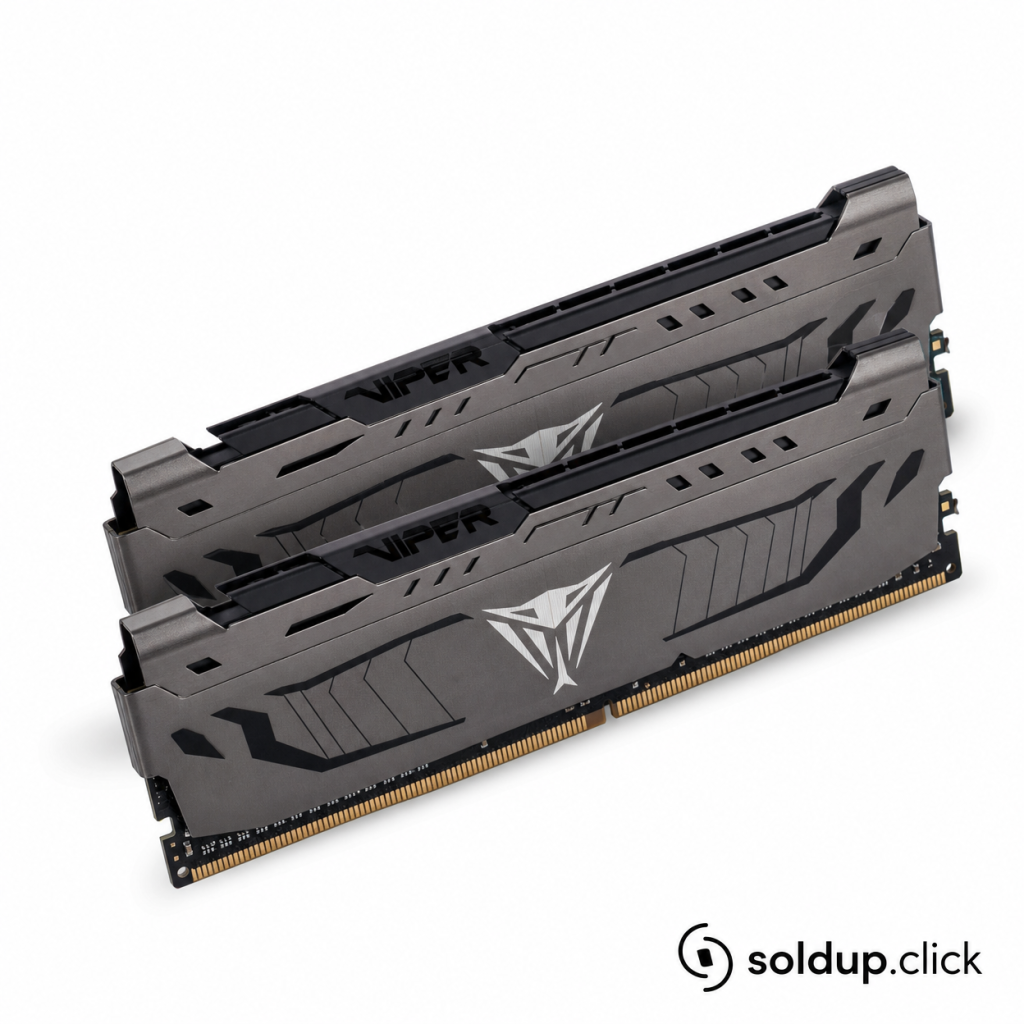
The Patriot Viper Steel series is designed with a focus on durability and thermal efficiency rather than visual complexity. The modules feature a brushed aluminum heat spreader that gives them a clean, industrial appearance. This design not only enhances heat dissipation but also reinforces the product’s performance-oriented identity.
Unlike many modern memory kits that rely heavily on RGB lighting for appeal, the Viper Steel 4400MHz kit deliberately avoids RGB altogether. This makes it especially attractive for users who prefer minimalistic builds or who prioritize airflow and compatibility over aesthetics.
The heat spreader design is relatively low-profile compared to RGB-heavy alternatives, though still tall enough that users should consider clearance when pairing with large air coolers. Build quality is consistent with Patriot’s reputation in the performance memory segment, offering solid PCB construction and reliable IC selection suited for high-frequency operation.
Thermal stability is particularly important at 4400MHz, where increased voltage and signal integrity demands can generate more heat than standard DDR4 configurations. The steel heat spreader helps maintain stable operating temperatures, especially during sustained workloads or stress testing.
Value for Money and Price Comparison
High-frequency DDR4 kits like the Patriot Viper Steel 4400MHz occupy a niche price segment. They are significantly more expensive than mainstream 3200MHz or 3600MHz kits, yet they do not always deliver proportional real-world performance gains.
Compared to DDR4-3600 CL16 kits, the 4400MHz kit offers higher bandwidth but looser latency, meaning the performance difference depends heavily on workload type. In gaming scenarios, the improvement is often minimal, while in synthetic benchmarks or bandwidth-heavy applications, the advantage becomes more noticeable.
When compared to DDR5 entry-level kits, the value proposition becomes even more situational. DDR5 offers higher future scalability and platform longevity, but early DDR5 kits often suffer from higher latency and cost inefficiencies. In contrast, high-end DDR4 kits like this one benefit from mature platform stability and optimized tuning potential.
Ultimately, the value of the Viper Steel 4400MHz kit depends heavily on user intent. For enthusiasts chasing benchmark records or maximizing DDR4 performance ceilings, it is a justified premium purchase. For mainstream users or gamers, however, lower-frequency kits with tighter timings often provide better overall value.
Pros and Cons
The Patriot Viper Steel DDR4 4400MHz kit offers several clear advantages:
- Extremely high DDR4 frequency for maximum bandwidth
- Strong performance in memory bandwidth-intensive workloads
- Solid and durable steel heat spreader design
- Clean, minimalist aesthetic without RGB distractions
- XMP 2.0 support for easy configuration
- Suitable for enthusiast overclocking and benchmarking
However, it also comes with notable limitations:
- High CL19 latency reduces real-world efficiency gains
- Limited gaming performance improvement over 3600MHz CL16 kits
- Requires strong CPU memory controller and high-end motherboard for stability
- Higher voltage (1.45V) increases thermal and tuning demands
- Less suitable for AMD Ryzen platforms due to Infinity Fabric constraints
These trade-offs clearly position it as a niche enthusiast product rather than a mainstream recommendation.
Who Should Buy This?
The Patriot Viper Steel DDR4 4400MHz kit is best suited for:
- Enthusiast overclockers pushing DDR4 limits
- Benchmarkers seeking maximum memory bandwidth scores
- Intel platform users with high-end Z-series motherboards
- Users running memory bandwidth-heavy professional workloads
- Hardware enthusiasts experimenting with fine-tuned system performance
It is not recommended for:
- Budget builders prioritizing cost efficiency
- AMD Ryzen users targeting optimal Infinity Fabric performance
- Gamers who want the best FPS-per-dollar ratio
- Users who prefer plug-and-play stability without tuning
Conclusion
The Patriot Viper Steel DDR4 16GB 4400MHz kit represents the upper boundary of mainstream DDR4 performance. It is a specialized product designed for enthusiasts who want to explore the limits of DDR4 bandwidth rather than maximize everyday gaming efficiency.
While its real-world gaming gains over lower-frequency kits are often modest, its strengths become clear in synthetic benchmarks and memory-intensive workloads where bandwidth matters most. Combined with its solid build quality and minimalist design, it remains a respected option in the enthusiast DDR4 space.
In essence, the Viper Steel 4400MHz is not a general-purpose recommendation—it is a performance tool for users who understand exactly what they are optimizing for, and who want to push DDR4 memory as far as it can possibly go.
