
Post
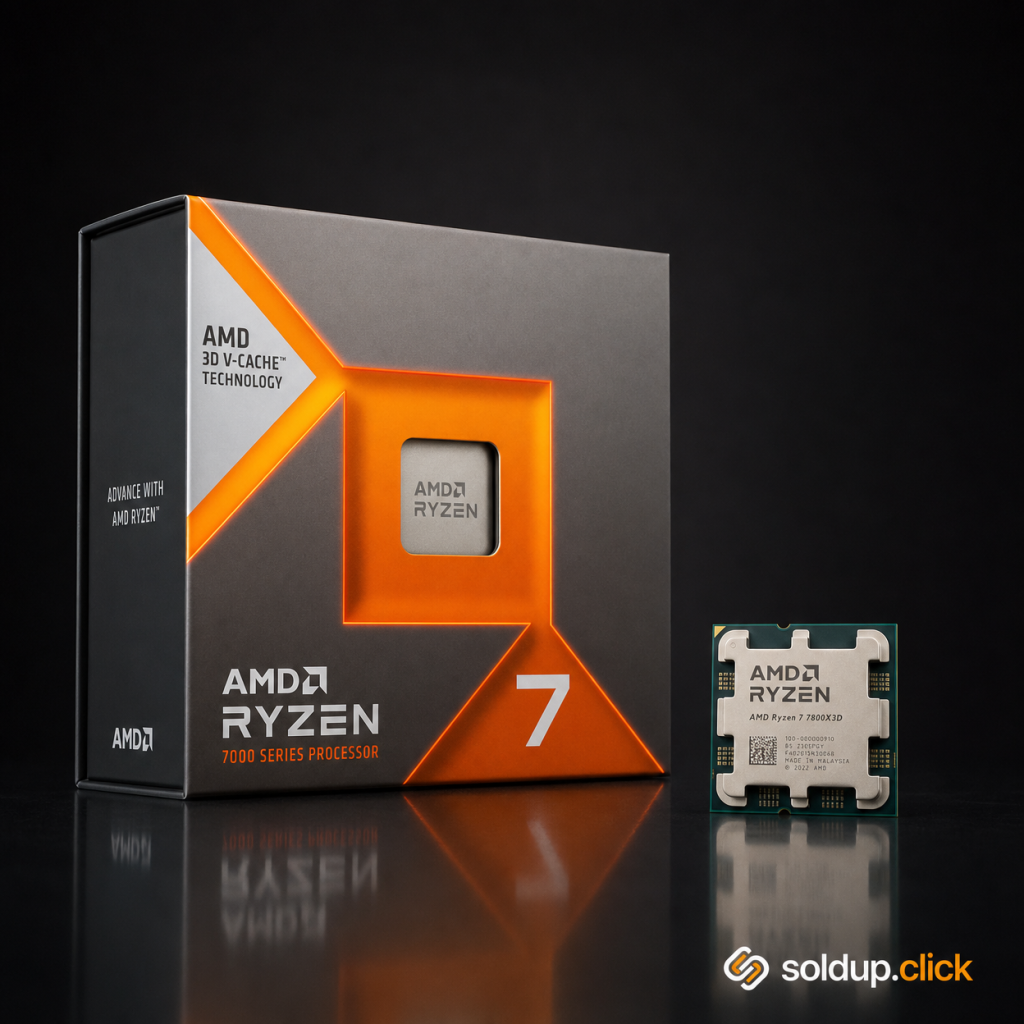
AMD Ryzen 7 7800X3D Processor
May
Introduction
The AMD Ryzen 7 7800X3D is widely regarded as one of the most impressive gaming processors AMD has ever released. Building upon the success of the groundbreaking Ryzen 7 5800X3D, this chip elevates the concept of gaming-focused CPU design by combining AMD’s modern Zen 4 architecture with its innovative 3D V-Cache technology.
Unlike traditional CPUs that rely primarily on higher clock speeds or increased core counts to improve performance, the 7800X3D takes a different approach. It dramatically increases cache capacity, reducing memory latency and improving data availability for gaming workloads. This design philosophy has resulted in a processor that consistently leads gaming benchmarks, often outperforming higher-core-count and more expensive CPUs.
For gamers who prioritize frame rates, frame consistency, and low latency above all else, the Ryzen 7 7800X3D has become the gold standard. It is not just another high-performance CPU—it is a specialized gaming powerhouse designed to maximize real-world gaming experience.
Key Specifications and Technical Overview
The AMD Ryzen 7 7800X3D features 8 cores and 16 threads, built on TSMC’s advanced 5nm manufacturing process. This places it within AMD’s Zen 4 generation, bringing significant improvements in instructions per cycle (IPC), efficiency, and overall performance compared to previous Zen 3 processors.
The CPU operates with a base clock speed of 4.2 GHz and can boost up to 5.0 GHz. While these frequencies may appear modest compared to some high-clocked Intel chips, the real strength of this processor does not come from raw frequency alone—it comes from its cache architecture.
The defining feature of the 7800X3D is AMD’s 3D V-Cache technology. This innovation stacks an additional layer of L3 cache directly on top of the CPU core complex, significantly increasing total cache capacity. As a result, the processor features a massive 96MB of L3 cache, far exceeding traditional desktop CPUs.
This large cache reduces the need for the processor to access slower system memory (RAM), which is especially beneficial in gaming workloads where repeated data access is common. The result is lower latency, fewer cache misses, and smoother frame delivery.
The processor uses the AM5 socket and supports DDR5 memory only. This ensures compatibility with modern high-speed memory standards and future AMD platform upgrades. It also supports PCIe 5.0, allowing for next-generation GPUs and ultra-fast NVMe storage devices.
The chip has a relatively low TDP of 120W compared to other high-end desktop processors. This makes it significantly more power-efficient and thermally manageable than chips like the Ryzen 9 7950X or Intel’s flagship i9 models.
Performance Analysis
The Ryzen 7 7800X3D is, without exaggeration, one of the best gaming CPUs ever created. In gaming benchmarks across a wide range of titles, it consistently ranks at or near the top of performance charts, often outperforming CPUs with more cores and higher power consumption.
The secret to its performance lies in the massive 96MB L3 cache. Many modern games are highly sensitive to memory latency and cache efficiency. By keeping more game data directly on the processor, the 7800X3D significantly reduces the need to fetch data from system memory, which is slower by comparison.
This advantage becomes especially noticeable in CPU-bound scenarios such as:
- Open-world games with large streaming environments
- Real-time strategy games with many simultaneous units
- Simulation games with complex AI behavior
- Competitive esports titles requiring high and stable frame rates
In these scenarios, the 7800X3D can deliver performance improvements of 20% to 40% compared to standard high-end processors, depending on the game engine and workload.
Even in games that are less cache-sensitive, the processor still performs at the top tier, often matching or slightly exceeding Intel’s i9-13900K in gaming performance while using significantly less power.
At higher resolutions such as 1440p and 4K, where GPU limitations become more dominant, the performance differences between CPUs narrow. However, the 7800X3D still provides excellent frame pacing and consistency, which contributes to a smoother overall experience.
It is important to note that while gaming performance is exceptional, multi-threaded productivity performance is not the primary focus of this CPU. In heavily parallel workloads such as rendering or encoding, higher core-count CPUs like the Ryzen 9 7950X or Intel i9 series will outperform it.
Architecture and 3D V-Cache Innovation
The most important innovation in the 7800X3D is AMD’s 3D V-Cache technology. This approach stacks additional cache memory vertically on the processor die rather than expanding it horizontally, which would increase size and power consumption.
This architectural design allows AMD to dramatically increase cache capacity without significantly increasing latency or power draw. In gaming workloads, this is particularly effective because many game engines rely heavily on frequently reused data sets.
Zen 4 itself also contributes to performance gains through improved branch prediction, higher IPC, and more efficient execution pipelines. Combined with 3D V-Cache, the result is a processor that is highly optimized for gaming-specific workloads rather than general-purpose compute scaling.
Thermals, Cooling, and Power Efficiency
One of the standout advantages of the Ryzen 7 7800X3D is its excellent thermal efficiency. With a 120W TDP, it consumes significantly less power than competing high-end processors, especially under gaming workloads.
Unlike higher-core CPUs that can exceed 200W under load, the 7800X3D remains relatively cool and efficient. This makes it easier to cool and allows for quieter system builds.
A high-quality air cooler or a 240mm All-in-One (AIO) liquid cooler is more than sufficient for most users. Even under sustained gaming or productivity workloads, the processor maintains stable temperatures without requiring extreme cooling solutions.
However, due to the stacked 3D V-Cache design, thermal transfer behaves slightly differently compared to traditional CPUs. While this does not negatively affect real-world performance, it does mean that thermal headroom is more limited for overclocking.
In fact, AMD intentionally restricts traditional overclocking on X3D processors to maintain stability and protect the stacked cache structure. Instead, performance tuning is primarily handled through Precision Boost Overdrive (PBO) and curve optimization.
Value for Money and Platform Considerations
At a launch price of approximately $449, the Ryzen 7 7800X3D is positioned as a premium gaming-focused CPU. While not cheap, its performance relative to price is extremely strong when evaluated in gaming workloads.
In many gaming benchmarks, it outperforms more expensive CPUs such as the Intel i9-13900K and even competes with newer generation processors, despite having fewer cores and lower power consumption.
From a platform perspective, the AM5 ecosystem represents a long-term investment. While it requires DDR5 memory and a compatible motherboard, AMD has committed to supporting AM5 for multiple future CPU generations, increasing upgrade potential.
However, the initial platform cost can be higher compared to older DDR4-based systems or Intel’s hybrid compatibility approach. This makes the 7800X3D most appealing for users building a new high-performance gaming system rather than upgrading legacy platforms.
Pros and Cons
The Ryzen 7 7800X3D offers unmatched gaming performance, exceptional cache-driven efficiency, low power consumption, strong thermal behavior, and a modern AM5 platform with upgrade longevity.
However, it does have limitations. Multi-threaded productivity performance is weaker compared to higher-core CPUs like the Ryzen 9 7950X or Intel i9 models. It also lacks traditional overclocking flexibility, and the AM5 platform requires a higher initial investment due to DDR5 and motherboard costs.
Who Should Buy the Ryzen 7 7800X3D?
The Ryzen 7 7800X3D is the ideal CPU for gamers who want the absolute best possible gaming performance without compromise. It is especially well-suited for high-refresh-rate gaming at 1080p and 1440p, where CPU performance has the greatest impact.
It is also an excellent choice for competitive esports players, simulation gamers, and anyone who prioritizes smooth frame delivery and low latency over raw core count.
However, it is less suitable for users whose workloads are heavily focused on rendering, video production, or scientific computing, where higher core-count CPUs deliver better productivity performance.
Conclusion
The AMD Ryzen 7 7800X3D represents a major milestone in CPU design and gaming performance. By combining Zen 4 architecture with groundbreaking 3D V-Cache technology, AMD has created a processor that fundamentally changes what is possible in gaming-focused CPU design.
While it is not the most powerful CPU in terms of raw multi-threaded performance, it is arguably the most effective gaming processor ever released. Its ability to deliver consistently high frame rates, excellent frame stability, and low latency makes it the top choice for serious gamers.
For anyone building a high-performance gaming PC today, the Ryzen 7 7800X3D is not just a strong option—it is the benchmark that all other gaming CPUs are measured against.
