Post
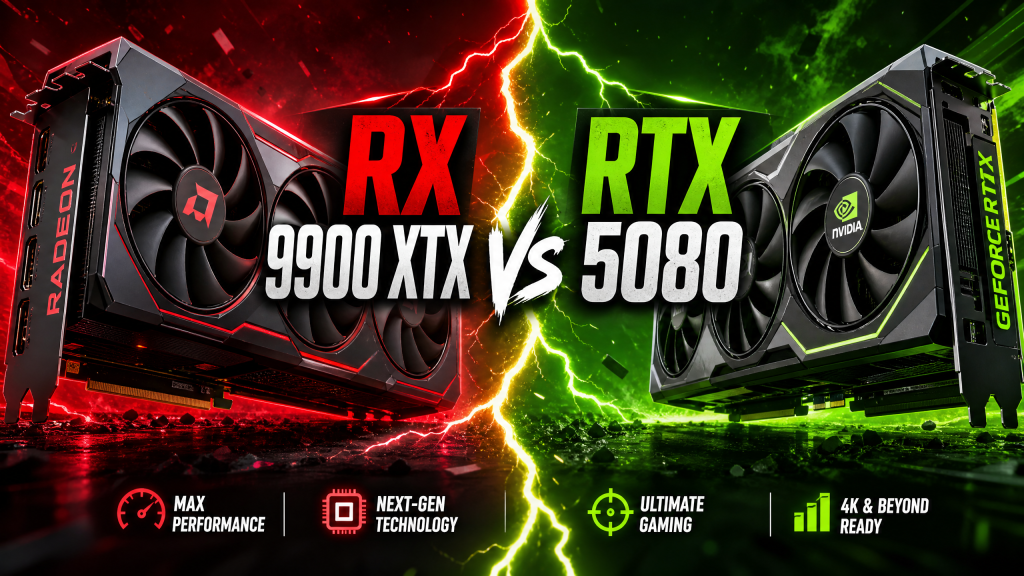
AMD Radeon RX 9900 XTX vs NVIDIA RTX 5080: Which GPU Should You Buy?
Jun
AMD Radeon RX 9900 XTX vs NVIDIA RTX 5080: Which GPU Should You Buy in 2025?
The battle between AMD and NVIDIA has defined the graphics card industry for decades, and in 2025 the competition is more intense than ever. While flagship GPUs such as the RTX 5090 dominate headlines with their extraordinary performance and equally extraordinary price tags, the real fight for enthusiast gamers takes place one tier below. This is where the AMD Radeon RX 9900 XTX and NVIDIA GeForce RTX 5080 compete for attention.
Both graphics cards target gamers who want premium performance without entering ultra-enthusiast territory. They promise exceptional 1440p and 4K gaming experiences, advanced ray tracing capabilities, AI-powered upscaling technologies, and enough raw horsepower to remain relevant for years.
However, while these GPUs target similar buyers, they take dramatically different approaches. AMD focuses on maximizing traditional gaming performance, offering generous VRAM capacity and competitive pricing. NVIDIA emphasizes advanced technologies such as DLSS 4, superior ray tracing performance, AI acceleration, and a mature software ecosystem.
So which card deserves your money? In this comprehensive comparison, we’ll examine every major category to help you make the right decision.
Specifications Comparison
| Specification | AMD RX 9900 XTX | NVIDIA RTX 5080 |
|---|---|---|
| Architecture | RDNA 4 | Blackwell |
| Manufacturing Process | TSMC 4nm | TSMC 4nm |
| VRAM | 24GB GDDR6 | 16GB GDDR7 |
| Memory Bus | 384-bit | 256-bit |
| Upscaling Technology | FSR 4 | DLSS 4 |
| Ray Tracing Hardware | 3rd Gen RT Accelerators | 4th Gen RT Cores |
| AI Hardware | AI Accelerators | Tensor Cores |
| Target Resolution | 1440p / 4K | 1440p / 4K |
At first glance, both cards appear evenly matched. However, their specifications reveal key philosophical differences. AMD prioritizes memory capacity and bandwidth, while NVIDIA focuses on advanced AI hardware and memory efficiency.
Price and Value
For many buyers, pricing is the most important factor when selecting a GPU.
The RX 9900 XTX generally enters the market at a lower MSRP than the RTX 5080. This immediately positions AMD as the value-focused alternative.
Historically, AMD has relied on aggressive pricing strategies to compete with NVIDIA’s stronger brand recognition and software ecosystem. The RX 9900 XTX continues this trend.
However, MSRP rarely tells the full story.
Launch demand, supply shortages, retailer markups, and regional pricing can significantly affect real-world costs. Depending on availability, either card may become the better value option at a given moment.
When both are available at MSRP, AMD generally offers more raw hardware per dollar, particularly when considering its 24GB VRAM configuration.
Architecture Overview
AMD RDNA 4
The RX 9900 XTX is built upon AMD’s RDNA 4 architecture, which introduces major improvements in:
- Rasterization efficiency
- Ray tracing acceleration
- AI processing
- Power optimization
- FSR 4 compatibility
AMD’s primary focus remains gaming performance. The architecture is designed to maximize frame rates while maintaining competitive efficiency.
NVIDIA Blackwell
The RTX 5080 utilizes NVIDIA’s Blackwell architecture, which places significant emphasis on:
- AI acceleration
- Ray tracing performance
- DLSS 4 Multi-Frame Generation
- Content creation workloads
- Machine learning applications
Blackwell represents NVIDIA’s most advanced consumer architecture to date and continues the company’s strategy of combining graphics processing with AI-powered enhancements.
Gaming Performance: Rasterization
Traditional rasterization remains the foundation of gaming performance.
In games that rely primarily on standard rendering techniques, both GPUs perform exceptionally well.
1440p Gaming
At 1440p, both cards deliver excellent performance, frequently exceeding 120 FPS in modern AAA titles.
Games such as:
- Call of Duty
- Forza Horizon 5
- Assassin’s Creed Shadows
- Starfield
- Baldur’s Gate 3
run effortlessly on both GPUs.
In many rasterization-heavy titles, the RX 9900 XTX matches or slightly exceeds the RTX 5080.
AMD’s architecture performs particularly well in games optimized for Vulkan and DirectX 12.
4K Gaming
Moving to 4K places significantly greater stress on both GPUs.
At this resolution, the RTX 5080 generally gains a small advantage.
Reasons include:
- More efficient memory subsystem
- Superior upscaling technologies
- Stronger driver optimizations
- Better support in certain game engines
However, the margin is usually small—often within 5% to 10%.
Most gamers would struggle to notice the difference without benchmark software.
Ray Tracing Performance
Ray tracing remains one of NVIDIA’s strongest advantages.
The RTX 5080’s fourth-generation RT cores deliver significantly better performance in ray-traced workloads.
Games featuring advanced ray tracing include:
- Cyberpunk 2077
- Alan Wake 2
- Metro Exodus Enhanced Edition
- Portal RTX
- Black Myth: Wukong
In these titles, the RTX 5080 often leads by:
- 15% to 40%
depending on the complexity of the ray tracing implementation.
AMD has improved substantially with RDNA 4, but NVIDIA still maintains a noticeable lead.
DLSS 4 vs FSR 4
Upscaling technologies have become essential for modern gaming.
Rather than rendering games at full resolution, these technologies render internally at lower resolutions and reconstruct the image using sophisticated algorithms.
DLSS 4
NVIDIA’s DLSS 4 offers:
- AI-powered upscaling
- Transformer-based image reconstruction
- Frame Generation
- Multi-Frame Generation
- Excellent image quality
DLSS 4 continues to lead the industry in objective image quality testing.
FSR 4
AMD’s FSR 4 has improved dramatically.
Benefits include:
- AI-assisted image reconstruction
- Broad hardware compatibility
- Open ecosystem
- Lower implementation barriers
While DLSS 4 still holds a slight quality advantage, FSR 4 is closer than ever before.
VRAM: AMD’s Biggest Advantage
One of the most significant differences between these cards is memory capacity.
- RX 9900 XTX: 24GB
- RTX 5080: 16GB
Today, 16GB remains sufficient for virtually all games.
However, future titles are likely to demand more VRAM, particularly at:
- 4K resolution
- High-resolution texture packs
- Ray tracing workloads
- AI-enhanced graphics
Content creators also benefit substantially from larger memory pools.
For long-term future-proofing, AMD clearly holds the advantage.
Content Creation and Professional Workloads
While gaming performance is important, many buyers also use their systems for creative work.
Applications such as:
- Adobe Premiere Pro
- DaVinci Resolve
- Blender
- Cinema 4D
- Unreal Engine
often favor NVIDIA hardware.
Reasons include:
- CUDA acceleration
- NVENC encoder support
- Broader software optimization
- AI-assisted creative tools
For professional workflows, the RTX 5080 generally offers superior compatibility and performance.
Power Consumption and Thermals
Power efficiency is increasingly important.
The RTX 5080 generally consumes less power while delivering similar performance levels.
Benefits include:
- Lower electricity costs
- Reduced heat output
- Quieter operation
- Smaller cooling requirements
The RX 9900 XTX remains manageable but typically runs:
- Hotter
- Louder
- Less efficient
under heavy gaming loads.
Software Ecosystem
NVIDIA’s software ecosystem remains one of its strongest selling points.
Exclusive technologies include:
- DLSS 4
- NVENC
- NVIDIA Broadcast
- RTX Video Super Resolution
- CUDA
- RTX Remix
AMD’s Adrenalin software is excellent and continues to improve, but NVIDIA still offers the broader feature set.
Who Should Buy the RX 9900 XTX?
- Value-focused enthusiasts
- 1440p gamers
- Gamers prioritizing rasterization performance
- Buyers wanting 24GB VRAM
- Users concerned about long-term memory requirements
Who Should Buy the RTX 5080?
- Ray tracing enthusiasts
- Content creators
- Streamers
- AI users
- Gamers wanting DLSS 4
- Users seeking the most polished software ecosystem
Final Verdict
The AMD Radeon RX 9900 XTX and NVIDIA RTX 5080 are two of the best high-end graphics cards available in 2025. Neither choice is wrong, and both deliver exceptional gaming experiences at 1440p and 4K.
If your primary goal is maximizing value, securing abundant VRAM, and achieving excellent rasterization performance, the RX 9900 XTX is an outstanding option. Its 24GB memory configuration provides additional future-proofing that may prove valuable over the coming years.
If you prioritize ray tracing, content creation, AI workloads, streaming capabilities, and NVIDIA’s industry-leading software ecosystem, the RTX 5080 remains the superior choice despite its higher price.
Ultimately, the decision comes down to your priorities. AMD offers more hardware for the money, while NVIDIA offers a richer feature set and stronger ray tracing performance. Both cards represent the pinnacle of enthusiast gaming hardware in 2025 and are capable of delivering an exceptional experience for years to come.
