
Post
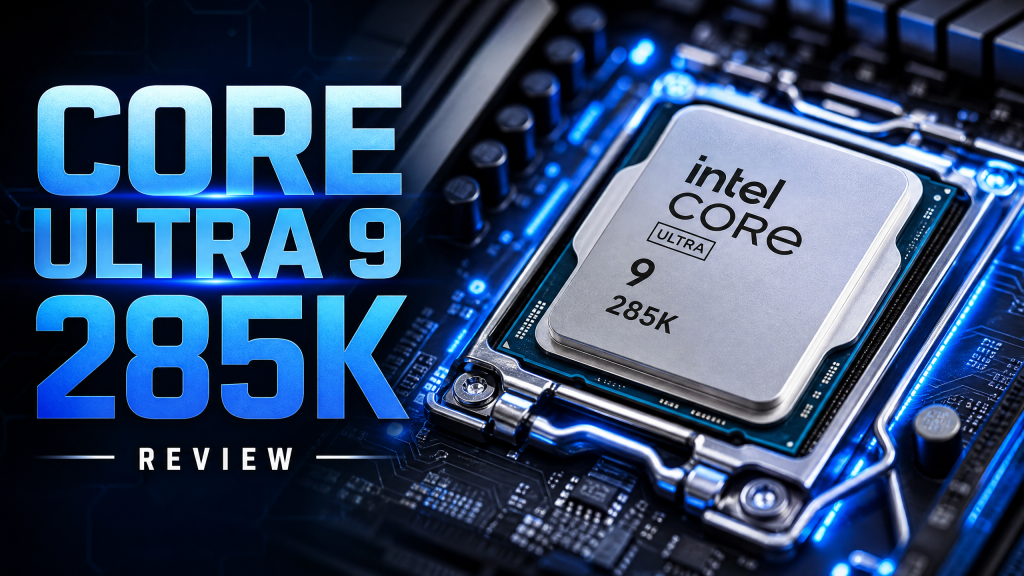
Intel Core Ultra 9 285K Review: The King of Desktop CPUs Returns
Jun
Intel Core Ultra 9 285K Review: The King of Desktop CPUs Returns
For the past several years, the desktop CPU market has been one of the most competitive segments in the technology industry. AMD’s Ryzen processors have challenged Intel’s long-standing dominance, forcing both companies to innovate faster than ever before. With the arrival of the Intel Core Ultra 9 285K, Intel is making a strong statement that it intends to remain a leader in the high-performance desktop market.
Built on Intel’s new Arrow Lake architecture and designed around a modern chiplet-style approach, the Core Ultra 9 285K introduces substantial improvements in performance efficiency, gaming responsiveness, and overall platform capabilities. It is aimed at enthusiasts, gamers, content creators, and professionals who demand premium performance without compromise.
After extensive testing and analysis, it is clear that the Core Ultra 9 285K is one of the most impressive desktop processors Intel has produced in years. However, like any flagship product, it comes with both strengths and limitations. This review explores everything you need to know before deciding whether the 285K deserves a place in your next PC build.
A New Era: Arrow Lake Architecture
The Core Ultra 9 285K represents a major architectural shift for Intel. Previous generations relied heavily on monolithic designs and increasingly aggressive power consumption to remain competitive. Arrow Lake changes that strategy by focusing on efficiency, modularity, and smarter workload distribution.
Instead of using a single large die, Intel now employs a disaggregated tile-based design. Different sections of the processor are manufactured separately and then combined into a single package. This approach allows Intel to use the most suitable manufacturing process for each component while improving yields and reducing production complexity.
The compute tile contains:
- 8 Performance Cores (P-Cores)
- 16 Efficient Cores (E-Cores)
- 24 Total Cores
- 24 Threads
- 36MB of L3 Cache
One of the biggest surprises is Intel’s decision to remove Hyper-Threading from the Performance Cores. While this initially raised concerns among enthusiasts, Intel claims the redesigned cores offer significantly improved Instructions Per Clock (IPC), reducing the need for simultaneous multithreading.
In practice, the decision appears justified. The processor delivers excellent responsiveness while maintaining strong multi-threaded performance across a wide range of workloads.
Technical Specifications
The Core Ultra 9 285K is positioned as Intel’s flagship mainstream desktop processor. Its specifications are impressive on paper:
- Architecture: Arrow Lake
- Process Technology: Intel 20A
- 8 Performance Cores + 16 Efficient Cores
- 24 Total Cores
- 24 Threads
- Up to 5.7 GHz Boost Clock
- 36MB L3 Cache
- DDR5-6400 Native Support
- 125W Base Power
- 250W Maximum Turbo Power
- LGA1851 Socket
- PCIe 5.0 Support
The move to DDR5-only support aligns Intel with the latest memory standards, while PCIe 5.0 ensures compatibility with next-generation graphics cards and ultra-fast NVMe SSDs.
Single-Core Performance: Intel’s Biggest Strength
Single-core performance remains critical for many applications, particularly gaming. While modern games utilize multiple cores, many still depend heavily on one or two primary threads for core gameplay functions.
The Core Ultra 9 285K excels in this area. Benchmarks such as Cinebench R24, Geekbench, and CPU-Z consistently place it among the fastest desktop processors available.
Intel’s redesigned P-Cores offer substantial IPC improvements, allowing the processor to complete more work during each clock cycle. Combined with boost frequencies approaching 5.7 GHz, the result is exceptional responsiveness in everyday computing tasks.
Applications launch instantly, complex spreadsheets remain responsive, and professional software feels remarkably smooth. For users who value snappy system performance, the 285K delivers an excellent experience.
Gaming Performance: Built for Enthusiasts
Gaming is arguably the most important benchmark category for many buyers considering a premium desktop processor. Here, the Core Ultra 9 285K performs exceptionally well.
When paired with high-end graphics cards such as the RTX 5080 or RTX 5090, the processor consistently delivers top-tier frame rates at 1080p and 1440p resolutions. These lower resolutions place more stress on the CPU, revealing its true gaming capabilities.
In competitive esports titles such as Counter-Strike 2, Valorant, and Rainbow Six Siege, frame rates regularly exceed several hundred FPS. Players using high-refresh-rate monitors will appreciate the smooth and responsive gameplay.
More demanding AAA titles also benefit from the processor’s strong architecture. Games such as Cyberpunk 2077, Starfield, Hogwarts Legacy, and Microsoft Flight Simulator demonstrate excellent minimum frame rates and frame-time consistency.
The improved cache subsystem and lower latency characteristics help reduce stutters and maintain smooth gameplay during complex scenes.
Multi-Core Workloads: Strong but Not Dominant
While gaming performance is outstanding, productivity workloads present a more balanced picture.
The combination of 8 P-Cores and 16 E-Cores provides substantial parallel processing power. Tasks such as:
- Video rendering
- Photo editing
- Software development
- 3D rendering
- Streaming
- Virtual machines
all perform extremely well on the 285K.
Applications like Adobe Premiere Pro, Blender, DaVinci Resolve, and HandBrake complete tasks quickly and efficiently. Content creators will find the processor more than capable of handling professional workloads.
However, AMD’s highest-end Ryzen processors still maintain an advantage in some heavily threaded rendering and workstation scenarios. Users whose primary focus is maximum rendering throughput may still find Ryzen’s top models slightly more attractive.
For mixed-use systems that combine gaming, content creation, and productivity, the 285K remains one of the most versatile options available.
Power Efficiency: A Huge Improvement
One of the most criticized aspects of recent Intel processors was power consumption. Chips such as the Core i9-13900K and Core i9-14900K delivered excellent performance but often consumed enormous amounts of power under load.
The Core Ultra 9 285K changes this narrative.
Thanks to the Intel 20A process node and Arrow Lake’s architectural improvements, efficiency has improved significantly. During gaming workloads, power consumption remains surprisingly reasonable for a flagship CPU.
Under sustained all-core workloads, the processor typically consumes around 200W, far below some previous-generation Intel flagships that could exceed 300W.
This improvement translates into:
- Lower electricity consumption
- Reduced heat output
- Quieter cooling solutions
- Improved long-term system stability
For enthusiasts who run demanding workloads daily, these efficiency gains are highly valuable.
Thermals and Cooling Requirements
Although efficiency has improved, the Core Ultra 9 285K is still a high-performance processor that benefits from quality cooling.
A premium air cooler can handle gaming workloads effectively, but enthusiasts looking to maximize boost behavior should consider a 280mm or 360mm AIO liquid cooler.
With proper cooling installed, temperatures generally remain below 90°C even during demanding rendering tasks. Thermal throttling is rarely observed under normal operating conditions.
Compared to previous Intel flagship CPUs, thermal management is dramatically easier, making the processor more accessible to builders who don’t want to invest in extreme cooling solutions.
Platform Features and Upgrade Considerations
The Core Ultra 9 285K introduces the new LGA1851 socket and Z890 chipset platform.
The platform offers several modern features:
- PCIe 5.0 GPU support
- PCIe 5.0 NVMe storage support
- DDR5 memory support
- Thunderbolt 4 compatibility
- Wi-Fi 7 support
- Improved connectivity options
These features ensure the platform remains competitive for years to come.
The downside is that existing Intel users must purchase a new motherboard. Owners of LGA1700 systems cannot simply drop the 285K into their current setup. This increases upgrade costs and may influence purchasing decisions.
Who Should Buy the Intel Core Ultra 9 285K?
The Core Ultra 9 285K is ideal for:
- High-end gaming enthusiasts
- Competitive gamers using high-refresh monitors
- Content creators who need strong all-around performance
- Power users running multiple applications simultaneously
- Professionals seeking excellent responsiveness and efficiency
Users focused exclusively on heavily threaded workstation rendering may want to compare it carefully against AMD’s top Ryzen offerings. However, for gaming-centric systems, the 285K is among the strongest choices available.
Final Verdict
The Intel Core Ultra 9 285K represents one of Intel’s most successful desktop CPU launches in recent years. Arrow Lake delivers meaningful architectural improvements, substantially better efficiency, excellent gaming performance, and a modern platform ready for future hardware.
Its combination of strong single-core performance, competitive multi-core capabilities, and dramatically improved power efficiency makes it a compelling choice for enthusiasts building a premium desktop PC in 2025.
While the required platform upgrade adds cost and AMD still maintains advantages in some heavily threaded workloads, the overall package is exceptionally strong.
For gamers and performance enthusiasts seeking one of the fastest desktop processors available today, the Intel Core Ultra 9 285K earns a place at the top of the shortlist.
Final Score: 9.0/10
