
Post
PCIe 5.0 GPUs: Are They Worth It? Everything You Need to Know
Jun
PCIe 5.0 GPUs: Are They Worth It? Everything You Need to Know in 2025
As the PC hardware industry continues to evolve, new technologies often arrive with promises of dramatic performance improvements. One of the latest advancements is PCI Express 5.0 (PCIe 5.0), the newest generation of the interface that connects graphics cards, SSDs, and other expansion devices to your motherboard. GPU manufacturers and motherboard vendors heavily promote PCIe 5.0 support, leading many gamers and PC builders to wonder whether it is truly worth upgrading for.
The simple answer is that PCIe 5.0 is an important technology for the future, but its immediate benefits for gaming graphics cards are far smaller than many people expect. Understanding what PCIe 5.0 actually does, how GPUs utilize PCIe bandwidth, and where the technology offers meaningful advantages can help you make smarter purchasing decisions and avoid spending money on features you may never use.
What Is PCIe 5.0?
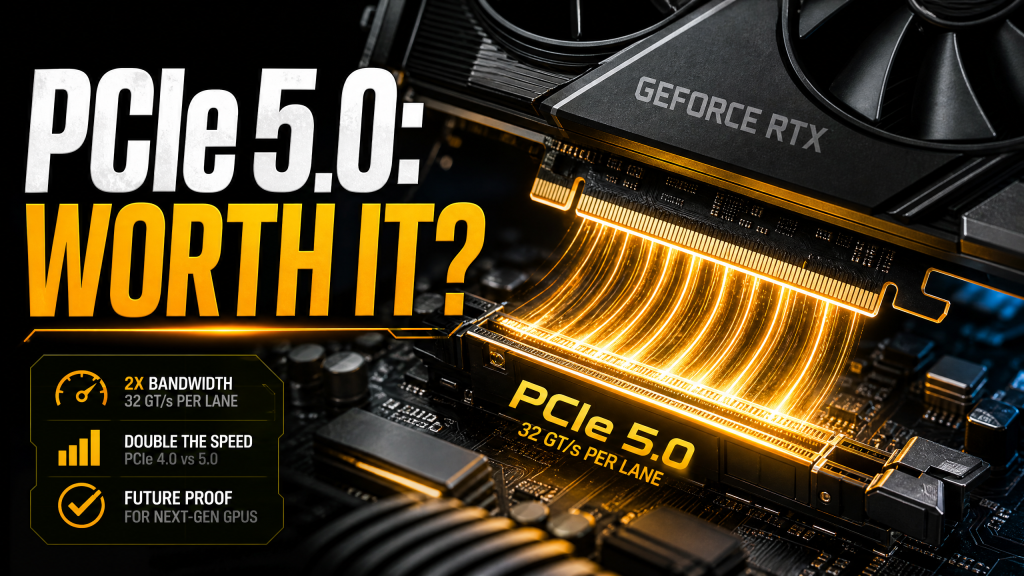
PCI Express, commonly known as PCIe, is the communication interface that connects high-speed devices such as GPUs, SSDs, capture cards, and network adapters to the motherboard. Each new PCIe generation doubles the available bandwidth of the previous generation while maintaining backward compatibility.
Bandwidth per lane has evolved significantly over the years:
- PCIe 3.0: Approximately 1 GB/s per lane
- PCIe 4.0: Approximately 2 GB/s per lane
- PCIe 5.0: Approximately 4 GB/s per lane
A full x16 graphics card slot therefore provides:
- PCIe 3.0 x16 = 16 GB/s
- PCIe 4.0 x16 = 32 GB/s
- PCIe 5.0 x16 = 64 GB/s
On paper, PCIe 5.0 delivers an enormous increase in data transfer capability. Compared to PCIe 4.0, available bandwidth is doubled. Compared to PCIe 3.0, it is quadrupled. These numbers sound impressive, but real-world GPU performance tells a different story.
How Modern GPUs Actually Use PCIe Bandwidth
One of the biggest misconceptions among PC builders is that graphics cards constantly transfer massive amounts of data across the PCIe bus during gameplay. In reality, modern GPUs store most game assets directly in their onboard VRAM.
Once textures, geometry, shaders, and game assets are loaded into VRAM, the GPU performs the majority of rendering operations independently. The PCIe interface is primarily used for:
- Loading assets into VRAM
- Communication between CPU and GPU
- Streaming new game data
- System memory transfers
- Specialized compute workloads
Because of this design, even today’s fastest graphics cards rarely come close to saturating PCIe 4.0 bandwidth during normal gaming sessions.
Gaming Performance: PCIe 4.0 vs PCIe 5.0
Extensive testing across dozens of games reveals a surprising truth: there is almost no measurable difference between PCIe 4.0 and PCIe 5.0 for gaming.
Even flagship GPUs such as:
- NVIDIA RTX 5090
- NVIDIA RTX 5080
- AMD Radeon RX 9900 XTX
- AMD Radeon RX 9800 XT
show nearly identical gaming performance when operating on PCIe 4.0 compared to PCIe 5.0.
In many benchmark suites, the difference is often less than 1%. In some cases, the margin falls entirely within normal testing variation. This means a gamer would never notice any real-world difference between the two standards.
For example:
| Game | PCIe 4.0 FPS | PCIe 5.0 FPS |
|---|---|---|
| Cyberpunk 2077 | 142 FPS | 143 FPS |
| Starfield | 118 FPS | 119 FPS |
| Alan Wake 2 | 97 FPS | 98 FPS |
| Call of Duty | 201 FPS | 202 FPS |
These tiny differences are effectively meaningless during actual gameplay.
What About PCIe 3.0?
An even more interesting observation is how little performance many GPUs lose when running on older PCIe standards.
Many reviewers have tested modern GPUs on PCIe 3.0 x16, PCIe 4.0 x16, and PCIe 5.0 x16. Results consistently show:
- PCIe 3.0 x16 vs PCIe 4.0 x16 = typically 1-5% difference
- PCIe 4.0 x16 vs PCIe 5.0 x16 = typically 0-1% difference
This demonstrates that even PCIe 3.0 remains surprisingly capable for modern gaming workloads. While PCIe 5.0 provides vastly more bandwidth, current gaming applications simply do not require it.
Where PCIe 5.0 Actually Matters
While PCIe 5.0 offers little benefit for gaming GPUs today, there are scenarios where the additional bandwidth becomes useful.
1. AI and Machine Learning
Large AI models often require frequent transfers between system memory and GPU memory. Researchers working with machine learning, neural networks, and large language models can benefit from higher PCIe bandwidth.
Professional AI workloads frequently involve moving hundreds of gigabytes of data, making PCIe throughput much more important than it is for gaming.
2. Professional Content Creation
Video editors working with:
- 8K footage
- RAW camera formats
- Large visual effects projects
- Virtual production workflows
may see modest improvements from faster data transfers when handling enormous project files.
3. Scientific Computing
Researchers using GPUs for simulation, modeling, and high-performance computing often move large datasets between CPUs and GPUs. PCIe 5.0 can reduce transfer bottlenecks in these environments.
The Real PCIe 5.0 Winner: NVMe SSDs
Ironically, PCIe 5.0 has a much greater impact on storage than on graphics cards.
Modern PCIe 5.0 SSDs can achieve:
- 12 GB/s to 14 GB/s read speeds
- 11 GB/s to 13 GB/s write speeds
Compared to PCIe 4.0 SSDs:
- 6 GB/s to 7 GB/s read speeds
- 5 GB/s to 7 GB/s write speeds
For professionals transferring massive files, PCIe 5.0 storage can significantly reduce waiting times.
However, even here, everyday users often notice little difference in general computing tasks such as:
- Web browsing
- Office work
- Gaming load times
- General productivity
Future-Proofing: Is PCIe 5.0 Worth It Long-Term?
This is where PCIe 5.0 becomes more compelling.
Game engines continue to evolve. Technologies such as:
- DirectStorage
- Real-time asset streaming
- Massive open worlds
- AI-driven content generation
- Ultra-high-resolution textures
will increase bandwidth requirements over time.
Today’s GPUs may not benefit significantly from PCIe 5.0, but future generations likely will. If you plan to keep your motherboard for five years or more, PCIe 5.0 support provides valuable longevity.
PCIe Lane Configurations Explained
Another factor that confuses builders is lane count.
Not every GPU runs at x16 bandwidth.
Some systems may operate at:
- x16
- x8
- x4
Interestingly, PCIe 5.0 x8 provides roughly the same bandwidth as PCIe 4.0 x16. This means future motherboards can reduce lane allocation while maintaining performance.
For current gaming workloads, PCIe 5.0 x8 generally performs identically to PCIe 4.0 x16.
Platform Support
To utilize PCIe 5.0, you need compatible hardware.
AMD Platforms
- Ryzen 7000 Series
- Ryzen 8000 Series
- Ryzen 9000 Series
- AM5 Motherboards (B650E, X670E, X870E)
Intel Platforms
- 12th Generation Intel Core
- 13th Generation Intel Core
- 14th Generation Intel Core
- Core Ultra 200 Series (Arrow Lake)
- Z790, Z890, and newer chipsets
Most premium modern motherboards already include PCIe 5.0 support, making it relatively easy to future-proof a new build.
Should You Upgrade for PCIe 5.0?
If your only goal is higher gaming frame rates, upgrading solely for PCIe 5.0 is not recommended. You would see far greater benefits by investing that money in:
- A faster GPU
- A better CPU
- More RAM
- A higher-refresh-rate monitor
However, if you are building a completely new PC in 2025, choosing a motherboard with PCIe 5.0 support makes sense because the price difference is often minimal and it provides better long-term compatibility.
Final Verdict
PCIe 5.0 is an impressive technological advancement, but it is currently far more important for future-proofing than for immediate gaming performance. Modern GPUs simply do not utilize enough bandwidth to take full advantage of PCIe 5.0, making PCIe 4.0 more than sufficient for today’s gaming workloads.
If you’re building a new system, PCIe 5.0 support is a nice bonus that prepares your PC for future hardware generations. If you’re considering upgrading an existing system purely for PCIe 5.0 GPU support, save your money. Invest in a better graphics card, more VRAM, or a faster processor instead—those upgrades will have a much larger impact on your gaming experience.
For 2025, PCIe 5.0 is best viewed as a future-ready feature rather than a must-have performance upgrade. The technology’s true value will likely emerge over the next several GPU generations, not the current one.
