Post
AMD vs Intel in 2025: Which CPU Brand is Right for You?
Jun
AMD vs Intel in 2025: Which CPU Brand is Right for You?
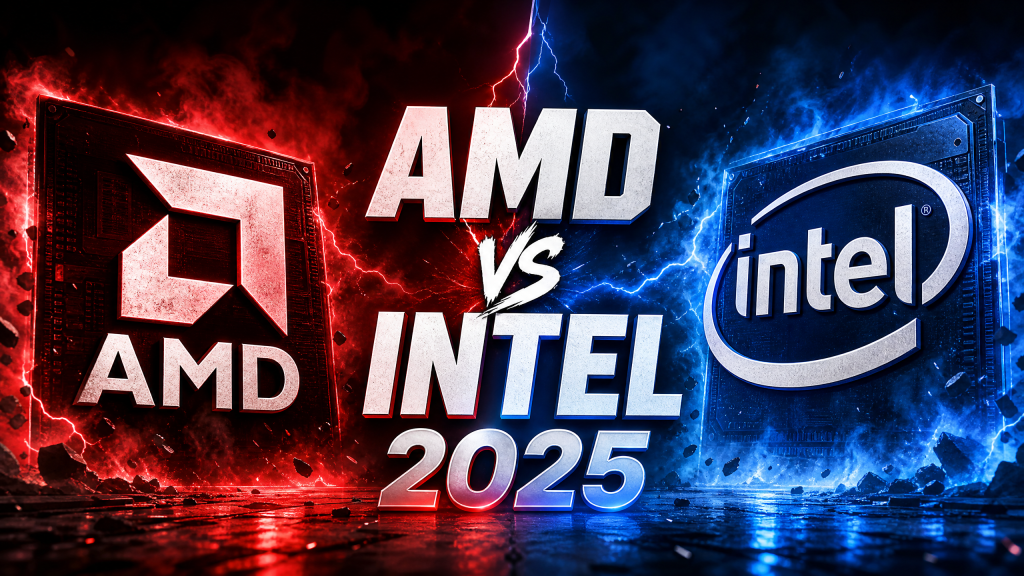
The AMD vs Intel rivalry is one of the most enduring debates in PC building. Both companies produce excellent processors, and the right choice genuinely depends on your specific use case, budget, and priorities. This comprehensive comparison will help you make an informed decision based on what actually matters for your workloads.
The Current State of Competition
For the first time in years, neither AMD nor Intel holds a decisive overall advantage. Both companies produce processors that compete effectively across different workloads and price points. Intel’s Arrow Lake excels in gaming and single-threaded performance with excellent efficiency improvements. AMD’s Zen 5 dominates in multi-threaded workloads and offers exceptional value with the AM5 platform’s longevity commitment.
This competitive parity is good news for consumers — prices are reasonable, feature sets are generous, and both platforms offer compelling reasons to choose them. The decision comes down to nuanced factors rather than clear-cut performance leadership.
Gaming Performance Comparison
For pure gaming, Intel’s processors have historically held a slight edge due to their higher single-core clock speeds. This advantage persists in certain titles, particularly strategy games and simulations that are less optimized for multi-threading. Intel Core Ultra 9 285K and Core i9 processors typically lead in CPU-bound gaming scenarios at high refresh rates.
However, AMD has closed the gap significantly with Zen 5. The Ryzen 7 9700X and 9800X3D (with its massive 3D V-Cache advantage) compete directly with Intel’s gaming champions. The Ryzen 9 9800X3D, with its tripled L3 cache, is arguably the best gaming CPU available due to its dramatically reduced cache latency — a key bottleneck in many modern games.
Workstation and Content Creation
AMD’s Zen 5 architecture leads in heavily multi-threaded workloads. For video editing, 3D rendering, software compilation, scientific computing, and similar tasks, AMD’s higher core count processors with more cache typically outperform Intel equivalents at similar price points. The Ryzen 9 9950X’s 16 cores make it especially compelling for professionals who also game.
Intel counters with strong performance in specific professional applications optimized for Intel’s architecture and AI acceleration features. Intel’s Deep Learning Boost and AMX (Advanced Matrix Extensions) provide advantages in AI inference workloads. For office and productivity tasks, both platforms are essentially equal.
Platform Longevity
AMD’s AM5 platform is a major differentiator. AMD has committed to AM5 support through at least 2027, meaning current Ryzen 7000 and 9000 processors can be upgraded to future generations without replacing the motherboard. This is a significant economic advantage — a $150 motherboard can serve multiple CPU generations.
Intel has historically changed sockets more frequently, though the LGA1851 platform supporting Arrow Lake is still relatively new and will likely support at least the next generation. Intel offers compelling features like Thunderbolt 4 integration and strong enterprise support on their platforms.
Value at Each Price Point
At the budget tier (under $200), AMD’s Ryzen 5 7600 and 5600 offer excellent gaming performance for the money, with the AM5 upgrade path being particularly valuable. Intel’s i5-13400F and i5-14400F are competitive alternatives, especially when found at discounted prices.
In the mid-range ($200-$350), competition is fierce. The Ryzen 7 9700X and Intel Core i7-14700K trade blows, with AMD typically winning on efficiency and Intel on peak gaming performance. At the high end ($350+), AMD’s multi-core leadership is clear for professional workloads.
Integrated Graphics
AMD’s Ryzen processors with Radeon integrated graphics (non-X models) offer significantly better integrated graphics than Intel’s competing offerings in many cases. For systems without a discrete GPU, AMD’s integrated graphics can handle light gaming and media playback more capably than Intel’s. However, Intel’s latest Intel Arc integrated graphics in Core Ultra processors are closing this gap rapidly.
Our Recommendation
Choose Intel if: gaming performance is your primary priority, you value single-core performance for responsive applications, or you need specific Intel-exclusive features. Choose AMD if: you run multi-threaded professional workloads, want the best platform upgrade path, value efficiency, or want the best overall value. For most users building a balanced system, either brand will serve excellently — let price, availability, and platform features guide your final decision.
