Post
Intel Arc B580 Deep Dive: Has Intel Finally Cracked the GPU Market?
Jun
Intel Arc B580 Deep Dive: Has Intel Finally Cracked the GPU Market?
For years, the dedicated graphics card market has effectively been a two-horse race between NVIDIA and AMD. While Intel dominated the CPU industry and integrated graphics segment, its attempt to enter the discrete GPU market faced significant skepticism. The launch of Intel Arc Alchemist graphics cards showed promise but was hindered by immature drivers, inconsistent gaming performance, and compatibility issues with older APIs.
Fast forward to 2025, and Intel has returned with its second-generation Battlemage architecture. At the center of this effort is the Intel Arc B580, a graphics card that aims to challenge NVIDIA’s RTX 4060 and AMD’s RX 7600 XT while offering compelling features, generous VRAM, and aggressive pricing.
The question many PC builders are asking is simple: Has Intel finally become a serious competitor in the GPU market? After extensive analysis of the architecture, gaming performance, creator features, software ecosystem, and overall value proposition, the answer is more positive than ever before.
The Road to Battlemage
Intel’s journey into dedicated graphics has been anything but smooth. The first-generation Arc A-series represented the company’s first major attempt at competing in the modern GPU space. While the hardware itself showed potential, software limitations held it back.
Many early Arc users experienced:
- Driver instability in certain games
- Poor DirectX 9 performance
- Inconsistent frame pacing
- Limited game optimization
- Performance fluctuations across different APIs
However, Intel continued investing heavily in driver development. Throughout the Arc A-series lifecycle, performance improvements often exceeded 20-40% in some games through software updates alone. This long-term commitment laid the foundation for Battlemage.
Rather than abandoning the market, Intel doubled down on GPU development. The result is Xe2 Battlemage, an architecture built specifically to address the shortcomings of its predecessor.
Xe2 Battlemage Architecture Explained
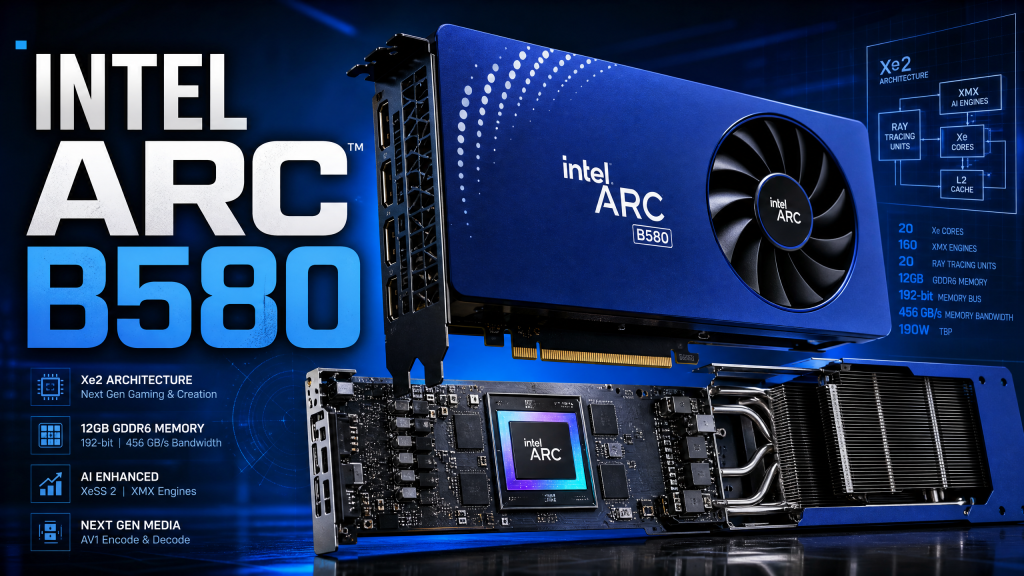
The Arc B580 is powered by Intel’s new Xe2 architecture, internally known as Battlemage. This architecture focuses on three primary goals:
- Improved gaming efficiency
- Higher shader throughput
- Better software compatibility
Intel redesigned its shader engines to execute instructions more efficiently while reducing bottlenecks that affected the first-generation Arc cards. The geometry pipeline has also been enhanced significantly, helping the GPU process modern game workloads more effectively.
One of the most important upgrades is cache optimization. Modern games rely heavily on memory efficiency, and Intel has introduced larger cache structures to reduce memory latency and improve frame consistency.
The result is a graphics card that performs substantially better per compute unit compared to the previous generation.
Technical Specifications
| Specification | Intel Arc B580 |
|---|---|
| Architecture | Xe2 Battlemage |
| Xe Cores | 20 |
| Shader Units | 2560 |
| Memory | 12GB GDDR6 |
| Memory Bus | 192-bit |
| TDP | 190W |
| Upscaling | XeSS 2 |
| Video Encoding | AV1 Hardware Encoder |
The standout specification is undoubtedly the 12GB of GDDR6 VRAM. In a market where many competing GPUs still ship with 8GB, Intel’s decision provides valuable headroom for future games and content creation tasks.
Gaming Performance at 1080p
The Arc B580 targets the mainstream gaming segment, where 1080p remains the most popular resolution worldwide. At this resolution, the card performs exceptionally well.
In modern AAA titles such as:
- Cyberpunk 2077
- Forza Horizon 5
- Starfield
- Hogwarts Legacy
- Resident Evil 4 Remake
- Call of Duty
The B580 consistently delivers frame rates exceeding 60 FPS at High settings, with many games comfortably reaching 100 FPS or more.
Compared to NVIDIA’s RTX 4060, the performance differences vary by title. Some games favor NVIDIA, while others favor Intel. On average, the B580 sits surprisingly close to the RTX 4060 despite often costing less.
This level of competitiveness would have been difficult to imagine during Intel’s first-generation Arc launch.
1440p Gaming Performance
Moving to 1440p introduces greater demands on memory bandwidth and VRAM capacity. This is where the Arc B580’s 12GB memory configuration begins to shine.
Many modern games are increasingly VRAM-hungry, especially when using high-resolution textures. Titles like:
- Alan Wake 2
- The Last of Us Part I
- Star Wars Jedi: Survivor
- Microsoft Flight Simulator
benefit noticeably from the additional memory.
While the RTX 4060’s 8GB memory can occasionally become a limiting factor, the B580 maintains smoother frame delivery under memory-heavy conditions.
For gamers targeting 1440p Medium or High settings, Intel’s offering proves surprisingly capable and future-resistant.
Ray Tracing Performance
Ray tracing remains one of the most demanding graphics technologies available today.
Intel’s Battlemage architecture improves ray tracing performance significantly compared to Alchemist. Dedicated ray tracing hardware enables realistic lighting, shadows, and reflections while maintaining playable frame rates.
However, NVIDIA still retains an advantage in ray tracing efficiency. RTX cards generally achieve higher frame rates when ray tracing effects are heavily utilized.
That said, Intel closes the gap considerably when paired with XeSS 2 upscaling.
XeSS 2: Intel’s DLSS Competitor
XeSS 2 is Intel’s AI-powered upscaling technology designed to compete directly with NVIDIA DLSS and AMD FSR.
Using machine learning models, XeSS renders games at a lower internal resolution before reconstructing them into higher-resolution output.
Benefits include:
- Higher frame rates
- Improved image quality
- Reduced GPU workload
- Enhanced ray tracing performance
The latest version of XeSS produces image quality that is remarkably close to native rendering in many supported games.
For gamers who prioritize performance without sacrificing visuals, XeSS 2 is one of the Arc B580’s strongest features.
Driver Improvements: Intel’s Biggest Victory
Perhaps the most important improvement isn’t hardware—it’s software.
Intel’s driver team has spent years refining Arc support. Modern game compatibility has improved dramatically, and driver updates arrive regularly.
Areas showing significant improvement include:
- Frame pacing consistency
- Game launch compatibility
- DirectX 12 optimization
- Vulkan performance
- Application stability
While some older DirectX 9 titles can still present occasional issues, the overall experience is dramatically better than it was during Arc’s debut.
Content Creation Performance
The Arc B580 isn’t just a gaming card. It also offers excellent functionality for creators.
Applications like:
- Adobe Premiere Pro
- DaVinci Resolve
- OBS Studio
- HandBrake
- Blender
benefit from Intel’s hardware acceleration capabilities.
Video editing performance is particularly impressive thanks to Intel’s media engine support.
AV1 Encoding: The Hidden Advantage
One of the most underrated features of the Arc B580 is its AV1 encoder.
AV1 provides significantly better visual quality than H.264 at the same bitrate. For streamers and content creators, this translates to:
- Sharper video quality
- Improved streaming efficiency
- Smaller file sizes
- Higher-quality recordings
Many reviewers consider Intel’s AV1 implementation among the best available on consumer GPUs today.
For creators focused on YouTube, Twitch, or content production, this feature alone adds substantial value.
Power Consumption and Thermals
The Arc B580 carries a 190W TDP, placing it comfortably within mainstream power requirements.
Most quality 650W power supplies can handle the card without issue.
Thermal performance is also respectable. Under sustained gaming loads, temperatures remain well within safe operating ranges, and cooling solutions from major board partners maintain quiet acoustics.
Compared to high-end GPUs consuming 300W to 500W, the B580 is refreshingly manageable.
Who Should Buy the Intel Arc B580?
The Arc B580 is ideal for:
- 1080p high-refresh-rate gamers
- 1440p budget enthusiasts
- Content creators seeking AV1 encoding
- Builders looking for strong VRAM value
- Users interested in modern DirectX 12 gaming
It is particularly attractive for buyers who want more than 8GB of VRAM without spending significantly more money.
Final Verdict
The Intel Arc B580 represents a major milestone for Intel’s graphics ambitions. Unlike the first-generation Arc cards, this GPU doesn’t require excuses or caveats. It delivers genuinely competitive gaming performance, strong creator features, modern AI-powered upscaling, excellent AV1 encoding, and a generous 12GB memory configuration.
While NVIDIA still leads in ray tracing and AMD remains highly competitive in value-focused segments, Intel has finally established itself as a legitimate third option in the discrete GPU market.
For gamers building a modern PC in 2025, the Arc B580 deserves serious consideration. It offers a balanced combination of performance, features, and future-proofing that makes it one of the most interesting GPUs in its class.
Final Score: 8.5/10
Intel has officially arrived in the GPU market, and the Arc B580 proves the company is here to stay.
