
Post
CPU Cooling Guide 2025: Air Cooler vs AIO Liquid Cooler — Which is Better?
Jun
CPU Cooling Guide 2025: Air Cooler vs AIO Liquid Cooler — Which Is Better?
When building a gaming PC, workstation, or content creation system in 2025, choosing the right CPU cooler is just as important as selecting the processor itself. Modern CPUs are more powerful than ever, but they also generate significant amounts of heat under load. Without proper cooling, even the fastest processor can experience thermal throttling, reduced performance, increased noise levels, and potentially shorter component lifespan.
The two most popular cooling solutions on the market today are traditional air coolers and All-In-One (AIO) liquid coolers. Both are capable of keeping modern processors operating safely, but each has unique advantages and disadvantages. The ideal choice depends on your CPU, case size, budget, performance requirements, and personal preferences.
This comprehensive guide explores how each cooling solution works, compares their performance, discusses reliability and maintenance, and helps you decide which option is best for your next PC build.
Why CPU Cooling Matters
Every processor consumes electrical power and converts part of that energy into heat. As CPU performance increases, heat output increases as well. High-performance processors such as the AMD Ryzen 9 9950X or Intel Core Ultra 9 285K can generate over 200 watts of heat during demanding workloads.
When temperatures rise beyond safe limits, modern CPUs automatically reduce clock speeds to protect themselves. This process is called thermal throttling. While it prevents hardware damage, it also reduces system performance. A properly sized cooling solution allows the CPU to maintain higher boost clocks for longer periods, delivering better performance in gaming, rendering, compiling code, and other intensive tasks.
Good cooling also improves system stability, reduces component wear, and often lowers overall system noise by preventing fans from operating at maximum speed.
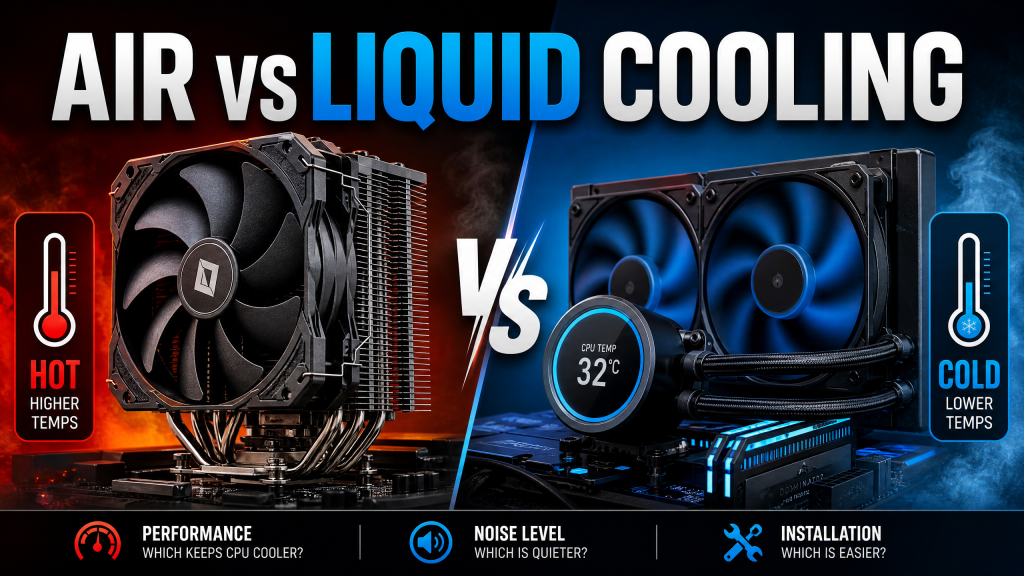
How Air Coolers Work
Air coolers have been the standard CPU cooling solution for decades. Despite their simplicity, modern air coolers are remarkably effective and continue to evolve with improved materials and engineering.
A typical air cooler consists of:
- A metal base plate that contacts the CPU.
- Copper heat pipes that transfer heat away from the processor.
- A large aluminum fin stack for heat dissipation.
- One or more cooling fans that move air through the heatsink.
Heat generated by the CPU travels through thermal paste into the cooler’s base plate. The heat pipes then distribute the thermal energy across the fin array, where airflow removes the heat and exhausts it into the case.
Popular air coolers in 2025 include the Noctua NH-D15 G2, be quiet! Dark Rock Elite, DeepCool Assassin IV, and Thermalright Phantom Spirit. These coolers can handle surprisingly high heat loads while maintaining low noise levels.
Advantages of Air Coolers
Excellent Reliability
Air coolers are known for their durability. Since they contain very few moving parts, there is little that can fail. The heatsink itself can last for many years, and the cooling fan can be replaced inexpensively if necessary.
Lower Cost
One of the biggest advantages of air cooling is value. Many high-quality air coolers cost significantly less than comparable liquid cooling solutions while providing similar performance for mainstream processors.
Easy Installation
Modern air coolers are relatively straightforward to install. There is no need to mount radiators, route tubes, or manage pump cables. This simplicity makes air coolers especially attractive for first-time PC builders.
Minimal Maintenance
Routine maintenance usually involves nothing more than removing dust from the heatsink and fan every few months. There are no liquids, pumps, or sealed systems to worry about.
How AIO Liquid Coolers Work
AIO liquid coolers use a sealed liquid loop to move heat away from the processor more efficiently than traditional air cooling in certain scenarios.
A typical AIO cooler consists of:
- A CPU water block and pump assembly.
- Tubing that circulates coolant.
- A radiator mounted in the case.
- One or more fans attached to the radiator.
The liquid coolant absorbs heat from the CPU block and transports it to the radiator. The radiator’s large surface area allows the attached fans to dissipate heat effectively before the coolant returns to the CPU block.
AIO coolers are available in several sizes, including:
- 120mm
- 240mm
- 280mm
- 360mm
- 420mm
Larger radiators generally provide better cooling performance and lower noise levels because they can dissipate heat more efficiently.
Advantages of AIO Liquid Coolers
Superior Cooling for High-End CPUs
While premium air coolers are highly capable, large 360mm and 420mm AIOs typically perform better when cooling processors that regularly consume over 200 watts.
This additional cooling capacity helps maintain higher boost clocks during prolonged workloads such as video rendering, scientific simulations, software compilation, and 3D rendering.
Improved Case Airflow
Since the radiator can be mounted separately from the CPU socket area, AIO coolers often create less congestion around the motherboard. This can improve airflow and make memory installation easier.
Better Aesthetics
Many builders prefer the clean appearance of liquid cooling systems. A compact CPU block leaves the motherboard visible, making RGB memory, motherboard lighting, and cable management more prominent.
Premium AIO coolers frequently include customizable RGB lighting, LCD displays, and software-controlled effects that appeal to enthusiasts.
Thermal Performance Comparison
For processors in the 65W to 150W range, the performance difference between a premium air cooler and a 240mm AIO is often surprisingly small. In many gaming scenarios, the temperature gap may be only a few degrees Celsius.
However, the advantage shifts toward liquid cooling as power consumption increases. CPUs such as the Ryzen 9 9950X and Core Ultra 9 285K can generate enough heat to benefit from the larger cooling capacity of 360mm AIO systems.
Under sustained heavy workloads, a quality 360mm AIO may run 5–10°C cooler than even the best air coolers. This temperature reduction can translate into slightly higher sustained clock speeds and improved overall performance.
Noise Levels
Noise is an important consideration for many users. Contrary to popular belief, liquid cooling is not always quieter.
Premium air coolers equipped with large, slow-spinning fans can be nearly silent during everyday tasks and gaming sessions. Their large heatsink mass allows them to dissipate heat efficiently without requiring high fan speeds.
AIO coolers add an additional source of noise: the pump. Even the best pumps produce a faint hum that some users notice in quiet environments.
The overall noise level depends heavily on the quality of the fans, pump design, fan curve configuration, and system airflow.
Reliability and Longevity
Air coolers are generally considered the most reliable cooling solution available. The heatsink itself rarely fails, and fan replacement is inexpensive if necessary.
AIO coolers are also highly reliable today, but they contain more potential failure points, including:
- Pump wear over time.
- Coolant evaporation.
- Tubing degradation.
- Rare manufacturing defects.
Most modern AIOs are rated for several years of operation and include long warranties, but air cooling still maintains an advantage in long-term simplicity and durability.
Which Cooler Is Best for Gaming?
For gaming-focused systems, either cooling solution can work exceptionally well.
If you’re using processors such as the Ryzen 7 9700X, Ryzen 7 9800X3D, Core Ultra 7 265K, or similar CPUs, a high-quality air cooler is often the best balance of performance, cost, and reliability.
For enthusiast gaming systems equipped with flagship processors and high-end GPUs, a 360mm AIO provides additional thermal headroom and often creates a cleaner aesthetic.
Best Cooling Recommendations for 2025
- Budget Builds: Thermalright Phantom Spirit 120 SE
- Mid-Range Builds: DeepCool Assassin IV
- Premium Air Cooling: Noctua NH-D15 G2
- Best 240mm AIO: Arctic Liquid Freezer III 240
- Best 360mm AIO: Arctic Liquid Freezer III 360
- Premium RGB AIO: Corsair iCUE H150i Elite LCD
Final Verdict
There is no universal winner in the air cooler versus AIO liquid cooler debate. Both solutions are capable of delivering excellent thermal performance when paired appropriately with the processor they are cooling.
For most users, a quality air cooler offers the best value, reliability, and ease of maintenance. Modern dual-tower air coolers can handle nearly any gaming workload while remaining quiet and affordable.
For enthusiasts running high-power CPUs, performing intensive productivity tasks, or building a showcase PC with premium aesthetics, a 360mm AIO liquid cooler provides superior thermal capacity and a cleaner visual presentation.
Ultimately, the best CPU cooler is the one that matches your processor’s power requirements, fits your case properly, stays within your budget, and aligns with your long-term priorities. Whether you choose air or liquid cooling, investing in a quality cooling solution ensures your CPU performs at its full potential for years to come.
