
Post
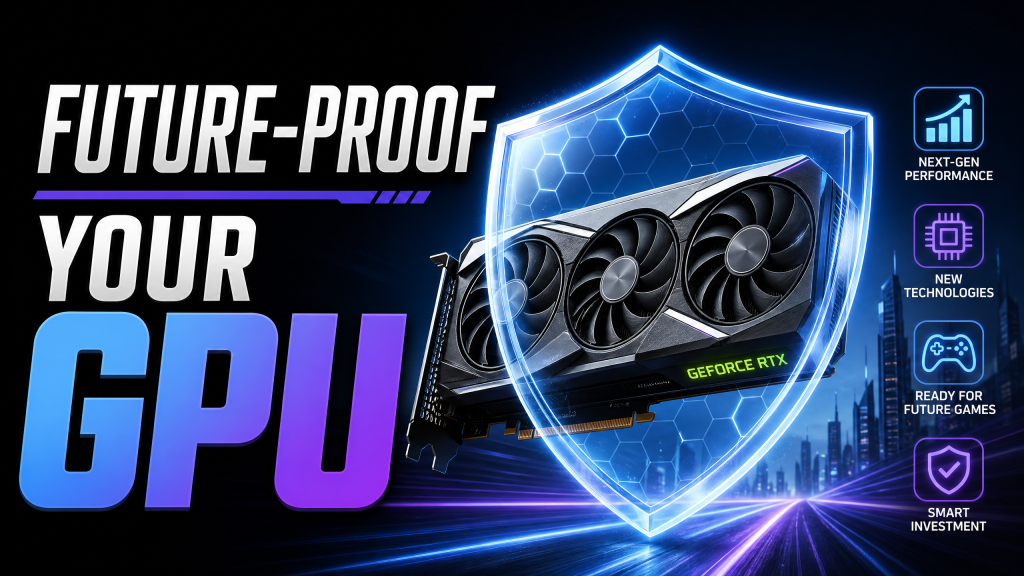
How to Future-Proof Your GPU Purchase: A Buyer’s Guide for 2025
Jun
How to Future-Proof Your GPU Purchase: A Complete Buyer’s Guide for 2025
Buying a graphics card is one of the most important decisions when building or upgrading a gaming PC. Unlike other components that can often remain relevant for many years, GPUs face constant pressure from increasingly demanding games, higher resolutions, advanced rendering technologies, and rapidly evolving software requirements. A GPU that feels powerful today may struggle to deliver the same experience just a few years later if its specifications aren’t chosen carefully.
This reality makes future-proofing more important than ever. While no hardware purchase can guarantee top-tier performance indefinitely, selecting the right graphics card based on long-term trends can significantly extend the useful life of your investment. Whether you’re building a budget gaming system, a high-end workstation, or an enthusiast-level gaming rig, understanding the factors that contribute to GPU longevity can save money and reduce the need for premature upgrades.
In this guide, we’ll explore the key considerations that determine how well a GPU will age and provide practical recommendations for buyers in 2025.
Why Future-Proofing Matters More Than Ever
The gaming industry is evolving at an unprecedented pace. Modern game engines such as Unreal Engine 5 are introducing technologies that dramatically increase graphical fidelity while simultaneously raising hardware requirements. Features like Nanite virtualized geometry, advanced global illumination systems, real-time ray tracing, and AI-assisted rendering are becoming standard rather than optional.
Additionally, the rise of 1440p and 4K gaming means that graphics cards must process significantly more pixels than they did just a few years ago. A GPU capable of handling modern games comfortably at 1080p today may find itself overwhelmed when future titles demand more memory, compute power, and bandwidth.
Future-proofing doesn’t mean buying the most expensive card available. Instead, it means understanding which specifications matter most over the long term and prioritizing them accordingly.
VRAM: The Most Important Long-Term Investment
If there is one specification that has consistently proven critical for GPU longevity, it is VRAM (Video Memory).
VRAM stores:
- Game textures
- Geometry data
- Ray tracing acceleration structures
- Frame buffers
- Shader resources
- AI-generated assets
As game worlds become more detailed, texture resolutions continue to increase, and VRAM requirements rise accordingly.
History has repeatedly shown that GPUs with insufficient VRAM tend to age poorly, even if their raw processing power remains competitive.
Recommended VRAM Capacities for 2025
| Build Tier | Recommended VRAM |
|---|---|
| Budget Gaming | 12GB Minimum |
| Mid-Range Gaming | 16GB Recommended |
| High-End Gaming | 20GB-24GB Recommended |
| AI & Workstation | 24GB+ Preferred |
While 8GB cards remain usable for 1080p gaming today, they are increasingly encountering limitations in newer AAA releases. Purchasing a GPU with additional VRAM can significantly extend its useful lifespan.
Resolution Goals Matter
Before purchasing a GPU, consider your intended resolution.
Many buyers focus exclusively on current monitor specifications without considering future upgrades.
For example:
- 1080p gaming requires less GPU power.
- 1440p demands roughly 77% more pixels.
- 4K requires four times the rendering workload of 1080p.
If you anticipate upgrading to a higher-resolution monitor within the next few years, purchasing a more capable GPU today can save money in the long run.
A card that barely handles 1080p today may struggle significantly at 1440p tomorrow.
The Growing Importance of AI Upscaling
One of the biggest shifts in gaming over the past several years has been the widespread adoption of AI-assisted upscaling technologies.
These technologies include:
- NVIDIA DLSS
- AMD FSR
- Intel XeSS
Rather than rendering every frame at full resolution, these systems render at a lower resolution and use advanced algorithms or AI models to reconstruct a higher-quality image.
Benefits include:
- Higher frame rates
- Lower GPU workload
- Improved ray tracing performance
- Extended hardware lifespan
When evaluating a GPU purchase, strong support for modern upscaling technologies should be considered essential.
Ray Tracing: A Long-Term Consideration
Ray tracing has transitioned from a niche feature into a mainstream graphics technology.
Modern games increasingly use ray tracing for:
- Reflections
- Global illumination
- Shadows
- Ambient occlusion
- Path tracing
While traditional rasterization remains important, future games are expected to rely more heavily on ray tracing.
This means GPUs with stronger ray tracing hardware are likely to remain relevant longer.
Current RT Leaders
- NVIDIA RTX 50 Series
- AMD RDNA 4 GPUs
- Intel Arc Battlemage GPUs
Investing in current-generation ray tracing hardware can help ensure compatibility with future graphics technologies.
Memory Bandwidth Is Often Overlooked
VRAM capacity is important, but bandwidth matters too.
Memory bandwidth determines how quickly data can move between VRAM and the GPU.
Higher bandwidth benefits:
- 4K gaming
- Ray tracing workloads
- High-resolution textures
- AI processing
Cards with wider memory buses and faster memory technologies generally age better when rendering demands increase.
For example:
- GDDR7 offers substantial advantages over GDDR6.
- 256-bit and wider buses generally provide more headroom for future workloads.
DirectX 12 Ultimate and API Support
Future-proof GPUs should support the latest graphics APIs and standards.
DirectX 12 Ultimate includes:
- DirectX Raytracing
- Variable Rate Shading
- Mesh Shaders
- Sampler Feedback
These features improve performance and visual quality while enabling modern game engine technologies.
Likewise, strong Vulkan support remains important for Linux gaming and cross-platform compatibility.
PCIe 4.0 vs PCIe 5.0: Should You Care?
Many buyers worry about PCIe bandwidth.
In reality, PCIe 4.0 remains more than sufficient for modern GPUs.
Current graphics cards rarely saturate PCIe 4.0 x16 connections.
PCIe 5.0 offers additional bandwidth, but real-world gaming gains are currently negligible.
While PCIe 5.0 support is nice to have, it should not be a deciding factor when selecting a GPU.
Driver Support and Software Ecosystems
A GPU’s lifespan depends heavily on driver support.
Regular driver updates provide:
- Performance optimizations
- Bug fixes
- Security updates
- Compatibility improvements
- Support for new game releases
Historically:
- NVIDIA offers excellent long-term support.
- AMD has significantly improved its driver ecosystem.
- Intel continues to rapidly improve Arc software support.
The quality of the software ecosystem should be considered alongside raw hardware specifications.
Power Efficiency Matters for Longevity
Efficient GPUs often age better because they:
- Generate less heat
- Require smaller cooling solutions
- Place less stress on power supplies
- Reduce electricity costs
A highly efficient GPU may remain practical for years longer than a power-hungry alternative, particularly as energy prices rise.
Efficiency also improves resale value and compatibility with future system upgrades.
Future-Proof GPU Recommendations by Budget
Budget Tier ($200–$350)
- AMD RX 7600 XT 16GB
- Intel Arc B580
Prioritize VRAM capacity over small performance differences.
Mid-Range Tier ($350–$600)
- RTX 4070 Super
- RTX 5070
- RX 7800 XT
These GPUs balance performance, ray tracing, VRAM, and upscaling support effectively.
Performance Tier ($600–$900)
- RTX 5070 Ti
- RX 9900 XT
Excellent choices for long-term 1440p and 4K gaming.
Enthusiast Tier ($1000+)
- RTX 5080
- RTX 5090
These GPUs offer enough performance headroom to remain relevant for many years.
Final Thoughts
Future-proofing a GPU purchase is about balancing current performance with tomorrow’s requirements. While no graphics card can remain cutting-edge forever, focusing on VRAM capacity, memory bandwidth, ray tracing capability, AI upscaling support, driver longevity, and overall efficiency can dramatically extend the useful life of your investment.
For most buyers in 2025, the smartest strategy is not necessarily purchasing the fastest GPU available but choosing the card that offers the best combination of features and specifications for the years ahead. In particular, generous VRAM capacity and strong support for modern rendering technologies will likely determine how well a GPU ages throughout the remainder of the decade.
The simplest rule remains: buy the most capable GPU you can comfortably afford, prioritize VRAM, and choose a platform with strong long-term software support. Doing so will provide the best chance of enjoying smooth gaming and productivity performance well into the future.
