
Post
AMD Ryzen 9 9800X3D: The 3D V-Cache Gaming CPU That Changes Everything
Jun
AMD Ryzen 9 9800X3D: The 3D V-Cache Gaming CPU That Changes Everything
For years, CPU manufacturers pursued higher clock speeds, more cores, and improved architectural efficiency as the primary methods of increasing processor performance. While these strategies remain important, AMD has introduced a different approach that has fundamentally changed the gaming CPU landscape: 3D V-Cache technology.
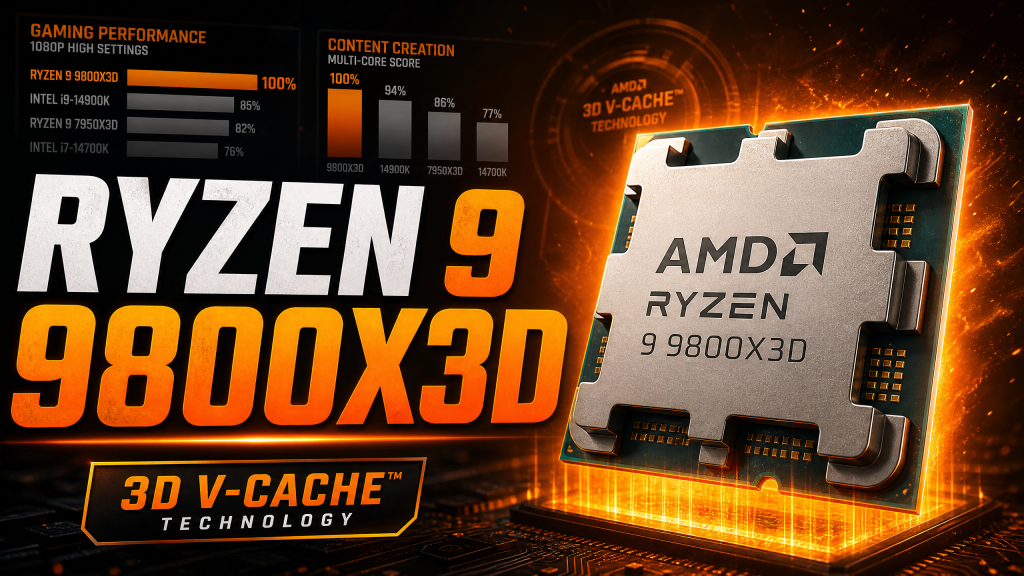
The AMD Ryzen 9 9800X3D represents the latest evolution of this strategy. Instead of relying solely on more cores or higher frequencies, AMD dramatically increases on-chip cache capacity by stacking additional cache directly on top of the processor die. The result is a gaming-focused CPU that consistently outperforms processors with more cores, higher clocks, and significantly higher power consumption.
With 96MB of L3 cache, Zen 5 architecture improvements, excellent efficiency, and class-leading gaming performance, the Ryzen 9 9800X3D has quickly become one of the most discussed processors in the enthusiast PC market.
In this detailed review, we’ll explore the technology behind 3D V-Cache, analyze real-world performance, examine strengths and weaknesses, and determine whether the Ryzen 9 9800X3D deserves a place in your next gaming build.
What Is 3D V-Cache?
To understand why the Ryzen 9 9800X3D is so fast in gaming, it’s important to understand what cache does.
A CPU spends much of its time accessing data. The closer that data is to the processor cores, the faster it can be accessed. Modern CPUs use multiple layers of cache memory to minimize delays:
- L1 Cache: Smallest and fastest.
- L2 Cache: Larger but slightly slower.
- L3 Cache: Shared across cores and significantly larger.
When data isn’t available in cache, the processor must retrieve it from system memory (RAM). Although modern DDR5 memory is extremely fast, it is still dramatically slower than on-chip cache.
This latency creates bottlenecks that can reduce gaming performance.
AMD’s solution is elegant: add more cache.
Using advanced packaging technology, AMD physically stacks an additional cache die directly above the CPU chiplet, dramatically increasing total cache capacity without requiring a larger processor package.
The Science Behind 3D V-Cache
Traditional CPU designs place all components side-by-side on a single silicon die. AMD’s 3D V-Cache technology introduces a vertical dimension.
The additional SRAM cache layer is manufactured separately and then bonded directly to the CPU using high-density hybrid bonding techniques.
This process provides:
- Extremely low latency
- Massive bandwidth
- Minimal power overhead
- Compact physical design
The result is a processor capable of storing substantially more game data directly on-chip.
Instead of constantly requesting information from RAM, the CPU can access data almost instantly from its enormous cache pool.
Ryzen 9 9800X3D Specifications
| Specification | Ryzen 9 9800X3D |
|---|---|
| Architecture | Zen 5 |
| Cores | 8 |
| Threads | 16 |
| Base Clock | 4.7 GHz |
| Boost Clock | Up to 5.2 GHz |
| L2 Cache | 8MB |
| L3 Cache | 96MB |
| TDP | 120W |
| Socket | AM5 |
| Memory Support | DDR5 |
| PCIe Support | PCIe 5.0 |
Although the processor features only eight cores, its gaming performance consistently rivals or exceeds CPUs with significantly higher core counts.
Why Cache Matters More Than More Cores
Many modern games do not effectively utilize 16 or 24 CPU cores.
Instead, gaming workloads often depend on:
- Fast memory access
- Low latency
- Efficient cache utilization
- Strong single-thread performance
Large open-world games constantly stream:
- Textures
- Physics data
- AI routines
- Player information
- World simulation assets
When more of this data resides inside the CPU cache, fewer trips to system memory are required.
This significantly improves frame rates and responsiveness.
Gaming Performance Analysis
The Ryzen 9 9800X3D is designed specifically to dominate gaming workloads.
At 1080p with a flagship graphics card such as the RTX 5090, the CPU frequently sits at the top of benchmark charts.
Compared to conventional processors, gaming gains often range between:
- 10% to 20% in typical games
- 20% to 30% in CPU-heavy titles
- 40% to 50% in cache-sensitive workloads
Microsoft Flight Simulator
Flight Simulator is one of the most CPU-intensive games available.
The simulator continuously processes:
- Terrain data
- Weather systems
- Air traffic
- Physics calculations
The 9800X3D’s massive cache dramatically improves performance, especially in densely populated areas.
Cities: Skylines 2
City-building games generate enormous simulation workloads.
Thousands of citizens, vehicles, businesses, and AI routines must be tracked simultaneously.
The Ryzen 9 9800X3D frequently outperforms processors with double the core count thanks to its superior cache capacity.
Factorio
Factorio is famous for exposing CPU limitations.
Large factories create massive datasets that benefit enormously from the processor’s 96MB cache pool.
The result is faster simulation speeds and smoother gameplay.
Frame Time Consistency and 1% Lows
Average FPS only tells part of the story.
Frame time consistency often has a greater impact on perceived smoothness.
This is where the Ryzen 9 9800X3D truly shines.
Its massive cache reduces:
- Memory access delays
- Frame pacing inconsistencies
- Micro-stuttering
- Latency spikes
Many reviewers report:
- 25% to 40% improvements in 1% low FPS
- Better frame pacing
- More consistent gameplay
These improvements create a smoother gaming experience even when average FPS differences appear modest.
Performance in Productivity Workloads
While the 9800X3D dominates gaming benchmarks, productivity performance is more nuanced.
The processor features:
- 8 cores
- 16 threads
Compared to:
- Ryzen 9 9900X (12 cores)
- Ryzen 9 9950X (16 cores)
it simply has fewer resources available for heavily parallel workloads.
Applications such as:
- Blender
- Adobe Premiere Pro
- HandBrake
- Visual Studio compilation
generally favor CPUs with more cores and higher sustained clock speeds.
The 9800X3D remains capable, but it is clearly optimized for gaming first.
Power Consumption and Efficiency
One of AMD’s biggest advantages over competing high-end processors is efficiency.
Despite delivering class-leading gaming performance, the Ryzen 9 9800X3D maintains a relatively modest:
- 120W TDP
Compared to some enthusiast CPUs consuming over 250W under load, the efficiency advantage is substantial.
Benefits include:
- Lower electricity usage
- Reduced heat output
- Quieter cooling solutions
- Improved system stability
Thermal Performance
The stacked cache introduces a unique thermal challenge.
Heat generated by the CPU cores must travel through additional layers before reaching the cooler.
To accommodate this limitation, AMD slightly reduces maximum clock speeds compared to non-X3D processors.
Fortunately, modern cooling solutions handle the processor effectively.
Recommended cooling options include:
- High-end air coolers
- 240mm AIO liquid coolers
- 280mm AIO liquid coolers
- 360mm AIO liquid coolers
Under gaming workloads, temperatures remain well within safe operating limits.
AM5 Platform Advantages
The Ryzen 9 9800X3D benefits from AMD’s AM5 ecosystem.
Compatible chipsets include:
- X670
- X670E
- B650
- B650E
- X870
- X870E
Platform benefits include:
- DDR5 memory support
- PCIe 5.0 storage
- PCIe 5.0 graphics support
- Long-term upgrade path
AMD has committed to supporting AM5 for multiple future CPU generations, making it one of the most future-proof platforms available.
Who Should Buy the Ryzen 9 9800X3D?
- Competitive gamers
- High-refresh-rate enthusiasts
- RTX 5080 and RTX 5090 owners
- Simulation game players
- Flight simulator enthusiasts
- Users prioritizing gaming above all else
Who Should Consider Alternatives?
- Professional video editors
- 3D rendering professionals
- Software developers compiling large projects daily
- Workstation users requiring maximum multi-core performance
For these workloads, processors like the Ryzen 9 9950X may provide greater value.
Final Verdict
The AMD Ryzen 9 9800X3D is one of the most impressive gaming processors ever released. Its innovative 3D V-Cache technology demonstrates that gaming performance is not simply a matter of adding more cores or increasing clock speeds. By dramatically expanding on-chip cache capacity, AMD has created a processor capable of delivering extraordinary gaming results across virtually every genre.
Whether you’re playing competitive shooters, large-scale simulations, open-world RPGs, or strategy games, the Ryzen 9 9800X3D consistently ranks among the fastest gaming CPUs available. Combined with excellent power efficiency, strong platform longevity, and AM5 compatibility, it stands as the premier choice for enthusiasts seeking maximum gaming performance.
If gaming is your primary focus and you want the absolute best CPU available in 2025, the Ryzen 9 9800X3D earns its reputation as the king of gaming processors.
Score: 9.6/10 for Gaming
