
Post
Multi-GPU Setups in 2025: Are They Still Worth It?
Jun
Multi-GPU Setups in 2025: Are They Still Worth It?
For many years, multi-GPU configurations represented the ultimate dream for PC enthusiasts. The concept was straightforward: install two or more graphics cards in a single system and combine their processing power to achieve significantly higher gaming performance. Technologies such as NVIDIA SLI (Scalable Link Interface) and AMD CrossFire became iconic among gamers who wanted to push their systems beyond the limits of a single graphics card.
In the late 2000s and early 2010s, dual-GPU systems were frequently featured in enthusiast builds, gaming competitions, and hardware reviews. Seeing two high-end graphics cards connected through an SLI bridge was considered a sign of a premium gaming machine. However, by 2025, the consumer gaming landscape has changed dramatically. Multi-GPU gaming has largely disappeared, while professional computing and artificial intelligence have become the primary users of multi-GPU technology.
The Rise of Multi-GPU Gaming
The original appeal of multi-GPU systems was easy to understand. Graphics cards were advancing rapidly, but gamers always wanted more performance. Higher resolutions, improved textures, advanced lighting effects, and increasingly demanding games created a constant need for additional graphics power.
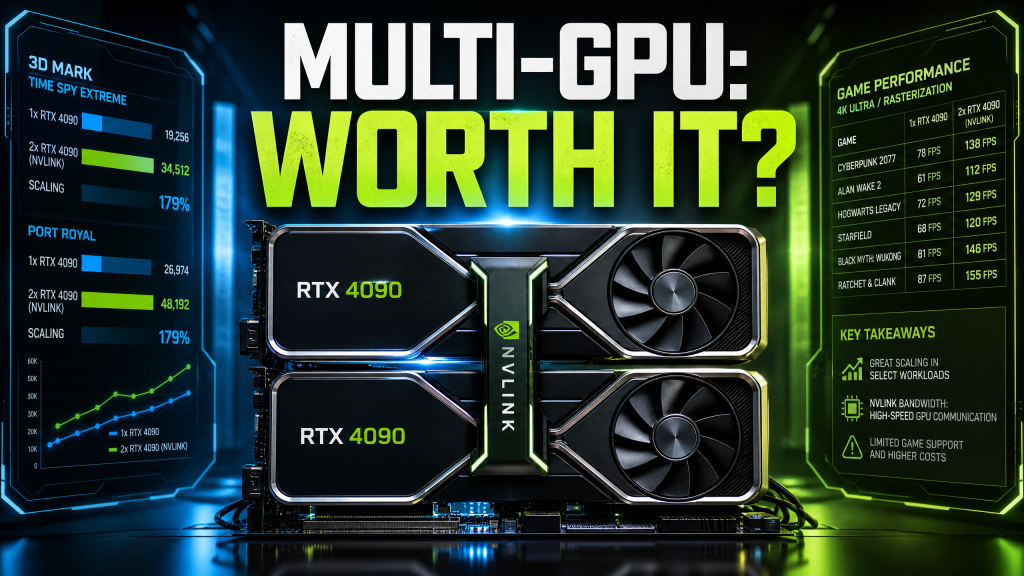
SLI and CrossFire promised nearly double the performance by allowing two GPUs to share rendering tasks. In ideal conditions, users could achieve performance gains of 70% to 90%, making multi-GPU setups an attractive option for enthusiasts. Popular titles during that era often included optimized profiles specifically designed for SLI or CrossFire, helping gamers maximize performance gains.
At the time, a dual-GPU system could outperform even the most expensive single graphics card available. This made multi-GPU configurations a popular choice among hardcore gamers, benchmark enthusiasts, and overclockers.
Why Multi-GPU Gaming Declined
Despite its promise, multi-GPU gaming faced numerous challenges that eventually led to its decline. One of the biggest problems was software support. SLI and CrossFire required game developers and GPU manufacturers to create specific optimization profiles. Without proper support, additional graphics cards often delivered little or no performance improvement.
As game engines became more advanced, supporting multi-GPU configurations became increasingly difficult. Modern engines such as Unreal Engine 5 rely on complex rendering pipelines, dynamic lighting systems, ray tracing calculations, and real-time asset streaming. Synchronizing these tasks across multiple GPUs introduced significant complexity and development costs.
Developers ultimately concluded that spending resources optimizing for a tiny percentage of users with multi-GPU systems was not economically practical. As a result, support gradually disappeared from newer games.
The Frame Pacing Problem
One of the most frustrating issues associated with multi-GPU gaming was frame pacing. While benchmark results often showed impressive average frame rates, real-world gameplay frequently felt less smooth than expected.
Frame pacing refers to the consistency of frame delivery. In many SLI and CrossFire implementations, frames were rendered alternately by different GPUs. While this approach increased overall throughput, it often resulted in uneven frame delivery. Players experienced micro-stuttering, where gameplay appeared inconsistent despite high FPS numbers.
This issue became more noticeable as gamers adopted high-refresh-rate monitors. A single GPU delivering 100 consistent FPS often felt smoother than a dual-GPU setup averaging 140 FPS with irregular frame timing.
As display technology improved and gamers became more sensitive to frame consistency, the disadvantages of multi-GPU rendering became increasingly difficult to ignore.
NVIDIA and AMD End Consumer Support
Recognizing declining adoption and increasing complexity, both NVIDIA and AMD gradually moved away from consumer multi-GPU gaming support. NVIDIA effectively discontinued traditional SLI support after the RTX 30 Series generation, while AMD phased out CrossFire support even earlier.
Today, modern gaming graphics cards are designed with the assumption that they will operate independently. Driver development focuses on maximizing single-GPU performance rather than coordinating multiple cards.
For the average gamer, this change has simplified system building and improved overall reliability. There is no longer a need to worry about compatibility profiles, bridge connectors, or inconsistent game support.
The Case for a Single Powerful GPU
In 2025, purchasing the most powerful single GPU within your budget is generally the best strategy for gaming. Modern GPUs such as the RTX 5080, RTX 5090, and AMD Radeon RX 9000 Series deliver exceptional performance on their own.
A single high-end GPU offers several advantages:
- Universal game compatibility
- Lower power consumption
- Reduced heat generation
- Simpler system configuration
- Better driver support
- Improved stability and reliability
- No frame pacing complications
For example, purchasing two mid-range graphics cards rarely makes sense today. Spending the same amount on one higher-tier GPU almost always results in superior gaming performance and a better user experience.
Multi-GPU in Artificial Intelligence and Machine Learning
While gaming no longer benefits significantly from multiple GPUs, artificial intelligence has become one of the strongest drivers of multi-GPU adoption.
Training large language models, image generation systems, and deep learning networks requires enormous computational resources. Even the most powerful consumer graphics card may not provide sufficient memory or processing capability for advanced AI workloads.
Frameworks such as TensorFlow, PyTorch, and JAX support distributed training across multiple GPUs. By dividing data batches or model parameters among several graphics processors, training times can be dramatically reduced.
Researchers, AI startups, and data scientists routinely deploy systems containing multiple RTX 4090, RTX 5090, or professional NVIDIA GPUs to accelerate machine learning tasks. In these environments, performance scaling can approach near-linear efficiency under ideal conditions.
NVLink and Shared Memory Advantages
NVIDIA’s NVLink technology remains important in professional computing environments. NVLink provides a high-speed communication pathway between GPUs, allowing them to share data more efficiently than traditional PCI Express connections.
One major advantage is the ability to effectively increase available GPU memory. Large AI models often exceed the memory capacity of a single graphics card. Multiple GPUs connected through NVLink can help overcome these limitations by distributing memory requirements across devices.
For organizations working with advanced AI models, this capability can be extremely valuable and cost-effective compared to purchasing enterprise-grade accelerators.
Professional Rendering and Content Creation
Beyond artificial intelligence, multi-GPU systems continue to provide benefits for certain professional applications. 3D artists, visual effects studios, architects, and animation professionals frequently work with rendering software capable of leveraging multiple GPUs.
Applications such as Blender, OctaneRender, Redshift, and V-Ray can distribute rendering workloads across several graphics cards simultaneously. This can significantly reduce rendering times for complex scenes, high-resolution animations, and visual effects projects.
For professionals whose income depends on rendering efficiency, the investment in multiple GPUs can often pay for itself through increased productivity and faster project completion.
Power Consumption and Thermal Challenges
One major consideration when building a multi-GPU workstation is power consumption. Modern high-performance graphics cards can consume between 300 and 600 watts each under heavy workloads.
A dual-GPU system may require a power supply rated at 1200 watts or higher. Additional cooling solutions are often necessary to maintain stable operating temperatures. Increased heat output can affect system longevity and contribute to higher electricity costs over time.
These factors make multi-GPU systems significantly more expensive to operate compared to traditional single-GPU gaming PCs.
The Future: GPU Chiplets and Disaggregated Computing
Although traditional multi-GPU gaming is effectively dead, the future may still involve multiple graphics processing units working together. The difference is that future implementations will likely be transparent to users.
Manufacturers such as AMD and NVIDIA are actively researching chiplet-based GPU architectures. Instead of one large monolithic graphics processor, future GPUs may consist of several interconnected compute tiles functioning as a single logical device.
AMD has already introduced chiplet concepts in its Radeon graphics architecture, while NVIDIA continues exploring advanced interconnect technologies. These approaches could provide many of the advantages of multi-GPU computing without requiring developers to implement special support.
Final Verdict: Are Multi-GPU Setups Worth It in 2025?
For gaming enthusiasts, the answer is generally no. Modern games are designed for single-GPU systems, and both NVIDIA and AMD have largely abandoned consumer multi-GPU support. Investing in one powerful graphics card remains the most effective and reliable strategy.
For AI researchers, machine learning engineers, data scientists, and professional content creators, the answer can be very different. Multi-GPU systems remain essential tools for accelerating training workloads, rendering complex projects, and handling computationally intensive tasks.
The era of dual-GPU gaming may be over, but multi-GPU computing is far from dead. It has simply evolved into a specialized solution for professional workloads where scalability, memory capacity, and computational throughput matter more than gaming frame rates. As technology continues to advance, future GPU architectures may bring new forms of multi-chip computing that deliver the benefits of multiple processors without the limitations that ultimately ended the SLI and CrossFire era.
