Post
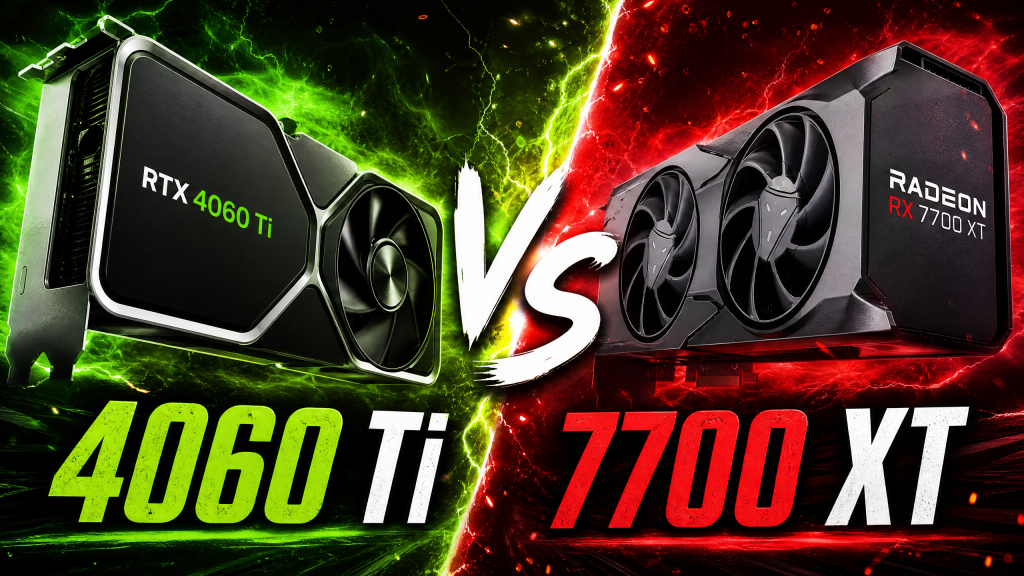
RTX 4060 Ti vs RX 7700 XT: The Mid-Range GPU Battle of 2025
Jun
RTX 4060 Ti vs RX 7700 XT: The Mid-Range GPU Battle of 2025
For most PC gamers, the mid-range graphics card market is where the real action happens. While flagship GPUs such as the RTX 5090 and Radeon RX 8900 XTX attract headlines with record-breaking performance, their high prices place them out of reach for many consumers. The majority of gamers want a graphics card that delivers excellent gaming performance without requiring a four-figure investment.
This is exactly where the NVIDIA GeForce RTX 4060 Ti and AMD Radeon RX 7700 XT compete. Positioned in the highly competitive $300–$450 segment, these GPUs target gamers looking for strong 1080p and 1440p performance, modern features, and long-term value.
Both cards bring unique strengths to the table. NVIDIA offers advanced ray tracing, DLSS 3 technology, and exceptional power efficiency, while AMD counters with a wider memory bus, strong rasterization performance, and competitive pricing.
In this detailed comparison, we examine specifications, gaming performance, ray tracing capabilities, content creation features, power efficiency, and overall value to determine which GPU deserves a place in your next gaming PC.
Pricing and Market Position
Price remains one of the most important factors when purchasing a graphics card. Fortunately, both the RTX 4060 Ti and RX 7700 XT have become widely available in 2025, with pricing stabilizing after the supply shortages and inflated costs seen in previous years.
The RTX 4060 Ti is available in both 8GB and 16GB variants, though the 16GB model is generally the preferred option due to modern games becoming increasingly demanding on VRAM capacity.
The RX 7700 XT typically competes directly against the RTX 4060 Ti 16GB in terms of pricing. Depending on regional markets, promotions, and retailer discounts, either card may occasionally offer the better deal.
At standard retail pricing:
- RTX 4060 Ti 16GB: Approximately $399–$449
- RX 7700 XT: Approximately $379–$449
Because prices frequently fluctuate, buyers should monitor sales events and bundle promotions before making a final decision.
Architecture Comparison
NVIDIA RTX 4060 Ti
The RTX 4060 Ti is built on NVIDIA’s Ada Lovelace architecture, which focuses heavily on efficiency, AI acceleration, and ray tracing improvements.
Key specifications include:
- 4,352 CUDA Cores
- 16GB GDDR6 Memory
- 128-bit Memory Bus
- 32MB L2 Cache
- 165W TDP
- DLSS 3 Support
- 4th Generation Tensor Cores
- 3rd Generation RT Cores
One of the most controversial aspects of the RTX 4060 Ti is its relatively narrow 128-bit memory bus. NVIDIA compensates for this limitation with a significantly larger L2 cache, reducing the frequency of memory accesses and helping maintain competitive performance.
AMD RX 7700 XT
The RX 7700 XT uses AMD’s RDNA 3 architecture, designed to improve efficiency while delivering stronger rasterization performance compared to previous Radeon generations.
Key specifications include:
- 54 Compute Units
- 3,456 Stream Processors
- 12GB GDDR6 Memory
- 192-bit Memory Bus
- 48MB Infinity Cache
- 245W TDP
- FSR 3 Support
- AI Accelerators
- Ray Accelerators
The most obvious hardware advantage is the wider 192-bit memory interface, which provides substantially greater memory bandwidth than the RTX 4060 Ti.
This becomes increasingly important at higher resolutions and in memory-intensive games.
1080p Gaming Performance
For gamers using 1080p monitors, both cards provide exceptional performance.
Modern esports titles such as:
- Counter-Strike 2
- Valorant
- Fortnite
- Overwatch 2
- Rocket League
can easily exceed 200 FPS on either GPU when paired with a capable processor.
In AAA games, performance remains highly competitive.
The RTX 4060 Ti tends to perform slightly better in NVIDIA-sponsored titles and games optimized for DLSS technologies. Meanwhile, the RX 7700 XT often performs very well in Vulkan-based and DirectX 12 games that benefit from AMD’s architecture.
Across a large benchmark suite, the average difference between the two cards at 1080p is generally less than 10%.
For most players, the experience is effectively identical.
1440p Gaming Performance
1440p has become the preferred resolution for many enthusiasts because it offers significantly sharper visuals than 1080p while remaining less demanding than 4K.
At this resolution, the RX 7700 XT begins to leverage its wider memory bus more effectively.
Games with large textures, open-world environments, and heavy memory usage often show improved performance on AMD’s card.
However, NVIDIA’s DLSS technology changes the equation.
With DLSS Quality Mode enabled, the RTX 4060 Ti can achieve performance levels that rival or exceed the RX 7700 XT in many supported games while maintaining excellent image quality.
Without upscaling technologies, AMD’s card frequently holds a small advantage in raw rasterization performance.
With DLSS enabled, NVIDIA often closes or reverses the gap.
Ray Tracing Performance
Ray tracing continues to be one of NVIDIA’s strongest advantages.
Both GPUs support hardware-accelerated ray tracing, but implementation quality differs significantly.
NVIDIA’s third-generation RT Cores are generally more efficient and deliver stronger performance in demanding ray-traced workloads.
Games such as:
- Cyberpunk 2077
- Alan Wake 2
- Control
- Metro Exodus Enhanced Edition
- Portal RTX
consistently favor the RTX 4060 Ti.
In many ray tracing benchmarks, NVIDIA maintains a 15–25% advantage over the RX 7700 XT.
For gamers who frequently enable ray tracing effects, this difference is substantial and can significantly improve overall gameplay quality.
DLSS 3 vs FSR 3
Upscaling technologies have become increasingly important as game graphics grow more demanding.
DLSS 3
NVIDIA’s DLSS 3 combines:
- AI Super Resolution
- Frame Generation
- NVIDIA Reflex
This technology allows supported games to achieve dramatically higher frame rates while maintaining impressive image quality.
DLSS remains widely regarded as the industry leader in image reconstruction quality.
FSR 3
AMD’s FSR 3 introduces:
- Spatial Upscaling
- Temporal Reconstruction
- Fluid Motion Frames
FSR has improved significantly over previous generations and benefits from broader compatibility across GPU brands.
However, image quality and frame generation quality generally remain slightly behind NVIDIA’s DLSS implementation.
Content Creation Performance
Gaming is not the only use case for modern graphics cards.
Many users also stream, edit videos, create content, and perform creative workloads.
RTX 4060 Ti Advantages
- Excellent NVENC encoder
- Broad software support
- Strong AI acceleration
- Better support for creative applications
Applications such as Adobe Premiere Pro, DaVinci Resolve, OBS Studio, and Blender often benefit from NVIDIA’s mature software ecosystem.
RX 7700 XT Advantages
- Strong OpenCL performance
- Competitive rendering capabilities
- Good AV1 encoding support
While AMD has improved considerably in creative workloads, NVIDIA still maintains an advantage for many professional applications.
VRAM Capacity and Future-Proofing
Video memory has become increasingly important as modern games use larger textures and more complex assets.
The RTX 4060 Ti offers:
- 16GB GDDR6 VRAM
The RX 7700 XT includes:
- 12GB GDDR6 VRAM
While AMD compensates with greater memory bandwidth, NVIDIA’s larger memory capacity may prove beneficial in future titles and AI workloads.
Games are gradually consuming more VRAM, particularly at higher resolutions and maximum texture settings.
Power Consumption and Efficiency
One of the biggest differences between these cards is power efficiency.
RTX 4060 Ti:
- 165W TDP
RX 7700 XT:
- 245W TDP
This represents roughly an 80W difference under full load.
Advantages of NVIDIA’s lower power consumption include:
- Lower electricity usage
- Reduced heat generation
- Quieter operation
- Smaller cooling requirements
- Better suitability for compact builds
For users building Small Form Factor (SFF) systems, the RTX 4060 Ti is clearly the more efficient option.
Which GPU Should You Buy?
Choose the RTX 4060 Ti If:
- You frequently use ray tracing.
- You want DLSS 3 Frame Generation.
- You stream regularly.
- You perform content creation work.
- You need lower power consumption.
- You want 16GB of VRAM.
Choose the RX 7700 XT If:
- You prioritize rasterization performance.
- You prefer AMD’s ecosystem.
- You play primarily non-ray-traced games.
- You find it at a lower price.
- You value higher memory bandwidth.
Final Verdict
The RTX 4060 Ti and RX 7700 XT represent two of the strongest options in the mid-range graphics card market. Neither card is a clear winner in every category, which makes this one of the closest GPU battles of 2025.
The RX 7700 XT offers excellent rasterization performance, strong bandwidth advantages, and competitive value. Meanwhile, the RTX 4060 Ti counters with superior ray tracing, DLSS 3 technology, lower power consumption, better content creation capabilities, and larger VRAM capacity in its 16GB variant.
For gamers who prioritize modern features, ray tracing, and efficiency, the RTX 4060 Ti is generally the stronger choice. For players focused primarily on traditional gaming performance and value, the RX 7700 XT remains an excellent alternative.
Ultimately, pricing will often determine the better purchase. If both cards are available at similar prices, NVIDIA’s broader feature set gives the RTX 4060 Ti a slight overall advantage. However, a discounted RX 7700 XT can offer outstanding value and should not be overlooked by budget-conscious gamers.
